
How to Choose the Best Voice SEO Company in 2026?
Choosing the right voice SEO company can make a real difference if your website isn’t bringing enquiries. It’s not just about rankings, but understanding how people search today and making sure your business shows up with the right answers.

Deepak Sharma
SEO Consultant
April 06, 2026 | 6 min. read

Table of the content
- Introduction
- What Is a Voice SEO Company?
- Why Hire a Voice SEO Company in 2026?
- Core Services Offered by a Voice SEO Company
- Voice SEO Strategies That Actually Work
- Case Study: Voice SEO in Action
- How to Choose the Best Voice SEO Company
- Voice SEO Company Pricing and Investment
- Thinking About ROI, Not Just Cost
- Is a Voice SEO Company Worth It?
- FAQs
Introduction
Voice search optimization isn’t something to plan for later anymore. It’s already changing how people search, especially on mobile. I’ve seen this shift quite clearly over the last couple of years. People are no longer typing short phrases. They’re asking full questions.
Think about how someone searches today. Instead of typing “plumber London,” they’ll say, “Who’s the best plumber near me open right now?” That change alone affects how your website needs to be structured.
Tools like Siri, Alexa, and Google Assistant are driving this behavior. And the important part is this. They don’t show a list of ten results like traditional search. They usually pick one answer.
If your website isn’t set up for that, you’re simply not in the conversation.
From working with different businesses, I’ve seen that many websites are still built around old SEO practices. They might rank for some keywords, but they don’t bring enquiries. And when we dig into it, voice search is often one of the missing pieces.
That’s where choosing the right voice SEO company becomes important. Not just someone who understands SEO in general, but someone who knows how people actually search today and how to position your business as the answer.
📊 Around 76% of voice searches have local intent (“near me” queries).
Why it matters:
This is exactly why many websites fail to generate leads. If your site isn’t optimized for local and conversational queries, you’re missing users who are actively looking for a service right now. These are not casual visitors, they are ready to act.
Source: Twinstrata / Digiexe Voice Search Statistics
In this guide, I’ll walk you through what actually matters. Not theory, not trends, but what I’ve seen work in real projects. We’ll look at how voice search optimization works, what services you should expect, and how to decide if an agency is the right fit for your business.
Let’s start with the basics so everything else makes sense.
What Is a Voice SEO Company?
A voice SEO company focuses on helping your website show up when people search by speaking instead of typing.
That might sound like a small shift, but it changes how SEO actually works in practice.
In my experience, most websites are still built around short, typed keywords. The problem is, people don’t search like that anymore, especially on mobile. They speak in full sentences, and those searches tend to be more specific and more intent-driven.
For example:
Someone typing might search for “best SEO company.”
But when they speak, it usually sounds more like, “Which is the best voice SEO company for a small business like mine?”
That difference matters. It affects the kind of content you need, how your pages are structured, and how clearly your site answers real questions.
A good voice SEO company understands this shift. They don’t just look at keywords. They look at how people ask questions, what they expect as an answer, and how search engines choose which result to read out.
That usually means helping your site show up in places like:
- Featured snippets, where Google pulls a direct answer
- Voice assistant responses, where only one result is read out
- Local searches, especially “near me” queries where people are ready to take action
If your website isn’t structured to support that, even a decent ranking might not bring results.
This is where voice search optimization becomes more practical than technical. It’s about making your content clear, relevant, and easy for search engines to trust as the best answer.
In the next section, I’ll explain why this matters more than most businesses realise right now.
Why Hire a Voice SEO Company in 2026?
If your website isn’t bringing enquiries right now, there’s usually a gap between how your business is presented online and how people are actually searching.
Voice search is a big part of that gap.
I’ve seen this quite often. A business has a decent website, maybe even some rankings, but the leads are inconsistent. When we look closer, the site isn’t aligned with how real people are asking questions, especially on mobile.
That’s where voice search starts to matter.
People using voice are usually further along in the decision process. They’re not just browsing. They’re asking things like “who can help me with this” or “what’s the best option near me.” That’s high-intent traffic, and if your site isn’t showing up there, you’re missing those opportunities.
Here’s what usually improves when voice search is done properly:
- You start attracting more specific, ready-to-act visitors
- Your content has a better chance of appearing in direct answers, not just search listings
- Local visibility improves, especially for “near me” searches
- The website becomes easier to use on mobile, which often improves enquiries overall
From working with different businesses, I’ve noticed that even small changes in how content is structured can make a difference here. It’s not about adding more pages. It’s about answering the right questions clearly.
Another thing worth mentioning is competition. Most businesses still haven’t properly adapted to voice search. That creates a bit of an advantage if you get it right early.
A voice SEO company should bring both sides together. Not just the technical setup, but also how the content is written, structured, and positioned to match real searches.
Because in the end, it’s not just about getting traffic. It’s about getting the kind of traffic that actually turns into enquiries.
In the next section, I’ll break down what a good voice SEO company should actually be doing for your website.
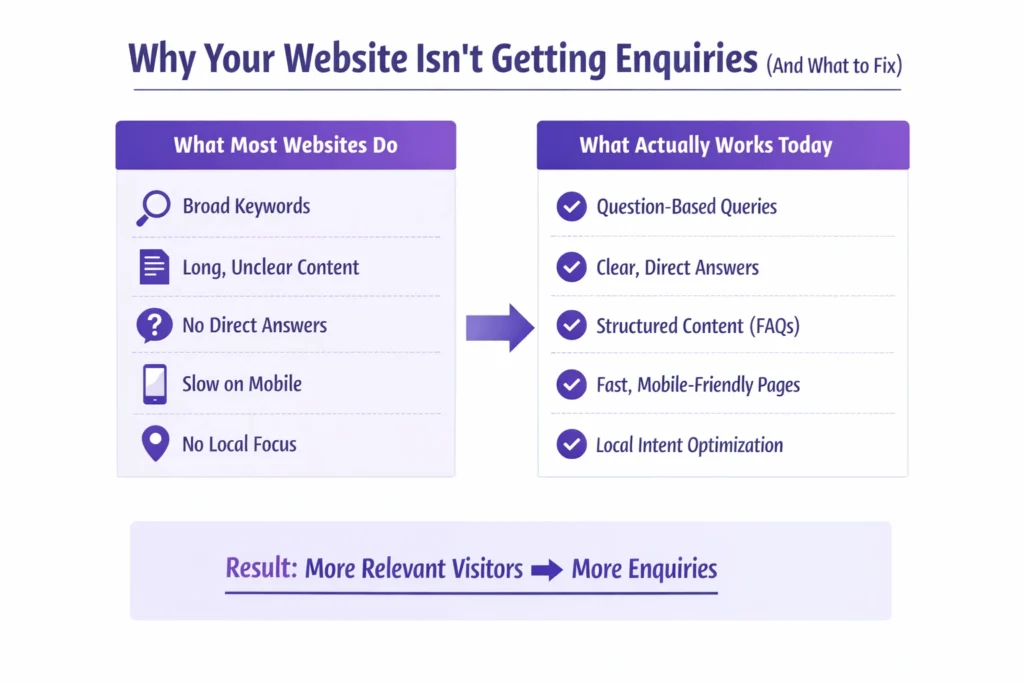
Core Services Offered by a Voice SEO Company
When you’re speaking to an agency, it’s easy to get lost in technical terms or long service lists. But in reality, there are a few core things that actually make a difference.
From my experience, if these areas aren’t covered properly, voice search results won’t improve no matter how much work is done elsewhere.
Here’s what you should be looking for.
Conversational Keyword Research
This is where everything starts.
Traditional keyword research focuses on short phrases. Voice search is different. People ask full questions, and those questions often show clear intent.
Instead of targeting something broad, the focus shifts to queries like:
- “How do I fix this issue?”
- “What’s the best option for my situation?”
- “Who can help me near me?”
I’ve seen that when businesses start targeting these types of queries, the traffic becomes more relevant. It might not always be higher in volume, but it’s usually better in quality. This is often where proper keyword research services make a difference, because they focus on how people actually search rather than just search volume.
Content Optimization for Voice Search
Once the right questions are identified, your content needs to answer them properly.
This is where many websites fall short. They mention topics, but they don’t clearly answer the question.
A good approach is:
- Adding FAQ-style sections
- Giving clear, direct answers
- Keeping responses simple and easy to understand
In a lot of projects I’ve worked on, just restructuring existing content into clearer answers has improved visibility without adding new pages. This is where content optimization services often come in, helping refine what’s already there instead of starting from scratch.
Technical SEO and Schema Markup
This is the part most business owners don’t see, but it plays an important role.
Search engines need help understanding your content. That’s where structured data comes in.
Things like FAQ schema or speakable markup help highlight key parts of your content. It doesn’t guarantee rankings, but it improves your chances of being selected as an answer.
At the same time, your website needs to load quickly and work smoothly on mobile. Most voice searches happen on phones, so if the experience is poor, it affects results. This is usually where technical SEO services play an important role, making sure the site performs properly behind the scenes as well.
Featured Snippet Optimization
Voice assistants often pull answers from featured snippets.
So instead of just trying to rank on page one, the goal becomes getting into that top answer box.
This usually comes down to how your content is written and structured:
- Clear headings
- Short, direct answers
- Well-organised sections
I’ve seen cases where a page wasn’t ranking number one but still got visibility because it was chosen for a snippet.
Local Voice Search Optimization
If your business depends on local enquiries, this part is critical.
A lot of voice searches include location intent, even if the user doesn’t say the location directly. Search engines use their location to personalize results.
This means your business details need to be consistent across platforms, and your local profile should be properly set up.
From working with local businesses, I’ve seen that even small fixes here can improve visibility for “near me” searches quite quickly. This is where local SEO services often make a noticeable difference, especially when everything is aligned properly.
Performance Tracking and Testing
Voice SEO isn’t something you set up once and leave.
Search behaviour changes, and results can shift depending on how content performs.
A good agency will keep testing:
- Which queries are bringing traffic
- Where your site is appearing
- How users are interacting with your content
This ongoing adjustment is what helps improve results over time.
If an agency can clearly explain how they handle these areas, that’s usually a good sign. It shows they’re focused on what actually moves the needle, often through proper SEO strategy services rather than just ticking boxes.
In the next section, I’ll walk you through the strategies that tie all of this together and how they work in practice.
📊 Over 1 billion voice searches happen every month, with users preferring voice because it’s faster and easier for immediate needs.
Why it matters:
Voice searches are usually done when users want quick answers or immediate action. This means your website isn’t competing for attention, it’s competing to be the answer. If your content isn’t structured properly, users will simply choose another result.
Source: GrabOn Voice Search Trends
Voice SEO Strategies That Actually Work
A lot of advice around voice search sounds good in theory, but not all of it works in practice.
From what I’ve seen, results usually come from getting a few key things right rather than trying to do everything. It’s about how your content, your website setup, and user intent all come together.
Here are the strategies that tend to make a real difference.
Focus on Question-Based Queries
Voice search is built around questions.
People don’t just search for services, they ask for help. And those questions often show exactly what they need and how ready they are to take action.
In many cases, the difference between a page that gets traffic and one that brings enquiries comes down to how well it answers those questions.
I’ve seen that when content is built around real queries, not just keywords, it naturally becomes more relevant. It also makes it easier for search engines to match your page with what someone is asking.
Optimize for Featured Snippets
If you’ve ever seen a box at the top of Google with a direct answer, that’s what voice assistants usually pull from.
Getting there isn’t about tricks. It’s mostly about clarity.
Your content should:
- Answer the question directly
- Keep explanations simple
- Place answers right after the heading
In a few projects I’ve worked on, small changes like rewriting a paragraph into a clearer answer helped pages move into those positions. It’s often about making things easier to understand, not adding more content.
Improve Page Speed and Mobile Experience
Most voice searches happen on mobile devices, so the overall experience matters more than people think.
If a page is slow or difficult to use, it affects how search engines evaluate it. And more importantly, it affects whether visitors stay or leave.
From working on different websites, I’ve noticed that improving load speed and simplifying layouts often has a wider impact. Not just on rankings, but on how many people actually take action.
Use Structured Data
Structured data helps search engines make sense of your content.
It highlights important sections like FAQs or key answers, which increases the chances of your content being selected for voice results.
It’s not something users see directly, but it supports everything happening in the background.
In my experience, when structured data is combined with clear content, it strengthens how your pages are understood and presented in search.
Target Local Searches
A large part of voice search has local intent, even when it’s not obvious.
People might ask general questions, but search engines often personalise results based on location.
That’s why it’s important to include location-based context in your content and make sure your business details are consistent.
I’ve seen local businesses gain visibility simply by aligning their content with how people search in their area. It doesn’t always require big changes, just the right adjustments.
These strategies work best when they’re applied together, not in isolation.
In the next section, I’ll show you what this looks like in a real scenario so you can see how these changes translate into actual results.
Case Study: Voice SEO in Action
Let me share something from my own work that might make this clearer.
I worked with a local service business that had a decent website. It looked fine, had a few rankings, but enquiries were inconsistent. Most of their traffic wasn’t turning into actual calls.
When I reviewed the site, the main issue was simple. The content wasn’t aligned with how people were searching, especially on mobile and voice.
So instead of rebuilding everything, we focused on a few targeted changes.
We started by adding FAQ sections based on real questions their customers were asking. Not generic ones, but the kind of questions people usually ask before making a decision.
Then we structured those answers properly so they were clear and easy to pick up. Alongside that, we implemented the right schema to help search engines understand those sections better.
We also adjusted the content to sound more natural. Less keyword-focused, more aligned with how someone would actually speak or ask a question.
On the local side, we cleaned up their business details and made sure everything was consistent. This helped strengthen their visibility for location-based searches.
We didn’t overcomplicate it. Just focused on getting the basics right.
Over the next few months, we started to see changes:
- Organic traffic increased by around 30 percent
- Some of their pages began appearing in direct answer sections
- More importantly, they started getting more calls, especially from mobile users
What stood out to me wasn’t just the traffic growth. It was the quality of enquiries. People were reaching out with clearer intent, which made a difference to their conversions.
From my experience, this is how voice SEO usually works. It’s not about big, dramatic changes. It’s about aligning your website with how people actually search and making it easier for search engines to trust your content as the right answer.
In the next section, I’ll walk you through how to choose the right voice SEO company so you can avoid common mistakes and get this right from the start.
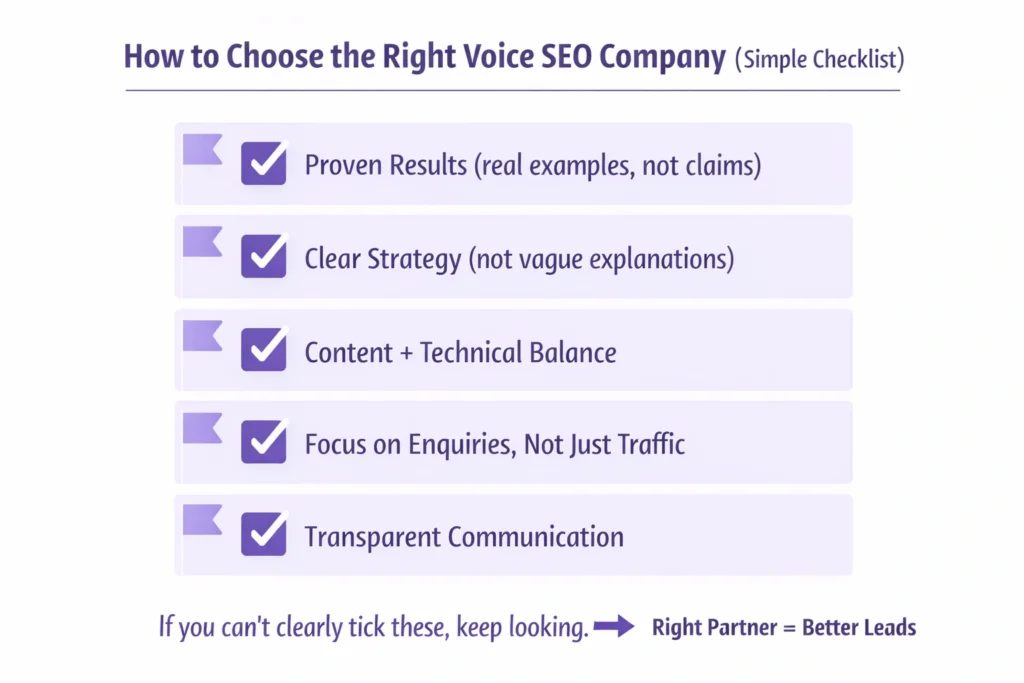
How to Choose the Best Voice SEO Company
Choosing the right agency can save you a lot of time, money, and frustration.
I’ve spoken to many business owners who had already worked with an SEO company but didn’t see results. Most of the time, the issue wasn’t effort. It was that the approach didn’t match how their customers were actually searching.
When it comes to voice search, that gap becomes even more noticeable.
Here are a few things I would personally look at before deciding.
Proven Experience
First, look at what they’ve actually done.
Not just general SEO work, but whether they’ve handled projects where content had to be structured around real search behavior.
Case studies help here. Not polished sales pages, but examples that show what changed and what impact it had.
In my experience, if someone understands voice search properly, they should be able to explain how they’ve improved visibility for specific queries or helped a business appear in direct answers.
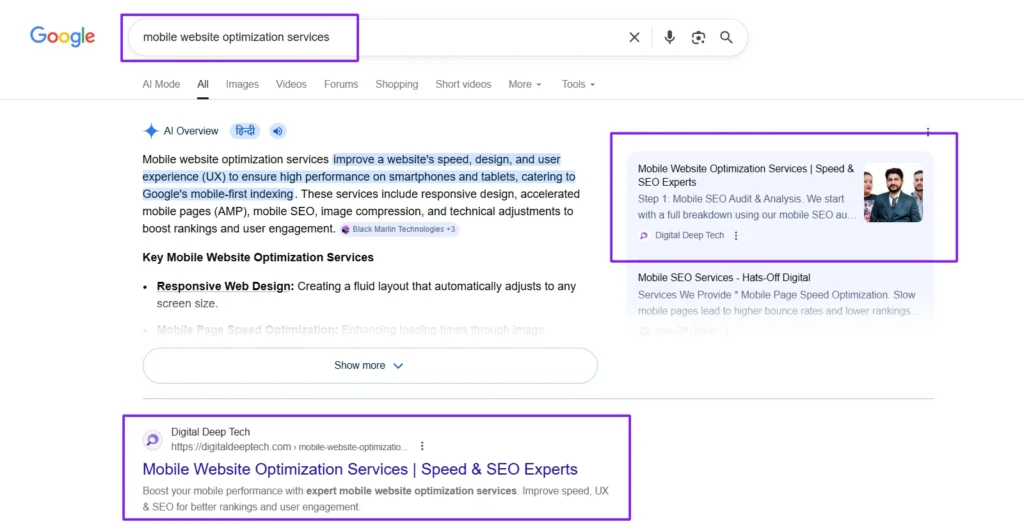
Here you can see how I optimized my website page for voice search optimization. The page now ranks in the first position and also shows in AI search results.
Full-Service Capabilities
Voice SEO isn’t just content or just technical work. It’s a mix of both.
If an agency only focuses on keywords or only talks about technical fixes, something is usually missing.
You want to see that they can:
- Structure content in a way that answers real questions
- Handle the technical side like schema and site performance
- Support local visibility if your business depends on it
From working with different businesses, I’ve found that results usually come when these pieces are aligned, not treated separately.
Data-Driven Approach
A good agency should rely on actual data, not assumptions.
That means tracking:
- What people are searching
- Which pages are getting visibility
- Where improvements are happening over time
But more importantly, they should be able to explain what that data means in simple terms.
I’ve seen situations where reports look detailed, but they don’t really tell you if things are improving in a meaningful way. What matters is whether the work is leading to better enquiries, not just more numbers.
Transparency
This is something that often gets overlooked.
You should have a clear understanding of what’s being done, how long it might take, and what to expect along the way.
If pricing is unclear or communication feels vague, that usually leads to problems later.
From my experience, the best working relationships are the ones where everything is straightforward. You know what’s happening, and you’re not left guessing.
Choosing the right voice SEO company isn’t about finding the biggest name or the lowest price. It’s about finding someone who understands how your customers search and can translate that into real results.
In the next section, I’ll break down how pricing usually works so you know what to expect before making a decision.
Voice SEO Company Pricing and Investment
This is usually one of the first questions that comes up, and honestly, the answer depends on what your website actually needs.
I’ve seen businesses pay very little and get no results, and I’ve also seen cases where a higher investment made sense because the work was done properly and led to consistent enquiries.
So instead of looking at price alone, it helps to understand what you’re paying for.
How Pricing Is Usually Structured
Most voice SEO work falls into one of these models:
- Monthly retainers
This is the most common. Ongoing work like content updates, technical improvements, and tracking is handled month by month. It works well if you’re looking for steady, long-term growth. - Project-based pricing
This is usually for a defined scope, like restructuring key pages, implementing schema, or improving specific sections of your site. - Custom packages
In some cases, a mix of both works better, especially if your site needs a bit of groundwork before ongoing work begins.
From my experience, businesses that treat SEO as an ongoing process tend to see more stable results compared to one-off fixes.
What Actually Affects the Cost
Not every website needs the same level of work.
Here are a few things that usually influence pricing:
- Website size
A small service website is very different from a large site with dozens of pages. - Competition level
If you’re in a competitive market, it takes more effort to stand out. - Technical improvements needed
Sometimes the foundation needs fixing first, like speed, structure, or indexing issues. - Content requirements
If your site needs new content or restructuring for voice search, that adds to the scope.
I’ve worked with businesses where small, focused changes made a noticeable difference, and others where we had to rebuild key parts before seeing results. It really depends on the starting point.
Thinking About ROI, Not Just Cost
This is the part that matters most.
Voice SEO isn’t just about traffic. It’s about getting the right kind of traffic that leads to enquiries.
If your website starts bringing in consistent leads from people who are actively looking for your service, the investment usually makes sense over time.
From what I’ve seen, the businesses that get the most value are the ones that focus on outcomes, not just pricing. They look at whether the work is helping them get more relevant enquiries, not just whether it’s cheaper.
In the next section, I’ll quickly compare voice SEO with traditional SEO so you can see where the real difference lies and why this shift matters.
Voice SEO Company vs Traditional SEO
| Feature | Traditional SEO | Voice SEO |
|---|---|---|
| Keywords | Short-tail | Long-tail, conversational |
| Content | General | Question-based |
| Focus | Rankings | Answers & intent |
| Devices | Desktop/Mobile | Voice assistants |
Voice SEO is not a replacement—it’s an evolution of SEO. A lot of people ask whether voice SEO replaces traditional SEO.
It doesn’t. It builds on it.
But the way people search has clearly changed, and that’s where the difference comes in.
Keywords Work Differently Now
Traditional SEO focused heavily on short phrases.
You’d optimize a page for something like “SEO company” and try to rank for that.
With voice search, people are more specific. They ask full questions.
Instead of a keyword, it becomes a conversation. That shift changes how content needs to be written.
From what I’ve seen, businesses that adapt to this tend to attract more relevant traffic, even if the search volume looks smaller on paper.
Content Needs to Answer, Not Just Explain
Most older SEO content was written to cover a topic broadly.
Now, it’s more about answering a specific question clearly.
If someone asks something, your page should respond directly, not make them scroll through paragraphs to find the answer.
I’ve worked on pages where simply rewriting sections into clearer answers improved both visibility and engagement. People stayed longer and took action because the content felt more useful.
The Focus Has Shifted
Traditional SEO is mostly about rankings.
Voice search is more about being selected as the answer.
That’s an important difference.
You could be ranking well, but if your content isn’t structured properly, it may never get picked for those direct answers.
In my experience, once content is aligned with intent, not just keywords, results start to improve more consistently.
Devices and Behavior Have Changed
Earlier, most searches came from desktops, then mobile.
Now, a growing number come through voice assistants.
And when someone uses voice, their behavior is different. They expect quick, clear responses.
That expectation carries over to your website as well. If the content isn’t easy to follow, it affects how people interact with it.
Voice SEO isn’t a separate strategy you add on top. It’s more like an adjustment to how SEO works today.
If your current setup is still focused on older methods, it might explain why traffic isn’t turning into enquiries.
In the next section, I’ll answer some common questions that usually come up when businesses start looking into voice SEO.
Is a Voice SEO Company Worth It?
If your website isn’t bringing consistent enquiries, it’s usually not just a traffic issue. It’s a visibility and intent issue.
Voice search is changing how that visibility works.
People are no longer just browsing. They’re asking direct questions and expecting clear answers. And in many cases, they’re ready to take action when they search.
From what I’ve seen, businesses that adapt to this early tend to get ahead quietly. Not because they’re doing something complicated, but because they’re aligning their website with how people actually search today.
When voice search is done properly, a few things start to improve:
- Your content becomes easier to find for specific queries
- You attract visitors who already know what they’re looking for
- Enquiries become more consistent, not just occasional
It’s not about chasing every new trend. It’s about making sure your website keeps up with how search is evolving.
If your current setup is still built around older SEO methods, that might be the reason things feel stuck.
A good voice SEO company should help bridge that gap. Not by overcomplicating things, but by focusing on what actually matters for your business.
Not Getting Enquiries From Your Website?
Let’s review what’s holding your website back and fix it.
If you want your business to show up when someone asks for help, not just when they type, then this is something worth taking seriously now rather than later.
If you’re at a point where your website isn’t performing the way it should, it might be worth reviewing how it handles real search behavior.
Start there, make the right adjustments, and you’ll be in a much better position as search continues to shift in this direction.
FAQs
What is a voice SEO company?
A voice SEO company helps your website appear when people search by speaking instead of typing. This usually involves restructuring content to answer real questions clearly, improving site setup, and making it easier for search engines to pick your content as the direct answer.
How is voice search different from traditional SEO?
Voice search is more conversational. People ask full questions instead of typing short phrases. That means your content needs to answer specific queries clearly, rather than just targeting keywords. In my experience, this shift is where most websites fall behind.
Do I really need a voice SEO company for my business?
It depends on how your customers search. If they’re using mobile or asking questions like “best service near me,” then yes, it can make a real difference. I’ve seen businesses improve enquiries just by aligning their content with how people actually speak.
How long does voice SEO take to show results?
It’s not instant, but it’s not overly slow either. Some changes, like improving content structure, can show results within a few weeks. More consistent growth usually takes a few months, especially in competitive industries.
Can voice SEO actually increase enquiries or leads?
Yes, but only if it’s done properly. Voice search traffic tends to be more specific, which means people are often closer to taking action. From what I’ve seen, even a small increase in the right kind of traffic can lead to better enquiries.
What should I look for in a voice SEO company?
Focus on how they approach real search behavior. They should be able to explain how they structure content, handle technical setup, and improve visibility for question-based searches. If everything sounds generic, it usually means the strategy isn’t tailored.
Is voice SEO only important for local businesses?
Local businesses benefit the most, but it’s not limited to them. Any business where customers ask questions before making a decision can benefit. That includes services, consultants, and even some online businesses.
Deepak Sharma is an SEO consultant with 10+ years of experience helping small businesses in the US and UK turn underperforming websites into consistent enquiry channels. In my experience, a lot of missed opportunities now come from voice search, and I focus on practical Voice SEO strategies that help businesses show up when real customers are asking real questions.
Recent Blogs
- Common WordPress Mistakes That Stop You Getting Leads
- Does SEO still work for small businesses in 2026?
- Why Your Website Isn’t Generating Leads and How to Fix It
- Why SEO traffic doesn’t turn into enquiries
- How Long Does SEO Take for a Small Business?
- Why a Slow WordPress Site Kills Your Enquiries
- Mobile Website Optimization: Why Most Sites Fail on Mobile