
How to Find the Best SEO Company for Hotels (2026 Guide)
Finding the best SEO company for hotels can make the difference between relying on OTAs and generating consistent direct bookings. This guide explains how to evaluate hotel SEO agencies, understand their strategies, and choose a partner that delivers real, measurable growth.

Deepak Sharma
SEO Consultant
April 26, 2026 | 6 min. read

Table of the content
- Introduction
- Why SEO Is Critical for Hotels in 2026 (Not Optional Anymore)
- What Does a Hotel SEO Company Actually Do?
- 7 Signs You Need the Best SEO Company for Your Hotel
- How to Choose the Best SEO Company for Hotels (Step-by-Step Framework)
- Key Questions to Ask Before Hiring a Hotel SEO Agency
- Hotel SEO Strategy That Top Agencies Use (Proven Framework)
- Common Mistakes Hotels Make When Hiring an SEO Company
- How Much Does Hotel SEO Cost in 2026?
- How Long Does SEO Take for Hotels?
- Can Small Hotels Compete with Big Brands Using SEO?
- Choosing the Right Hotel SEO Company Can Transform Your Bookings
- FAQs
Introduction
If you’re reading this, chances are your hotel website isn’t bringing in the kind of bookings you expected. You’ve probably invested in a decent design, maybe even tried ads, but enquiries still feel inconsistent or overly dependent on platforms like Booking.com or Expedia.
I’ve seen this a lot. From working with different businesses, especially in hospitality, the issue usually isn’t effort. It’s direction. Most hotels aren’t lacking visibility everywhere, they’re just not visible where it actually matters, which is when someone is ready to book.
That’s where choosing the best SEO company for hotels becomes important. Not just any agency, but one that understands how people search for hotels, what influences their decisions, and how to turn that search into a direct booking.
In my experience, many hotel owners come in after working with a generic agency that focused on traffic but not results. More visitors, but no real increase in bookings. That’s usually a sign the strategy wasn’t aligned with the business goal.
A good hotel SEO agency doesn’t just try to rank your site. It looks at how your website performs as a whole. Are you showing up for the right searches? Is your site easy to use on mobile? Are people finding what they need quickly, or leaving within seconds?
These are the kinds of things that directly affect enquiries.
📊 The average hotel website converts below 2% of visitors, meaning over 98% of users leave without booking.
Why it matters:
This clearly shows the core problem your blog is addressing. Hotels are getting traffic, but most visitors don’t convert. This supports your point about poor UX, weak SEO targeting, and lack of booking-focused strategy.
Source: Hospitality Net
I’ve seen that when the right approach is in place, even smaller hotels can start competing with bigger brands, especially in local searches. You don’t need a massive budget. You just need the right focus.
In this guide, I’ll walk you through how to actually evaluate a hotel SEO company, what to look for, what to avoid, and how to make a decision that leads to real, steady growth.
Let’s start with why SEO matters so much for hotels right now.
Why SEO Is Critical for Hotels in 2026 (Not Optional Anymore)
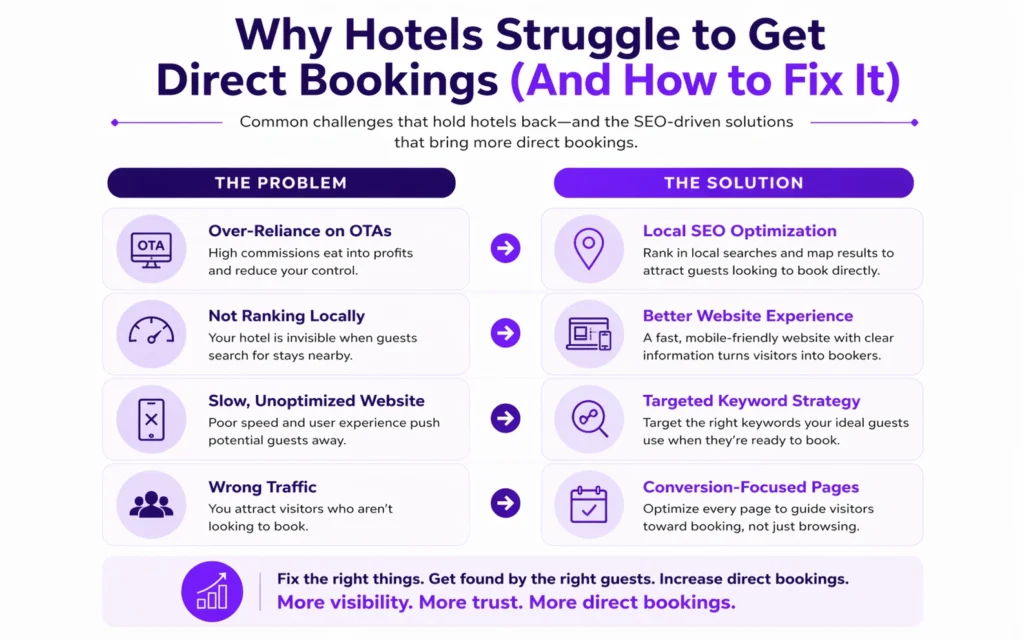
If most of your bookings are still coming through OTAs, you’re not alone. But it does put you in a position where you’re constantly paying for visibility instead of building your own.
In my experience, this is where many hotels start to feel stuck. Occupancy might look fine on paper, but margins are tighter than they should be. You’re filling rooms, just not on your terms.
That’s where SEO for hotels starts to change things.
| Channel / Factor | Hotel Website (Direct) | OTAs (Booking.com / Expedia) | What This Means |
|---|---|---|---|
| Conversion Rate | 2.2% – 3.9% | 12% – 15% | OTAs convert 3–5x higher due to trust and UX |
| Independent Hotels | 0.5% – 1.5% | — | Smaller hotels struggle without strong SEO |
| Mobile Traffic Share | 60% – 75% | High | Most users browse on mobile devices |
| Mobile Conversion Gap | 1.8x – 2.4x lower | Better optimized | Poor mobile experience reduces bookings |
| Bounce Rate (Slow Sites) | 48% – 67% | Lower | Slow websites push visitors away quickly |
| Booking Intent | Medium (research stage) | High (ready to book) | SEO must target high-intent users |
| Customer Ownership | Full control | Limited control | Direct bookings build long-term revenue |
Over the last few years, I’ve seen a clear shift in how people search and book. Before someone lands on an OTA, they usually start on Google. They search things like “best hotel near city centre” or “family-friendly hotel in [location]”. That moment is important. It’s where the decision starts forming.
If your hotel isn’t showing up there, you’re missing the first opportunity to connect.
Google has effectively become your first impression. In a way, it’s your new front desk.
I’ve worked with hotel websites that looked great but weren’t getting enquiries simply because they weren’t visible for the right searches. Once we aligned the hotel SEO strategy with what potential guests were actually searching for, the shift was noticeable. Not overnight, but steady and reliable.
Another thing that’s changed is how people search. Most of it now happens on mobile, often with local intent. Someone searching on their phone is usually closer to making a decision. They’re comparing options, checking reviews, looking at photos, and deciding quickly.
This is where search engine optimization for hotels plays a bigger role than most expect. It’s not just about ranking higher. It’s about showing up at the right time, with the right information, in a way that makes it easy to book.
From working with different businesses, I’ve seen that even small improvements in visibility can lead to better quality traffic. Not just more visitors, but people who are actually ready to book.
On the flip side, relying only on OTAs means you’re always competing on price, not value. And that’s a tough place to stay long-term.
With the right hospitality SEO approach, you start building your own source of bookings. You’re not dependent on third-party platforms as much, and over time, that gives you more control over your revenue.
This is why SEO isn’t really optional anymore. It’s becoming a core part of how hotels grow online.
In the next section, I’ll break down what a good hotel SEO company actually does behind the scenes.
What Does a Hotel SEO Company Actually Do?
This is where things often get a bit unclear.
A lot of agencies talk about rankings and traffic, but they don’t really explain what they’re doing or why it matters to your bookings. From working with different businesses, I’ve seen that hotel owners usually don’t need more reports. They need clarity on what’s actually improving their enquiries.
Good hotel SEO services are not about ticking boxes. They’re about fixing the parts of your website and online presence that are quietly stopping people from booking.
Here’s what that usually looks like in practice.
Technical SEO for Hotel Websites
This is the foundation. If this isn’t right, everything else struggles.
In my experience, many hotel websites have issues that aren’t obvious at first. Slow loading pages, broken links, pages not being indexed properly, or mobile usability problems.
I’ve seen websites where the homepage looks fine, but key pages like room details or booking pages take too long to load. People don’t wait. They leave.
Technical fixes make your site easier for Google to understand and much smoother for users to navigate. It’s not flashy work, but it makes a real difference.
On-Page Optimization (Rooms, Amenities, Location Pages)
This is where your actual content starts doing the heavy lifting.
Each page on your website should clearly match what someone is searching for. For example, if someone searches for “family hotel in Manchester,” your site should have a page that speaks directly to that.
I’ve seen that many hotel sites keep things too general. A single page trying to cover everything. That usually doesn’t perform well.
With proper hotel search engine optimization, each section of your site, rooms, amenities, nearby attractions, is structured in a way that answers specific search intent. That’s what helps you show up in more relevant searches.
Local SEO (Google Business Profile + Maps Ranking)
This is one of the biggest opportunities for hotels.
When someone searches for hotels in a specific area, Google often shows map results first. If you’re not appearing there, you’re missing high-intent traffic.
I’ve worked on cases where improving a hotel’s Google Business Profile alone increased calls and direct visits within weeks.
This includes keeping your profile updated, getting consistent reviews, adding real photos, and making sure your business details match across platforms.
For the SEO for hotel industry, local visibility often brings faster wins compared to broader rankings.
Content Strategy (Destination + Intent-Based Blogs)
Content isn’t just about writing blogs. It’s about answering questions your potential guests already have.
For example:
- Things to do near your hotel
- Best places to visit in your city
- Travel tips for your location
I’ve seen that when hotels create useful content around their location, they start attracting visitors earlier in the planning stage. That builds trust before the booking decision even happens.
A good hospitality SEO agency doesn’t just publish content. It plans it based on what your ideal guests are searching for.
Link Building in the Travel Niche
This is about building credibility.
When other relevant websites link to your hotel site, Google sees that as a positive signal. But not all links are equal.
From experience, links from travel blogs, local directories, tourism websites, or partnerships with local businesses tend to work much better than random links.
I’ve seen that a few strong, relevant links can outperform dozens of low-quality ones.
Overall, a good SEO company is not just trying to get you more traffic. It’s working on multiple areas that all connect back to one goal, getting more direct bookings.
In the next section, I’ll walk through some clear signs that usually indicate it’s time to bring in a hotel SEO company.
7 Signs You Need the Best SEO Company for Your Hotel
Not every hotel needs outside help straight away. But there are certain patterns I’ve seen again and again where things stop improving, even with effort.
If you notice a few of these, it’s usually a sign your current approach to SEO for hotels isn’t working as it should.
1. You Rely Heavily on OTAs for Bookings
OTAs can fill rooms, but they shouldn’t be your main source long-term.
I’ve worked with hotels where 70 to 80 percent of bookings were coming from platforms like Booking.com. Revenue looked stable, but once you factored in commissions, the actual profit was much lower.
If you don’t have a steady flow of direct bookings, it becomes difficult to grow on your own terms.
2. Your Website Gets Visitors but Not Enquiries
This one is more common than people think.
You might be getting traffic, maybe even from ads or social media, but very few enquiries or bookings. In my experience, that usually means the traffic isn’t aligned with what your hotel actually offers.
Good hotel SEO focuses on bringing in the right kind of visitors, not just more visitors.
3. You’re Not Ranking for “Hotel in [Your City]”
If someone searches for a hotel in your area and your website doesn’t show up, that’s a missed opportunity.
I’ve seen hotels with great locations and solid offerings, but they’re practically invisible in search results. That often comes down to weak keyword targeting or poor page structure.
This is one of the clearest signs your SEO needs attention.
4. Your Website Doesn’t Work Well on Mobile
Most people searching for hotels are doing it on their phones.
If your site is slow, hard to navigate, or difficult to book from, people won’t stick around. I’ve seen bounce rates drop significantly just by improving mobile usability.
It’s a simple fix in many cases, but it has a big impact.
📊 Hotel websites get 60–75% of traffic from mobile, but mobile conversion rates are nearly half of desktop (1.8x–2.4x lower).
Why it matters:
This directly supports your sections on mobile UX, SEO, and conversion issues. It explains why many hotel websites fail to generate bookings despite good traffic, especially if the mobile experience is poor.
Source: HotelsSEO (2026 Benchmark Data)
5. You’re Not Showing in Google Maps Results
Local visibility is crucial for hotels.
If your property isn’t appearing in map results, especially for searches near your location, you’re missing high-intent traffic.
From what I’ve seen, improving this alone can bring in more calls and direct visits without any major redesign.
6. Your Website Feels Outdated
This doesn’t always mean a full redesign is needed.
Sometimes it’s small things. Old content, unclear navigation, missing information, or a layout that doesn’t guide users properly.
Visitors notice this quickly. And when they do, they often leave before taking any action.
7. You Haven’t Updated Your SEO Strategy in Years
Search behavior changes, and what worked a few years ago doesn’t always work now.
I’ve seen businesses still relying on old tactics that no longer bring results. No content updates, no local optimization, no real tracking.
That’s usually when hotel SEO services start to make a difference, by bringing things back in line with how people actually search today.
If a few of these sound familiar, it doesn’t mean something is broken beyond repair. It just means there’s room to improve, and the right strategy can make a noticeable difference.
In the next section, I’ll walk you through how to actually choose the best SEO company for your hotel, without getting caught up in empty promises.
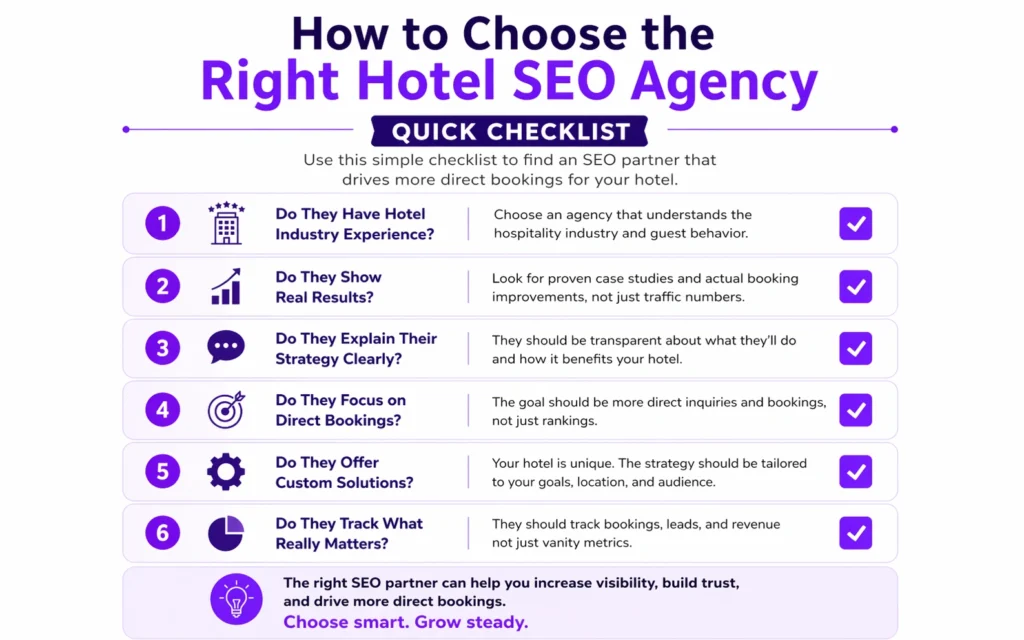
How to Choose the Best SEO Company for Hotels (Step-by-Step Framework)
Choosing the right partner is where most of the difference is made.
I’ve seen hotels invest in SEO, not get results, and assume it doesn’t work. In reality, it usually comes down to choosing the wrong agency or a strategy that wasn’t aligned with bookings.
If you’re trying to find the best SEO company for hotels, it helps to look at a few practical things rather than getting pulled in by promises.
Here’s a simple way to evaluate your options.
1. Look for Hospitality Industry Experience
SEO works differently in every industry.
From working with different businesses, I’ve noticed that hotels have a longer decision cycle. Guests compare options, check reviews, and often visit your site more than once before booking.
An agency with experience in hospitality SEO or the SEO for hotel industry will already understand this. They won’t just focus on traffic, they’ll structure things around how guests actually make decisions.
2. Check Real Case Studies and Booking Growth
Anyone can show rankings. That’s not hard.
What matters is whether those rankings led to actual bookings. When reviewing a hotel SEO company, look for examples where they’ve improved enquiries, not just visibility.
I’ve seen reports where traffic doubled, but bookings stayed flat. That usually means the wrong keywords were targeted or the website wasn’t set up to convert.
3. Evaluate Their SEO Strategy, Not Just Promises
A good agency should be able to explain their hotel SEO strategy clearly.
You don’t need technical detail, but you should understand what they’ll focus on. For example, will they improve your room pages, work on local visibility, or fix technical issues first?
If everything sounds vague or overly complicated, it’s worth questioning. Clear thinking usually leads to better execution.
4. Ensure They Focus on Direct Bookings (ROI)
This is one of the biggest gaps I see.
Some agencies focus on increasing traffic without connecting it to revenue. For hotels, the goal is simple. More direct bookings, less reliance on third-party platforms.
Good SEO for hotels should always tie back to that. Otherwise, you’re just increasing visibility without improving your bottom line.
5. Transparency in Reporting and KPIs
You should know what’s improving and why.
A reliable agency offering hotel SEO services will share clear updates. Not long reports filled with technical terms, but simple insights you can understand.
Things like:
- Are enquiries increasing
- Are you showing up for the right searches
- Is your local visibility improving
From my experience, when reporting is clear, decisions become easier.
6. Local SEO Expertise (Google Maps Ranking)
Local search plays a big role for hotels.
If someone searches for accommodation in your area, map results are often the first thing they see. If you’re not there, you’re missing strong booking intent.
I’ve seen that improving local SEO for hotels can bring quicker wins compared to broader campaigns, especially for independent properties.
7. Custom Strategy (Avoid One-Size-Fits-All)
Every hotel is different.
Your location, audience, competition, and pricing all influence how SEO should be approached. If an agency offers the same plan to every client, it’s unlikely to work well.
Good hotel search engine optimization is tailored. It’s built around your specific situation, not copied from another project.
Choosing the right agency isn’t about finding the biggest name or the lowest price. It’s about finding someone who understands how your bookings grow and can build a strategy around that.
In the next section, I’ll go through the key questions you should ask before making your final decision.
Key Questions to Ask Before Hiring a Hotel SEO Agency
Before you sign anything, it’s worth slowing things down and asking a few direct questions.
I’ve seen hotels commit to long-term contracts without really understanding what they’re getting. A good hotel SEO agency won’t avoid these questions. In fact, they should be able to answer them clearly and without overcomplicating things.
Here are the ones that usually give you the clearest picture.
What SEO strategy will you use for my hotel?
You’re not looking for a long technical explanation here. You’re looking for clarity.
A solid answer should include things like improving your website structure, targeting the right search terms, working on local visibility, and fixing any technical issues that might be holding your site back.
In my experience, if an agency can’t explain their plan in simple terms, it often means the strategy isn’t well thought through.
How will you increase direct bookings?
This is one of the most important questions.
Good SEO for hotels should always connect back to bookings, not just traffic. Ask them how they plan to bring in people who are actually ready to book, not just browse.
I’ve seen that focusing on high-intent searches, improving key pages like rooms and location, and making the booking process easier usually makes the biggest difference.
How long before I see results?
SEO takes time, and any honest answer should reflect that.
From what I’ve seen, most hotels start noticing early improvements within a few months, especially with local visibility. More competitive areas can take longer.
If someone promises quick results in a few weeks, it’s worth being cautious. Steady growth is far more reliable than short-term spikes.
What KPIs do you track?
You need to know how success will be measured.
A good hospitality SEO agency should focus on things that actually matter to your business. That usually includes enquiries, booking-related traffic, keyword visibility for important searches, and local presence.
I’ve found that when KPIs are tied to real outcomes, it becomes much easier to see whether the work is paying off.
Have you worked with hotels before?
Experience matters here.
Hotels have a different customer journey compared to most businesses. Guests compare options, check availability, and often return before making a decision.
From working with different businesses, I’ve seen that agencies with hotel experience tend to structure things better around that behaviour. It saves time and avoids unnecessary trial and error.
What keywords will you target?
This helps you understand how well they know your market.
You should expect a mix of location-based searches, specific intent queries, and terms related to your amenities or unique offering.
For example, instead of broad terms, a good approach might focus on searches that reflect real intent to book. That’s where most of the value comes from.
How will you keep me updated on progress?
This is often overlooked, but it makes a big difference.
You don’t need constant updates, but you should know what’s improving and what’s being worked on. Clear, simple communication usually leads to a smoother working relationship.
Asking these questions doesn’t just help you filter agencies. It also gives you a better understanding of what good SEO should look like for your hotel.
In the next section, I’ll walk you through how a typical hotel SEO strategy is actually built step by step.
Hotel SEO Strategy That Top Agencies Use (Proven Framework)
Once you understand how to choose the right agency, the next step is knowing what they should actually be doing for your hotel.
In my experience, the difference between average and strong results usually comes down to how structured the approach is. Good SEO isn’t random. It follows a clear process, where each step builds on the previous one.
Here’s a simple breakdown of what a practical hotel SEO strategy looks like when it’s done properly.
Step 1 – Keyword Research (Guest Intent Keywords)
Everything starts here.
But it’s not just about finding high search volume terms. It’s about understanding what your potential guests are actually looking for when they’re ready to book.
I’ve seen that many hotels target broad keywords that bring traffic but not enquiries. A better approach is focusing on intent. Searches that show someone is closer to making a decision.
Good hotel SEO focuses on terms that reflect real booking intent, not just visibility.
Step 2 – Website Optimization (Speed, UX, Mobile)
Once the right keywords are clear, your website needs to support them.
From working with different hotel websites, I’ve noticed that even small issues can affect performance. Slow loading pages, confusing navigation, or a booking process that feels clunky.
Most users are on mobile, and they expect things to work smoothly. If they struggle to find information or complete a booking, they leave.
This is where search engine optimization for hotels becomes practical. It’s about making the experience simple and fast, not just technically correct.
Step 3 – On-Page SEO (Rooms, Amenities, Location Pages)
This is where your website starts matching what people search for.
Each key part of your hotel should have its own focus. Rooms, amenities, nearby attractions, all structured in a way that answers specific queries.
I’ve seen that when everything is placed on one general page, it limits how well the site can rank.
With proper hotel search engine optimization, each page becomes more relevant and easier for both users and search engines to understand.
Step 4 – Local SEO (Google Business Profile + Maps)
For hotels, this is one of the most impactful areas.
When someone searches for a place to stay nearby, map results often appear first. If your hotel isn’t visible there, you’re missing people who are ready to book.
I’ve worked on projects where improving local SEO for hotels led to more calls and direct visits without major changes to the website.
It usually comes down to keeping your business profile accurate, adding real images, and building consistent reviews over time.
Step 5 – Content Marketing (Travel + Local Guides)
Content plays a different role in hotels compared to other industries.
It’s not just about writing for search engines. It’s about helping potential guests plan their trip.
For example, guides about local attractions, things to do, or travel tips related to your area.
From my experience, this kind of content attracts visitors earlier in their journey. They may not book immediately, but it builds trust and brings them back later.
That’s where a good hospitality SEO approach supports long-term growth.
Step 6 – Authority Building (Backlinks from Travel Sites)
This is about building credibility over time.
When relevant websites link to your hotel website, it signals trust. But quality matters more than quantity. Building quality backlinks is crucial for strengthening your website’s authority.
I’ve seen that links from travel blogs, local directories, or tourism websites tend to work better than generic sources.
Strong hotel SEO services usually include this as an ongoing effort, not a one-time task.
When all of these steps are working together, the results tend to feel more consistent. Not sudden spikes, but steady improvement in visibility and enquiries.
In the next section, I’ll walk through some common mistakes hotels make when hiring an SEO company, so you can avoid them early.
Common Mistakes Hotels Make When Hiring an SEO Company
By the time most hotels start looking for help, they’ve already tried a few things that didn’t work. That’s normal. But some mistakes tend to repeat, and they can slow things down more than expected.
From working with different businesses, I’ve seen that avoiding these early can save both time and budget.
Choosing the Cheapest Agency
It’s tempting to go with the lowest quote, especially if you’ve already spent money without seeing results.
But in most cases, cheaper SEO means less time spent on your project or a very basic approach that doesn’t go deep enough.
I’ve seen hotels come in after months of “SEO work” where very little had actually changed on their site. It looked active on the surface, but there was no real progress underneath.
A good hotel SEO company isn’t about being expensive, but it should be clear where the effort is going and why.
Ignoring Local SEO
For hotels, local visibility is not optional.
If someone searches for accommodation in your area and your property doesn’t show up in map results, you’re missing some of the highest intent traffic.
I’ve seen cases where hotels focused only on website rankings and completely overlooked their local presence. Once that was fixed, enquiries started improving without major changes elsewhere.
In the SEO for hotel industry, local search often brings the quickest wins.
Expecting Instant Results
This is one of the biggest misunderstandings.
SEO takes time because you’re building visibility gradually. It’s not like paid ads where you switch something on and see results immediately.
In my experience, steady improvement over a few months is a more reliable sign that things are working.
If an agency promises quick results in a short time, it’s worth questioning how they plan to do that.
No Tracking or Clear KPIs
If you don’t know what’s being measured, it’s hard to know what’s improving.
I’ve seen businesses receive long reports filled with data, but none of it connects back to bookings or enquiries.
You don’t need complex tracking, but you do need clarity. Are more people finding your hotel? Are enquiries increasing? Are you showing up for the right searches?
Without that, it becomes guesswork.
Not Focusing on Conversions
Getting traffic is one part of the picture. Turning that traffic into bookings is where the real value is.
I’ve worked with hotel websites that were getting visitors but very few enquiries. The issue wasn’t visibility, it was how the website guided users.
Simple things like clearer room details, better images, or an easier booking process can make a noticeable difference.
Most of these mistakes don’t come from poor decisions. They usually come from not having enough clarity on what good SEO should look like.
Once you understand that, it becomes much easier to choose the right direction.
In the next section, I’ll break down what hotel SEO typically costs and what you should realistically expect.
How Much Does Hotel SEO Cost in 2026?
This is usually one of the first questions that comes up, and understandably so.
In my experience, the cost of hotel SEO services can vary quite a bit. Not because agencies are pricing randomly, but because the level of work involved can be very different from one hotel to another.
A small independent hotel in a less competitive area won’t need the same level of work as a property in a busy city centre.
What Do Hotels Typically Pay?
To give you a general idea:
- Basic SEO support can start from around $500 to $1,000 per month
- Mid-range services usually fall between $1,000 to $3,000 per month
- More competitive markets or advanced strategies can go beyond that
These are not fixed numbers, but they give you a rough sense of what to expect when working with a hospitality SEO agency.
What Actually Affects the Cost?
From what I’ve seen, pricing usually depends on a few key things:
- Competition in your area
Ranking in a small town is very different from ranking in London or New York - Current state of your website
If your site has technical issues or hasn’t been updated in years, more groundwork is needed - Your goals
Whether you want to improve local visibility or compete on a broader level - Amount of ongoing work
Content, local updates, link building, all of this adds up over time
I’ve worked with hotels where the initial focus was fixing the basics, and others where we could move straight into growth. That alone changes the level of investment.
Cost vs Return: What Really Matters
This is where most decisions should be made.
If you look at SEO only as a cost, it can feel expensive. But when you look at what it replaces, OTA commissions, paid ads, inconsistent bookings, it starts to make more sense.
I’ve seen that even a small increase in direct bookings can cover the monthly SEO investment. And over time, that gap grows.
The goal isn’t to spend more. It’s to build a steady source of bookings that you control.
A good approach is to think long-term. Not in years, but in building something that keeps improving month by month.
In the next section, I’ll walk through how long SEO typically takes to show results, so you know what to expect realistically.
How Long Does SEO Take for Hotels?
This is probably the most common question I get.
And the honest answer is, it depends. But there is a realistic range you should expect, and understanding that upfront helps avoid frustration later.
From my experience, SEO for hotels usually starts showing noticeable movement within 3 to 6 months. Not full results, but clear signs that things are heading in the right direction.
What Happens in the First Few Months?
In the early stage, most of the work happens behind the scenes.
Fixing technical issues, improving key pages, setting up local profiles properly, and aligning your content with what people are actually searching for.
I’ve seen that once these basics are in place, small improvements start appearing. Better visibility, more relevant traffic, and in some cases, early enquiries.
Why Local SEO Often Shows Faster Results
If your hotel relies on local searches, you may see quicker progress.
For example, improving your Google Business Profile or local listings can sometimes bring results within a few weeks. More calls, more direction requests, more visibility in map results.
With hotel SEO, local improvements are often the first wins because they target people who are already close to making a decision.
Why Competitive Locations Take Longer
If your hotel is in a busy city or a high-demand tourist area, it takes more time.
You’re not just competing with other independent hotels. You’re up against large chains, booking platforms, and well-established websites.
In these cases, building visibility gradually is the only sustainable approach. I’ve seen that trying to rush this usually leads to poor decisions or short-term tactics that don’t last.
What You Should Really Look For
Instead of expecting quick results, it’s better to look for steady progress.
Things like:
- Are you appearing for more relevant searches?
- Is your website getting better engagement?
- Are enquiries starting to increase, even slightly?
These are early signs that your hotel SEO is moving in the right direction.
SEO isn’t instant, but when it’s done properly, it builds momentum. And over time, that consistency is what reduces your dependence on paid channels and third-party platforms.
In the next section, I’ll cover whether smaller hotels can realistically compete with larger brands using SEO.
Can Small Hotels Compete with Big Brands Using SEO?
Short answer, yes. But not by trying to do what big brands do.
I’ve worked with smaller hotels that assumed they couldn’t compete because large chains dominate search results. In reality, they were just approaching SEO for hotels the same way bigger brands do, which rarely works.
Smaller hotels win by being more focused, not bigger.
Local SEO Is Where Small Hotels Have an Edge
Big hotel chains have strong authority, but they don’t always dominate local results the way you might expect.
I’ve seen smaller properties outrank larger brands simply because their local presence was stronger. Better reviews, more accurate listings, and clearer information.
With hotel SEO, showing up in local searches often matters more than competing on broad terms.
If someone is searching for a place to stay nearby, they’re not comparing global brands. They’re looking for the best option in that specific area.
Niche Targeting Brings Better Results
This is something I’ve seen work consistently.
Instead of trying to rank for general terms like “hotel in London,” smaller hotels perform better when they focus on more specific searches.
For example:
- Hotels near a particular landmark
- Boutique or family-friendly stays
- Hotels with specific amenities
These searches may have lower volume, but they usually come with higher intent.
A well-focused hotel SEO approach can bring in visitors who already know what they’re looking for.
Personal Experience Matters More Than Scale
One advantage smaller hotels have is flexibility.
You can highlight what makes your property different. Whether that’s a unique location, a more personal experience, or specific services that larger chains don’t offer.
From working with different businesses, I’ve seen that when this is clearly communicated on the website, it improves both rankings and conversions.
People aren’t always looking for the biggest hotel. They’re looking for the right one.
It’s Not About Competing Everywhere
Trying to rank for everything usually leads nowhere.
What works better is choosing the right areas to focus on and building visibility there. Over time, that creates consistent traffic and enquiries.
I’ve seen smaller hotels build a steady flow of bookings by focusing on the right searches instead of chasing the biggest ones.
So yes, small hotels can compete. In many cases, they can outperform larger brands in the areas that matter most.
In the final section, I’ll wrap things up and help you decide the next step if you’re planning to improve your hotel’s SEO.
Choosing the Right Hotel SEO Company Can Transform Your Bookings
If there’s one thing I’d take from everything we’ve covered, it’s this. SEO for hotels isn’t just about getting more visibility. It’s about building a consistent way to bring in bookings without depending too much on third-party platforms.
I’ve seen hotels move from relying heavily on OTAs to generating a steady flow of direct enquiries. Not overnight, but step by step. And usually, it starts with choosing the best SEO company for hotels that understands how bookings actually happen.
Get Clear on What’s Holding You Back
We review your site and show what’s limiting bookings
A good hotel SEO agency won’t just focus on rankings. It will look at your website, your local presence, and how guests interact with your content. Small improvements across these areas tend to add up over time.
From my experience, the biggest shift happens when hotel owners stop thinking in terms of quick wins and start focusing on long-term growth. That’s when SEO becomes less of an expense and more of an asset.
If you’re unsure where your website currently stands, the best place to start is with a proper review. Look at what’s working, what’s missing, and where potential bookings are being lost.
You don’t need to change everything at once. But you do need a clear direction.
And when the right hotel SEO services are in place, the goal becomes simple. More direct bookings, better control over your revenue, and less reliance on platforms that take a share of every reservation.
FAQs
This section covers a few common questions I hear from hotel owners, especially when they’re trying to decide if SEO is the right step.
What does a hotel SEO agency do?
A good hotel SEO agency works on improving how your hotel appears in search results and how your website performs when people land on it.
That usually includes fixing technical issues, improving your pages, helping you show up in local searches, and bringing in visitors who are more likely to book.
In my experience, the real value is not just getting traffic, but making sure that traffic turns into enquiries.
Is SEO worth it for hotels?
In most cases, yes, but it depends on how it’s approached.
If SEO is treated as just another marketing task, results tend to be limited. But when it’s aligned with your booking goals, it can become a steady source of direct enquiries.
I’ve seen hotels reduce their reliance on third-party platforms over time simply by improving their visibility and website experience.
That’s where SEO for hotels starts to make a long-term difference.
Which keywords are best for hotels?
The best keywords are usually the ones that reflect booking intent.
From what I’ve seen, location-based searches, specific amenities, and phrases that match what your ideal guest is looking for tend to perform better than broad terms.
For example, instead of targeting general searches, it’s often more effective to focus on queries that show someone is closer to making a decision.
A well-planned approach to hotel SEO services focuses on relevance, not just volume.
Do I need local SEO for my hotel?
Yes, especially if you want to attract direct bookings.
Local search is often where guests start when they’re looking for a place to stay nearby. If your hotel isn’t visible there, you’re missing high-intent traffic.
I’ve seen that improving local visibility can bring quicker results compared to broader SEO efforts.
For most hotels, local SEO isn’t optional. It’s one of the core parts of a strong online presence.
These questions usually come up early in the process, and getting clear answers helps you make better decisions moving forward.
Deepak Sharma is an SEO consultant with 10+ years of experience helping small businesses turn underperforming websites into consistent enquiry sources. He focuses on practical strategies that improve visibility, traffic quality, and real booking or lead outcomes.
Recent Blogs
- How to Choose the Best Voice SEO Company in 2026?
- Mobile Website Optimization: Why Most Sites Fail on Mobile
- Cheap Link Building Packages: Pricing, Risks & What You Really Get
- SEO for Fitness Businesses: How Gyms & Trainers Get Clients from Google
- Why Your Website Isn’t Generating Leads and How to Fix It
- Why SEO traffic doesn’t turn into enquiries
- How Long Does SEO Take for a Small Business?