
What Database-Heavy Applications Need to Scale Without Issues
Database-heavy applications demand more than just powerful servers. This guide explains the core technical requirements needed to maintain performance, reliability, and scalability as data volume and user traffic grow over time.

Priya Sharma
Content Writer
Dec 21, 2025 | 6 min. read

Business websites, gaming websites, and AI/ML applications are database-heavy websites. Hence, they require enterprise-grade servers to handle heavy workloads. Dedicated servers with cPanel could be a great alternative to host strenuous websites/applications with user-friendly management. These websites constantly read, write, and process complex queries, making them highly sensitive to performance bottlenecks.
Scaling a database-heavy application is not just a matter of adding more hardware. It needs a mix of optimized architecture, efficient querying, controlled resource usage, and strong backend systems. Without the right technology and infrastructure, databases start to lag, and queries slow down, resulting in a negative user experience. In such cases, you need a cheap 10 Gbps dedicated server to scale applications smoothly while maintaining top-tier performance.
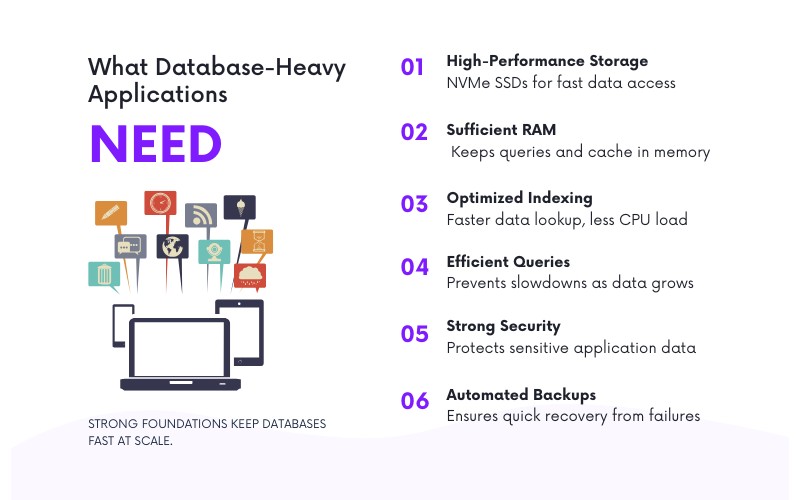
Things Required to Run Database-Heavy Applications
High-Performance Storage Is Non-Negotiable
For database-heavy workloads, storage speed directly impacts how fast queries run and how quickly data can be retrieved. SSD NVMe storage has faster processing power than conventional SSDs. It makes an ideal storage option for applications that demand faster processing. NVMe keeps unnecessary delays at bay. Faster storage helps maintain consistent performance even under heavy I/O workloads.
RAID configurations, like RAID 10, add another performance layer in hardware. RAID 10 combines speed and fault tolerance to protect your data while maintaining speed. Redundant storage becomes a crucial factor in avoiding downtime for smoother operations. Even an optimized database struggles to scale effectively without the right storage performance.
Adequate RAM to Handle Caching and Query Execution
Memory is the crucial aspect in database applications’ performance. Databases use RAM to store indexes, buffers, temporary tables, and cached results. If an application runs out of memory, the database has no choice but to resort to the much slower disk space. As a consequence, running queries takes much longer, loading pages takes a while, and performance drops. With enough memory, the system keeps the most frequently accessed data in memory for quick retrieval, rather than having to load more pages from disk.
More users and bigger datasets that you need to report on draw from the application’s memory. With a lot of users at the same time, the application works at high concurrency and needs enough memory to get queries from the database for all users. If enough RAM is available to the application, you ensure low latency, high responsiveness, and consistent performance during high load times. Investing in memory will also be one of the most cost-efficient ways to improve performance on workloads where databases are frequently accessed.
Proper Indexing and Query Optimization for Faster Queries
The most powerful server will still be the slowest if the queries being made are not optimized. Proper indexing means that the database can find the required data much faster, rather than needing to scan whole tables. If an application is slow to respond as data grows, it is often because the indexes that are needed are missing or the ones that are outdated. If you improve the existence of indexes in a system, you can significantly improve query speed and reduce CPU load.
As businesses expand, they have to pay greater attention to optimizing queries. Queries that are poorly framed, have excessive joins, or have filters that are inefficient can place tremendous strain on your systems. Periodic audits can help alleviate this risk by identifying queries that use excessive resources as they become progressively slower. As your database grows, your queries cannot remain static. There is little doubt that the performance of your database will depend on the efficient use of queries. In addition, the optimal use of indexing is critical to the efficient functioning of your database. A well-optimized database should be flexible enough to scale to your needs.
Robust Protection and Automated Data Backups
For many applications that rely on databases, the information handled is quite sensitive and must therefore be kept safe. Safeguarding information is foremost and is achieved by employing defensive techniques such as encryption, firewalls, access restriction, and monitoring tools to deter and detect any breaches and unauthorized information access. When applications become larger, security becomes more of a concern, as danger grows, requiring frequent audits and upgrades. Strong protection of sensitive information will provide and maintain the integrity of the application and gain the confidence of the users.
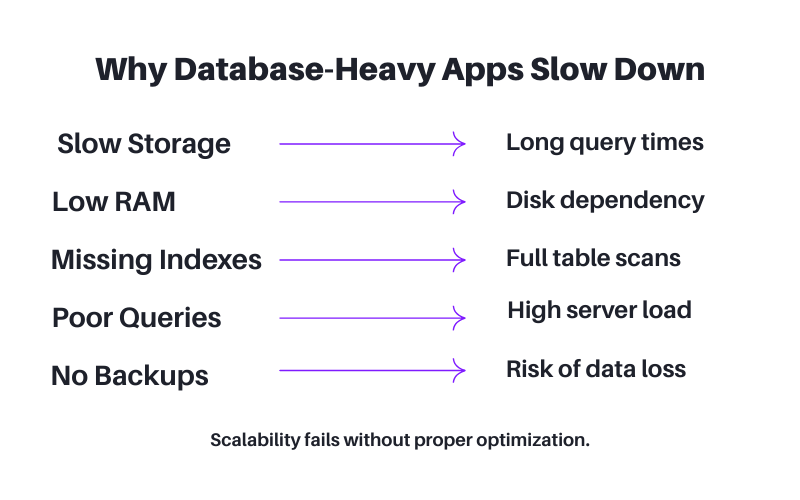
Protection of the stored information must be complemented by retention, and retention is achieved by backups. Automated data backups will protect the system from losses that might be due to accidental deletions, corruption, lost storage devices, or hardware failures. Automated backups come with features such as point-in-time recovery and off-site backups to ensure that data is restored to its previous state quickly. Dealing with larger databases also means that data protection strategies must be designed to scale with the increased data. Together, protection and backups are the hallmark of a reliable database system.
Need Better Performance at Scale?
If your application struggles with speed, reliability, or growth, we can help you optimize performance, infrastructure, and scalability.
Wrap Up
Database-heavy applications are powerful tools but require careful planning and the right infrastructure to operate smoothly at scale. Once the website’s traffic intensifies, performance bottlenecks lead to inadequate storage, memory, queries, and scalability that are properly managed. By integrating high-performance hardware, optimized queries, and secure, scalable architecture, these applications grow without suffering performance losses or downtime.
By building an application with a powerful backend, you will create a dependable and efficient user experience for every single user. By investing in performance, security, and scalability today, you will be able to protect against large-scale disruptions in the future and allow your company to continue to grow. When your application has the proper foundation, it can handle hundreds of thousands to millions of interactions without any issues.