Does SEO still work for small businesses in 2026?
Many small business owners are asking if SEO is still worth it for small businesses in 2026. This article explains what’s changed, why results feel harder to see, and when SEO still brings real leads instead of just traffic.

Santosh Sharma
Content Writer
Jan 08, 2026 | 6 min. read
If you’ve been wondering whether SEO still makes sense in 2026, you’re not alone. I hear this question almost every week. A lot of business owners are asking things like is SEO dead in 2026 or why SEO is dead in 2026 because what used to feel predictable now feels messy and uncertain.
Search results look different. Ads take up more space. Answers show up before you even click a website. It’s fair to question whether putting time and money into SEO is still worth it for a small business, especially when enquiries aren’t coming in the way you expected.
For local businesses, the doubt can feel even stronger. When visibility drops or leads slow down, it’s easy to assume local SEO isn’t working anymore. But in most cases, the problem isn’t that SEO has stopped working. It’s that the rules around how people search and decide have changed quietly.
To understand whether SEO is still worth it for your business, it helps to look at why this confusion exists in the first place.
Why SEO feels harder than before
The short answer is that SEO didn’t suddenly stop working. What changed is how people search and how Google shows results. Most expectations, though, are still based on how things worked years ago.
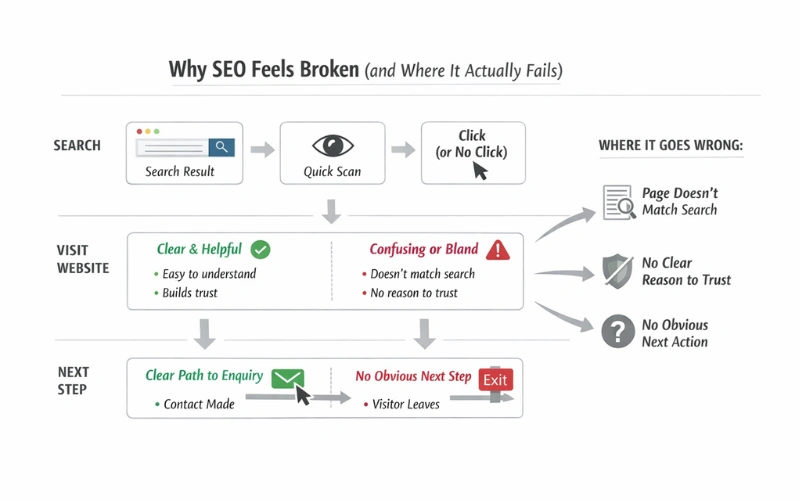
Today, someone might scan a result, read a quick answer, compare a few options, and leave without ever clicking the first link. That makes it feel like SEO isn’t doing its job. Business owners then start asking, does SEO work for small business anymore, when the real issue is that success is being judged the wrong way.
Another reason this feels broken is how SEO was sold. Many small business owners were promised traffic. Reports focused on rankings and visitor numbers, not on whether the website actually helped someone take the next step. Traffic went up, but enquiries didn’t, so trust in SEO dropped.
This is why SEO is important for small business in a different way than before. It’s no longer just about being visible. It’s about showing up in the right places and making it clear why someone should contact you when they land on your site.
For most small business owners, SEO still plays a role. But it only works when it’s aligned with how real people search and decide today, not how search worked in the past.
In 2025, about 58.5% of Google searches in the U.S. and 59.7% in the EU ended without clicking through to any website.
This means most people looked at search results but didn’t visit any external sites, making traditional SEO traffic less reliable on its own.
Source: Top SEO Statistics for 2025 — SMAMarketing
Common mistakes small business owners make
One of the biggest mistakes I see is expecting SEO to work quickly. It’s often treated like a switch you turn on and leads start coming in. When that doesn’t happen in a few weeks, frustration sets in and confidence drops.
Another common issue is judging success by traffic alone. More visitors look good on a report, but traffic doesn’t pay the bills. If people are landing on your site and leaving without getting in touch, the numbers don’t mean much. Enquiries are what matter.
A lot of small businesses also get stuck with generic SEO services for small business that look the same for everyone. The same checklist, the same monthly tasks, no real understanding of the business behind the website. Local businesses face this even more with local SEO services for small business that promise visibility but ignore what happens after someone clicks.
Website clarity is often overlooked too. Pages try to say everything at once or focus too much on the business instead of the visitor’s problem. When messaging isn’t clear, people hesitate and move on.
Finally, many owners stop too early. SEO gets cut just as small improvements start to build because results feel slow or unclear. Working with an SEO consultant for small business only makes sense if there’s patience to let the right changes settle and do their job.
Organic click‑through rates (CTR) for queries with AI summary features dropped by about 61% from mid‑2024 to late‑2025.
This shows that when search engines show direct answers, users are much less likely to click to a website.
Source: Google AI Overviews drive 61% drop in organic CTR — SearchEngineLand
What makes a real difference
What works today is simpler than most people expect. It starts with knowing exactly who the site is for and what problem it’s meant to solve. When SEO for small business tries to appeal to everyone, it usually connects with no one. Clear focus makes it easier for the right people to recognise themselves and stay.
Pages also need to match why someone landed there in the first place. If a visitor is searching for a specific service or answer, the page should meet that need quickly and clearly. This is one of the most overlooked parts of SEO strategies for small business. Relevance matters more than volume.
Another practical fix is making the next step obvious. If someone is interested, they shouldn’t have to hunt for how to get in touch or what happens next. Simple wording, clear buttons, and reassurance at the right moment remove hesitation.
It’s also important to measure the right thing. Rankings can move up and down, but leads tell the real story. One of the biggest benefits of SEO for small business is attracting people who are already looking for help. If those people aren’t reaching out, something in the journey needs adjusting.
Finally, consistency beats quick wins. Steady improvements, reviewed over time, work better than jumping from one idea to the next. That’s usually how you improve SEO for small business in a way that lasts and actually supports the business.
A real example from a local business
I see this a lot with local service websites. On the surface, everything looks fine. The site is clean, the content reads well, and traffic numbers look healthy. But when you dig a little deeper, the traffic isn’t coming from the right places. For local businesses, that’s a problem. You don’t need everyone. You need the right people in the right area.
In one case, the question wasn’t does SEO work for small business. It was whether the website was set up for local intent at all. We started by reviewing the site content and how a local visitor would move through the pages. The information was there, but it wasn’t written with a local searcher in mind.
We adjusted key pages to reflect location-specific needs, looked at what people in that area were actually searching for, and made the next steps clearer. We also focused on trust, adding real examples of past work and publishing regular blogs that answered common local questions.
Over time, the traffic became more relevant. Enquiries started coming from people who were a good fit. Local visibility improved, and conversations turned into real work. For many SEO for small business owners, that’s what progress really looks like. Consistent effort, clearer intent, and results that make sense for the business.
Get clarity before you decide
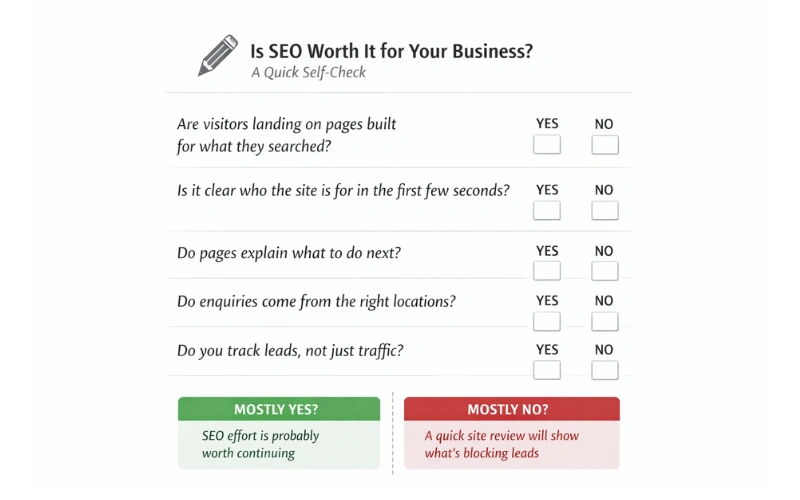
If you’re still unsure whether SEO is worth it for small business in 2026, the fastest way to get clarity is to look at your own site through fresh eyes. Not a long report. Not a sales call. Just an honest review of what’s helping and what’s quietly getting in the way.
Is SEO Worth It for You?
Get a quick, honest review of what’s helping or blocking leads.
I can take a quick look at your website and share clear feedback, sometimes through a short video so you can see exactly what I’m referring to. The goal isn’t to sell you anything. It’s to help you understand what’s really happening on your site and whether focusing on SEO makes sense for your situation right now.
Once you have that clarity, you can decide what to fix, what to ignore, and how far you want to take things.