
Why My Business Isn’t Ranking Locally — Even With Great Reviews?
Many business owners ask, why my business isn’t ranking locally even after collecting great reviews. The truth is, reviews alone don’t guarantee visibility. This blog explains what really affects local rankings and what practical steps you can take to improve them.

Deepak Sharma
SEO Consultant
Feb 20, 2026 | 6 min. read
Table of the content
- Why Your Business Is Not Showing in Google Maps or Local Search Results
- Common Mistakes to Avoid in Local SEO That Hurt Your Rankings
- How to Improve Local Search Visibility and Get Featured in Google Local Pack
- Why a 5-Star Business Still Didn’t Rank in Google Maps
- Not Ranking Locally? Let’s Fix What’s Really Holding You Back
- FAQs
I hear this a lot:
“I’ve got great feedback from customers. So why am I not ranking locally even with good reviews?”
It’s a fair question.
On the surface, it feels logical. If people like your service and leave five-star reviews, your business should show up in local search results. But that’s not how it works in practice.
Good reviews help. They build trust. They influence decisions. But when it comes to Google reviews and ranking for local SEO, they’re only one small part of a much bigger picture.
I’ve reviewed many websites where the business owner was doing a great job offline. Happy customers. Strong reputation. Solid word of mouth. Yet online, they were not ranking locally even with good reviews.
The issue usually isn’t the reviews.
It’s everything around them.
Google looks at how your website is structured, how clear your location signals are, how complete your business profile is, and how strong your local presence appears compared to competitors. Reviews support visibility, but they don’t replace the fundamentals.
📊 Most Visitors Don’t Convert
On average, only about 1.7% of website visitors convert into leads — meaning over 98% leave without taking action.
Why it matters:
This shows that getting traffic is only the first step. If your site isn’t guiding visitors clearly or making it easy to contact you, most visitors will simply leave without becoming leads — even if they find your business. This helps explain why many local businesses with decent traffic still struggle to generate enquiries.
At Digital Deep Tech, when we look into cases like this, we almost always find gaps that have nothing to do with star ratings.
In the next section, I’ll explain why your business might not be showing up properly in Google Maps or local search — even when customers clearly trust you.
Why Your Business Is Not Showing in Google Maps or Local Search Results
After reviewing a lot of small business websites, I can tell you this — when someone asks, why my business is not showing in Google Maps, the answer is rarely about reviews alone.
Reviews are one signal. Just one.
Google looks at three main things in local search results: how close you are to the searcher, how relevant your business looks for that search, and how strong your overall presence appears compared to others nearby.
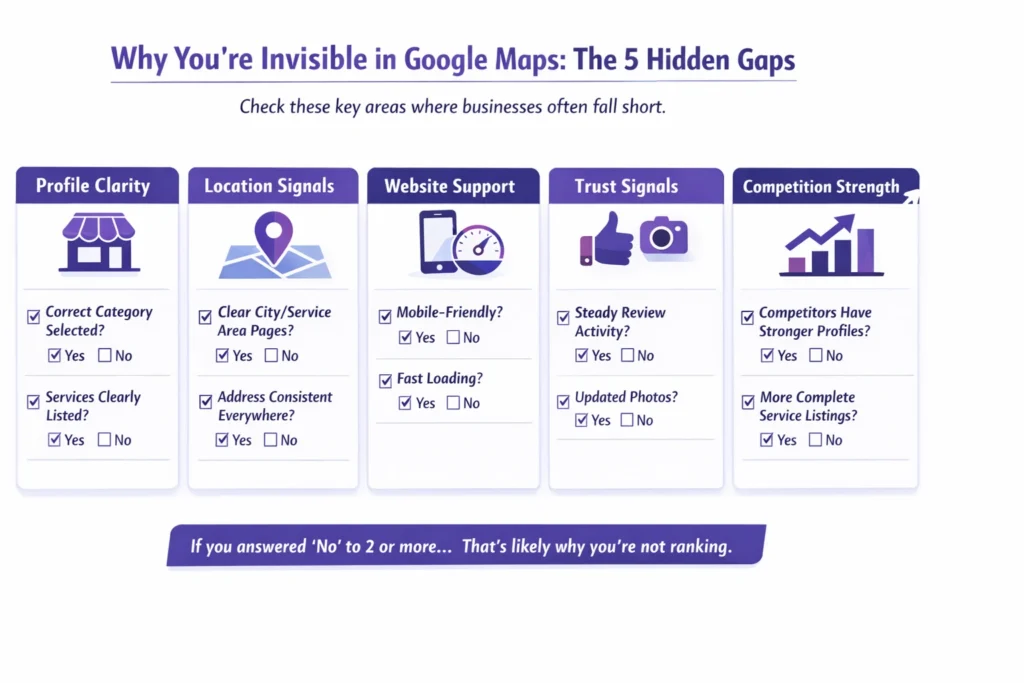
If your business is not showing in Google Maps, it’s usually because one of those pieces is weak.
Proximity is simple. If someone searches from 10 miles away, businesses closer to them often win. You can’t control that.
Relevance is about clarity. Does your profile clearly say what you do? Are your services properly listed? Is your website aligned with your location and service areas? If that connection isn’t obvious, Google hesitates.
Then there’s authority. This is where competition comes in. I’ve seen business owners confused about why their Google Business Profile is not ranking, only to realise three competitors nearby have:
- More complete profiles
- Stronger websites
- Clearer location pages
- More consistent business details online
That’s why it’s important to properly analyze local SEO competition instead of assuming reviews should carry the weight.
Another common issue is setup. Sometimes the business category is slightly off. Sometimes services aren’t listed clearly. Sometimes the profile is missing useful information. These small gaps affect google local pack ranking factors more than most people realise.
I also often find weak or missing location pages on the website. The location pages importance in local SEO is bigger than many expect. If your site doesn’t clearly show where you operate and what you offer in each area, Google has less confidence placing you in local results.
So when someone asks, why is my business not appearing on Google Maps, it’s usually a mix of clarity, competition, and profile structure, not a lack of good customer feedback.
In the next section, I’ll walk through the common mistakes I see business owners make that quietly hold their rankings back.
Common Mistakes to Avoid in Local SEO That Hurt Your Rankings
When I review sites for business owners in the US and UK, the issue usually isn’t effort. It’s small gaps that quietly stack up.
These are the most common mistakes to avoid in local SEO that I see again and again.
1. Ignoring Google Business Profile Optimization
Many owners set up their profile once and leave it.
Incomplete services. Wrong primary category. No updates. Thin descriptions.
Your profile needs to clearly explain what you do and where you operate. If it’s vague or half-filled, Google struggles to position you properly. That’s often why rankings stall.
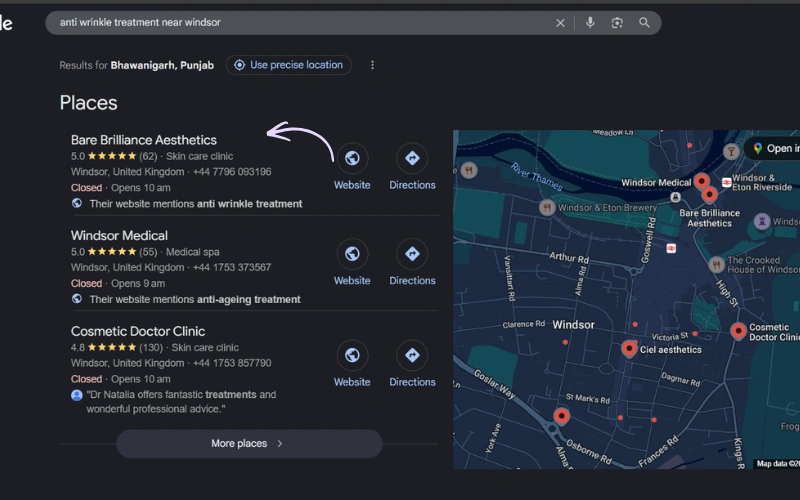
In my last case study, I was working on a project that had a good number of reviews, but the listing was not ranking in Google’s 3-Pack. I optimized the profile properly and posted regularly to keep the listing active. The results came after one month. You can see in the screenshot below that the listing is now ranking.
2. NAP Inconsistency
Before discussing this, I’ll explain the full form of NAP — Name, Address, and Phone Number. It is very important for any business listing.
Your business name, address, and phone number need to match everywhere online.
Even small differences — “Street” vs “St.” — can create confusion. Google Business Profile NAP consistency guidelines aren’t complicated, but they matter.
If Google sees mixed signals, trust drops slightly. And in local search, small trust drops make a difference.
3. Weak or Missing Local Pages
I often get asked, how do you optimize a website for local SEO?
It starts with clear location signals on your website. If you serve specific towns or cities, those areas need proper pages that explain:
- What you do there
- Who you help
- How customers can contact you
Thin, copied, or generic pages won’t help. They need to feel real and specific.
I often see that many businesses link their homepage to their Google Business Profile listing. This confuses search engines because when someone lands on the homepage, there are no clear local signals.
4. Technical Issues That Quietly Hold You Back
You don’t need to understand every technical detail, but some basics matter.
Slow loading speed. Broken pages. Mobile layout issues. Poor internal linking.
When clients ask me which technical SEO issues are most important for local SEO, I usually say this: focus on speed, mobile usability, and clean structure. If your site is hard to use, rankings suffer.
Local listings help bring local traffic to your website. Before contacting you, most users want to learn about your services and check your online reputation. Your website plays a big role in that decision.
If your website structure is poor, loads slowly, or the content is not aligned with the needs of your local audience, visitors will leave quickly. That is why it’s important to make sure everything is properly set up to improve your conversion rate.
5. Citation Errors
Many business owners don’t fully understand what are local business citations. In simple terms, they’re online listings that mention your business details — directories, local listings, industry platforms.
Common local citation mistakes that hurt local SEO include:
- Inconsistent contact details
- Duplicate listings
- Outdated addresses
- Wrong phone numbers
These don’t always cause dramatic drops, but they weaken your overall presence.
And just to clear up one more confusion I hear often — are social signals a Google ranking factor official statement? No. Google has said social media activity itself isn’t a direct ranking factor. It can help visibility, but it’s not the core issue when you’re not ranking locally.
None of these problems are dramatic on their own. But together, they explain why a business with good reviews still struggles to appear consistently.
In the next section, I’ll show you what actually works — practical steps you can take to improve your local visibility properly.
How to Improve Local Search Visibility and Get Featured in Google Local Pack
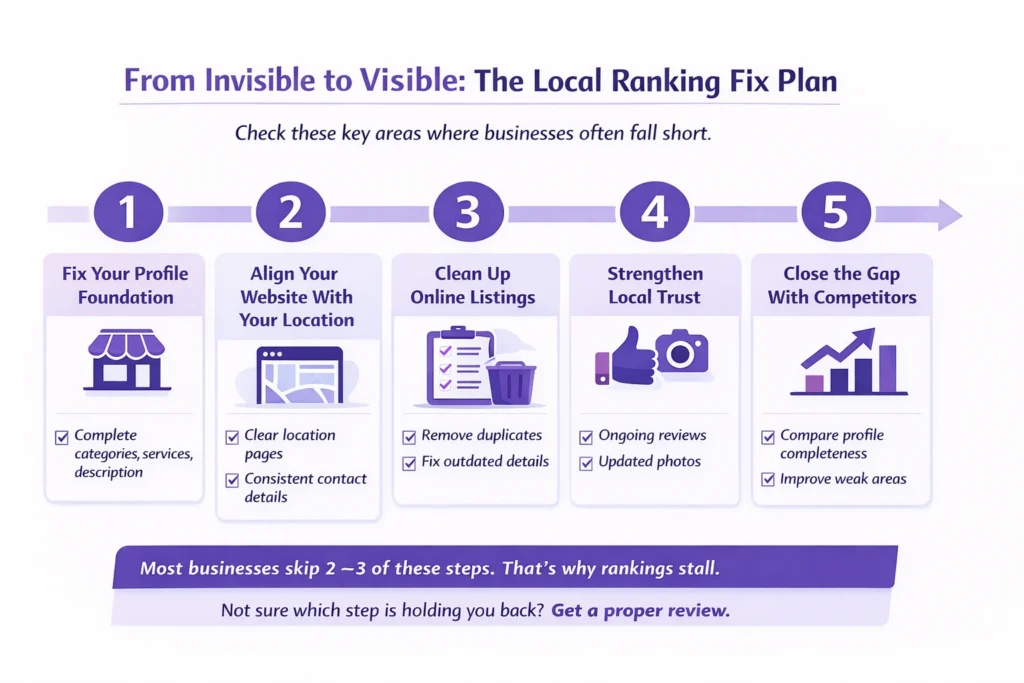
Now let’s talk about what actually moves the needle.
If your goal is to improve local search visibility and show up more consistently, the solution isn’t complicated — but it does require doing the basics properly.
Here’s what I usually walk clients through on a call.
1. Fully Optimize Your Google Business Profile
This is your starting point.
When people ask how to optimize Google Business Profile, I tell them to think of it like a storefront. It needs to be complete, clear, and active.
That means:
- Choosing the right primary and secondary categories
- Listing every relevant service properly
- Writing a clear business description
- Adding real photos
- Keeping hours accurate
A proper Google Business Profile optimization checklist isn’t about tricks. It’s about completeness and clarity. Small gaps here often explain why profiles don’t perform.
If your Google Business Profile isn’t fully set up, nothing else will compensate for it.
2. Fix NAP Consistency Everywhere
Next, make sure your business name, address, and phone number match exactly across all listings.
Even small differences create doubt in Google’s system. When that doubt builds up, rankings soften.
Consistency strengthens trust. And trust supports visibility.
3. Improve Website Local Signals
Your website must clearly support your location.
That includes:
- Clear service area mentions
- Strong location pages
- Contact details in the footer
- Consistent messaging between your site and your profile
If someone asked me how to optimize for Google local 3 pack, I’d say this: your website and your profile must tell the same story.
When they align, your chances of appearing in local map listings increase.
4. Build Authority and Local Trust
Authority doesn’t mean hundreds of links or flashy campaigns.
It means:
- Earning real reviews steadily
- Getting mentioned in local directories
- Keeping information updated
- Publishing helpful local content when relevant
This is how you slowly build the kind of presence that helps you get featured in Google local pack results.
There’s no shortcut here. It’s steady work.
5. Monitor Competition
Finally, pay attention to who is ranking above you.
Look at:
- Their profile completeness
- Their website quality
- Their local pages
- Their review patterns
Sometimes improving visibility in local map listings is less about doing more — and more about closing the gap between you and the businesses already showing up.
At Digital Deep Tech, when we apply these steps consistently, rankings don’t jump overnight — but they do move in the right direction.
In the next section, I’ll give you a simple real-world example of how this plays out for a typical local business.
Why a 5-Star Business Still Didn’t Rank in Google Maps
Let me give you a real-world type of situation I see often.
A local salon in the Windsor, UK reached out. They had over 60 reviews. Average rating above 4.8. Customers were clearly happy.
But they kept asking, “Why are we not showing in the local pack when smaller salons are?”
When I looked at things more closely, the problem wasn’t reputation.
It was structure.
First, their location page was thin. It mentioned the city name once and didn’t clearly explain the areas they served. There was no depth. No real local signals.
Second, their business details weren’t consistent across directories. Some listings had an old phone number. One had a slightly different business name. These small inconsistencies weaken trust.
Third, their profile setup wasn’t complete. Services weren’t clearly listed. Categories weren’t fully aligned with what they actually did. It wasn’t terrible — just unfinished.
None of these issues alone seemed dramatic. But together, they explained why they were invisible in Google Maps.
We focused on tightening everything up. Clearer location pages. Consistent contact details everywhere. A properly structured profile.
This wasn’t about tricks. It was about proper setup.
Some business owners try to solve this themselves. Others choose to work with experts in Google Business Profile optimization when they realise the details matter more than they thought.
There are many providers offering Google Business Profile optimization services, but the real difference comes from understanding how your website, profile, and local presence connect together — not just filling out fields.
In this case, once the gaps were fixed, visibility improved steadily. No overnight spike. Just gradual, stable movement into better positions.
If your business feels stuck despite strong reviews, it’s usually something similar — not a lack of customer trust, but a few structural weaknesses holding you back.
In the final section, I’ll explain what your next step should be if you want clarity on what’s affecting your rankings.
Not Ranking Locally? Let’s Fix What’s Really Holding You Back
If you’ve read this far, you probably recognise parts of your own situation.
Strong reviews. Solid service. But still not showing where you should in local search.
The truth is, guessing won’t solve it.
What usually helps is a proper manual review — someone looking at your website, your profile, your location pages, and your competition together. Not an automated report with charts, but a real assessment that explains what’s working and what isn’t.
Not Sure What’s Holding You Back?
Get a clear, practical review of your local visibility gaps.
When I review a business, I look for the small structural gaps we’ve talked about in this article. Then I outline a clear action plan. What to fix first. What can wait. What will likely move visibility in a steady, realistic way.
No promises. No dramatic claims. Just clarity.
If you’d like that kind of review, you can book a consultation with Digital Deep Tech. We’ll go through your setup properly and give you straightforward feedback on what’s holding your rankings back — and what to do next.
From there, you can decide how you want to move forward.
📊 Form Abandonment Is a Major Leak
About 41% of users abandon forms because they have too many fields, significantly reducing lead capture.
Why it matters:
If your contact or enquiry form asks for too much information or feels complicated, nearly half your potential leads may leave before completing it. For small businesses, simplifying forms and removing friction often leads to measurably better lead flow.
FAQs
Why am I not ranking locally even with good reviews?
This is one of the most common questions I hear. The honest answer is that reviews are only one part of the puzzle. If you’re wondering why my business isn’t ranking locally, it’s usually because Google looks at more than ratings. It considers how close you are to the searcher, how clearly your services are defined, how strong your website is, and how your business compares to competitors nearby. Reviews support trust, but they don’t replace a solid setup.
Does Google Business Profile optimization really improve rankings?
Yes, when it’s done properly. Google Business Profile optimization helps Google understand exactly what you do, where you operate, and which searches you’re relevant for. A complete profile with accurate categories, clear services, updated photos, and consistent details improves clarity. That clarity increases your chances of appearing in local results. It’s not instant, but it does make a measurable difference over time.
How long does it take to improve local search visibility?
It depends on your starting point and your competition. If your profile and website only need minor adjustments, you may notice movement within a few weeks. If there are structural issues or strong competitors in your area, it can take a few months. Local rankings usually improve gradually, not overnight. Steady corrections and consistency matter more than quick fixes.
Are Google reviews enough to rank in the local pack?
No, reviews alone are not enough to rank in the local pack. They influence trust and can improve click-through rates, but they are just one ranking signal. Businesses with fewer reviews sometimes rank higher because their profiles are more complete, their website is stronger, or their location signals are clearer. Reviews help, but they don’t override weak foundations.
What are the most important local ranking factors?
The most important google local pack ranking factors generally include proximity to the searcher, relevance of your business to the query, and overall authority. Authority comes from a strong website, consistent business details online, and steady customer engagement. Google wants to show businesses that are clear, reliable, and easy for users to contact.
Why is my business not appearing on Google Maps?
If your business isn’t appearing on Google Maps, it’s often due to incomplete profile setup, category misalignment, inconsistent contact details, or weak location signals on your website. In some cases, strong competitors nearby may simply have more complete profiles. A proper review usually reveals one or two gaps that explain the issue.
How can I improve my chances of showing in the Google local 3 pack?
Start by ensuring your profile is fully completed and accurate. Then align your website with your service areas clearly. Keep your contact details consistent everywhere. Continue collecting genuine reviews over time. Finally, monitor competitors and close the gaps between your setup and theirs. Showing in the local 3 pack is usually the result of steady improvements, not a single change.
Recent Blogs
- Common WordPress Mistakes That Stop You Getting Leads
- Why a Good-Looking Website Doesn’t Convert
- Does SEO still work for small businesses in 2026?
- Why Your Website Isn’t Generating Leads and How to Fix It
- Why SEO traffic doesn’t turn into enquiries
- How Long Does SEO Take for a Small Business?
- Why a Slow WordPress Site Kills Your Enquiries