
Cheap Link Building Packages: Pricing, Risks & What You Really Get
Cheap link building packages can look similar on the surface, but what you actually get can vary a lot. This guide breaks down pricing, quality, and risks so you can choose affordable link building packages that genuinely support your website’s growth.

Deepak Sharma
SEO Consultant
Mar 30, 2026 | 6 min. read
Table of the content
- Introduction
- What Are Cheap Link Building Packages?
- How Much Do Link Building Packages Cost?
- What Do You Actually Get in Cheap Packages?
- Are Cheap Link Building Packages Safe?
- Cheap vs Quality Backlinks (Simple Comparison)
- What’s the Right Ratio of DoFollow vs NoFollow Backlinks?
- What to Look for in Affordable Link Building Packages
- How to Choose the Right Package
- Final Thoughts
- FAQs
Introduction
Most people I speak to assume that cheaper means more links, and more links means better rankings. On paper, that sounds logical. But in reality, it rarely works that way.
I’ve looked at a lot of websites where business owners invested in cheap link building packages expecting quick results. What they usually end up with is a long list of backlinks that don’t bring traffic, don’t improve rankings, and don’t lead to enquiries.
The issue isn’t just the price. It’s how those links are built, where they come from, and whether they actually make sense for your business. Pricing and quality don’t move together in a straight line here, and that’s where most of the confusion starts.
Before you spend money on backlinks, it’s worth understanding what you’re actually paying for and what you should expect in return.
At Digital Deep Tech, affordable doesn’t mean low-quality backlinks. It means high-quality backlinks where quality matters, not quantity. Creating 100 low-quality backlinks is not the same as creating 10 high-quality backlinks.
📊 The #1 result on Google has 3.8× more backlinks than positions 2–10.
Why it matters:
This clearly shows that backlinks are still one of the strongest ranking factors. It supports your message that better links (not just more links) directly impact rankings.
Source: Semrush / industry studies
What Are Cheap Link Building Packages?
When people talk about cheap link building packages, they’re usually referring to a monthly service where you get a set number of backlinks built to your website.
On the surface, most backlink packages look similar. You pay a fixed amount, and each month you receive links pointing to your site. But the real difference is in how those links are actually created.
Some providers use proper outreach. That means reaching out to real websites, placing your link within relevant content, and making sure it fits naturally. This is closer to how affordable link building services should work when done properly.
On the other side, there are services that rely on bulk methods. These often involve placing your links on low-quality sites, automated networks, or pages that exist only to sell links. There’s no real audience, no relevance, and no long-term value.
You’ll also hear terms like guest posts and niche edits.
- Guest posts are new articles written and published on another website where your link is included naturally
- Niche edits are links added to existing content on a website that’s already live
Both can work well when done on the right sites. But again, the quality of those sites and the way the link is placed matters far more than the label itself.
So while cheap link building packages may promise a certain number of links each month, what really matters is whether those links come from real, relevant websites or just exist to fill a report.
How Much Do Link Building Packages Cost?
This is usually the first question I get, and honestly, it’s where most of the confusion starts.
Link building cost isn’t fixed. It depends on what kind of links you’re getting and how they’re built. That’s why you’ll see very different pricing across the market.
| Package Level | Monthly Price | What You Typically Get | Who It’s For |
|---|---|---|---|
| Basic | Starting at $149/month | Consistent backlinks, content-based links, basic outreach, link monitoring | New websites or businesses starting link building |
| Authority | $249/month | Stronger backlinks, better site selection, improved relevance, ongoing link growth | Websites looking to improve rankings steadily |
| Premium | $499/month | Higher authority links, focused outreach, content creation, link audit and cleanup | Businesses aiming for competitive keywords and long-term growth |
| Key Difference | — | Quality, relevance, and outreach effort increase with each level | Higher investment usually means stronger and more reliable results |
Serving clients in: USA | UK | Australia | Canada
At a basic level, you’ll find packages starting around $149 per month. These are usually entry-level, where the focus is on getting consistent backlinks at a lower cost. It’s a starting point, but the quality and impact can vary depending on how those links are sourced.
As you move up, you’ll see plans around $249 per month. This is where things tend to improve. You’re not just paying for more links, but for better placement, more relevant websites, and a more controlled approach.
Then there are higher-tier packages, around $499 per month and above. This is where proper effort goes in. Outreach is more selective, content is handled with more care, and links are placed on sites that actually have some authority and traffic.
The reason backlink pricing varies like this comes down to a few key factors:
- Website quality (DR and relevance): Links from stronger, relevant sites cost more because they’re harder to get
- Traffic: A site that gets real visitors is more valuable than one that exists just to host links
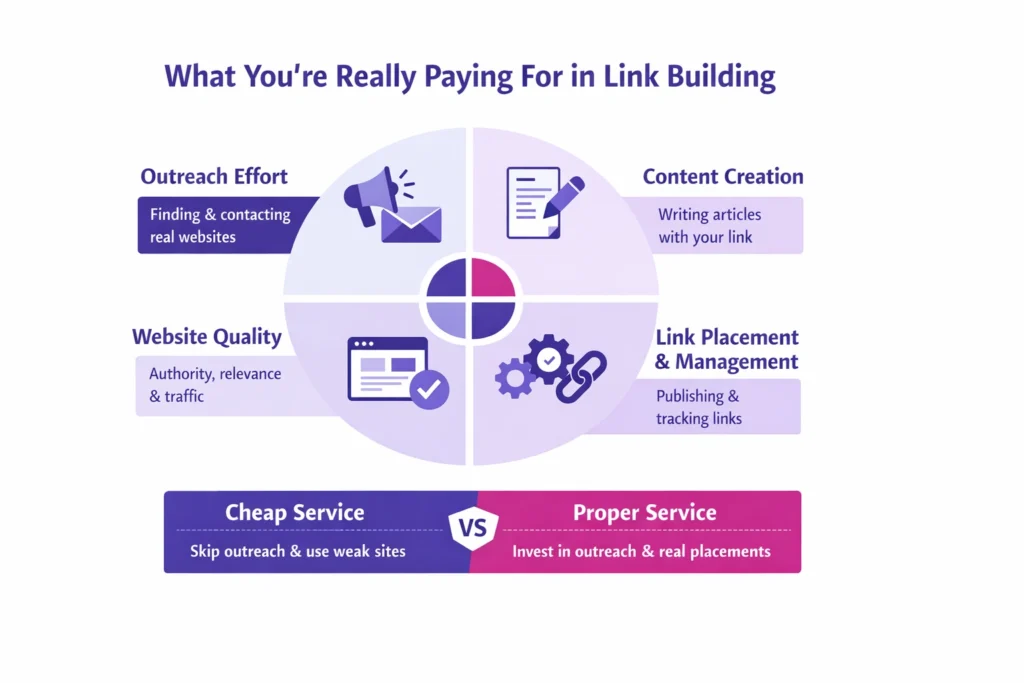
- Outreach effort: Real outreach takes time. Someone has to find sites, contact them, and place your link properly
So when you’re looking at the cost of backlinks, it’s not just about how many links you’re getting. It’s about whether those links are built in a way that actually supports your website.
That’s why two packages with the same price can deliver completely different results. Understanding that difference makes it much easier to choose the right option, which we’ll break down next
What Do You Actually Get in Cheap Packages?
This is where I usually ask clients to slow down a bit. Because the number of links you’re getting each month doesn’t tell the full story.
Most monthly link building packages are structured around volume. You’ll often see something like 4 to 8 links at the entry level, 8 to 20 links in mid-tier plans, and 20 or more links in higher packages. On paper, that looks like clear progress.
But what matters is what sits behind those numbers.
At the entry level, those 4 to 8 links are usually built on smaller sites. Sometimes they’re relevant, sometimes not. If done properly, even a few good links can help. But if they’re rushed or placed on weak sites, they don’t move the needle much.
In mid-tier packages, where you get around 8 to 20 links, you should start seeing better consistency. The sites are more relevant, content is handled more carefully, and the links begin to support your pages in a more meaningful way. This is where many businesses start noticing gradual improvement.
With higher-end packages, where you might see 20+ links, the expectation should shift from just volume to approach. These links should come from stronger websites, sometimes through more structured placements that feel closer to PR-style mentions. The focus here is not just building links, but building the right ones over time.
Now, here’s the part most providers don’t explain clearly.
Some cheap backlinks are created using shortcuts. That can include automated placements, private networks, or sites built only for selling links. On a report, everything looks fine. You see links, anchors, and URLs. But behind the scenes, those links often have no real value.
This is why people ask, are cheap backlinks safe? And the honest answer is, it depends on how they’re built.
Low cost backlinks are not a problem by default. The problem starts when quality is ignored. If links come from irrelevant sites, have no traffic, or are placed without any context, they’re unlikely to help your website in any meaningful way.
Safe link building services focus less on how many links they can deliver and more on whether those links actually make sense for your business. That’s the difference between something that just fills a report and something that supports your growth.
Once you understand that, it becomes much easier to look beyond the numbers and focus on what actually matters.
Are Cheap Link Building Packages Safe?
This is the part most people are unsure about, and for good reason.
Cheap doesn’t automatically mean bad. But when the price drops too low, you have to ask how those links are actually being built.
In many cases, very cheap packages skip proper outreach completely. There’s no effort to find relevant websites or place your link in content that makes sense. Instead, links are often added to low-quality sites that exist only to sell backlinks. These sites usually have no real traffic, no audience, and no connection to your industry.
You might come across offers like “50 links for $500.” On the surface, it feels like a good deal. But realistically, that level of volume at that price means corners are being cut somewhere. Either the sites are weak, the links are automated, or there’s no real quality control behind it.
This is where backlink quality vs quantity becomes important.
A handful of quality backlinks from relevant, real websites will almost always do more for your site than dozens of low-quality links placed randomly. Search engines look at context, relevance, and trust. If those signals aren’t there, the links are either ignored or carry very little value.
That’s also why white hat link building takes more time and effort. It involves real outreach, proper content, and placements that fit naturally within a page. It’s slower, but it builds something that lasts.
From what I’ve seen, the issue isn’t that cheap link building packages are unsafe by default. The issue is when the focus is only on volume without any attention to quality. That’s when links stop helping and start becoming a waste of budget.
Once you understand that difference, it becomes much easier to filter out what’s worth considering and what’s better to avoid.
📊 Around 66% of web pages have zero backlinks, meaning most content never ranks or gets visibility.
Why it matters:
This explains why many websites don’t get traffic. It’s not always content quality, it’s often because they have no backlinks at all.
Source: BacklinkGrid (2026 data)
Cheap vs Quality Backlinks (Simple Comparison)
This is where things usually become clearer.
A lot of business owners I speak to focus on how many links they’re getting. But once you look a bit deeper, the real difference is in how those links are built and where they come from.
Here’s a simple way to look at it:
- Cheap (bad): bulk links placed quickly without much thought
- Affordable (good): links built through manual outreach on relevant websites
- Cheap (bad): links from random sites with no connection to your business
- Affordable (good): links placed on websites within your niche or industry
- Cheap (bad): sites with no real traffic or audience
- Affordable (good): websites that actually get visitors and have some credibility
The difference may not be obvious in a report, but it shows over time in how your website performs.
When links come from the right places and are added naturally, they support your pages in a way that search engines can trust. When they’re placed just to increase numbers, they don’t carry the same weight.
That’s why, in most cases, quality and relevance matter far more than volume. A smaller number of well-placed links will usually do more for your site than a large batch of links that don’t really belong there.
Once you start looking at backlinks this way, it becomes easier to judge what’s actually worth paying for.
What’s the Right Ratio of DoFollow vs NoFollow Backlinks?
This is something a lot of business owners ask, especially when they start looking into backlinks more seriously.
There isn’t a fixed number that guarantees rankings. But when you look at real websites that perform well, a natural pattern shows up. Most healthy backlink profiles tend to have around 60–80% dofollow links and 20–40% nofollow links.
The reason this works is simple. DoFollow links help with rankings because they pass authority, while NoFollow links usually come from places like social media, forums, or directories and help keep your profile looking natural.
What matters more than the exact ratio is how genuine it looks. If your profile is 100% dofollow, it often signals artificial link building. On the other hand, too many nofollow links can mean you’re not earning strong editorial mentions.
In practice, you don’t need to manage this manually. If your links are coming from real outreach and relevant websites, the balance usually builds itself over time.
What to Look for in Affordable Link Building Packages
When you’re comparing different options, it’s easy to get distracted by numbers. But what actually matters is how those links are being built and where they’re coming from.
If you’re considering affordable link building packages, there are a few things I’d always check first.
Start with the websites themselves. Are the links coming from real sites that have traffic, or are they just pages created to host links? A site with actual visitors and some activity is always a better signal than one that exists only for SEO.
Next is how the link is placed. High quality backlinks are usually added within content where they make sense. Not forced, not random. Just naturally part of the page. That context is what gives the link value.
| Off-Page SEO Task | What It Involves | Backlink Type | Why It Matters |
|---|---|---|---|
| Guest Posting | Writing articles for relevant websites and adding your link naturally within the content | Dofollow (mostly) | Builds authority and brings links from niche-relevant sites |
| Niche Edits | Adding your link into existing content on already indexed pages | Dofollow | Faster results as pages already have authority and rankings |
| Manual Outreach | Contacting website owners for link placements or collaborations | Dofollow / Nofollow | Ensures links come from real websites with proper context |
| Business Citations | Submitting your business details to directories and listings | Nofollow (mostly) | Improves trust and supports local SEO visibility |
| Digital PR Mentions | Getting featured on blogs, news sites, or industry publications | Dofollow / Nofollow | Builds credibility and earns high-quality backlinks |
| Content Marketing | Creating useful content that naturally attracts links over time | Dofollow / Natural | Generates organic backlinks without direct outreach |
| Forum & Community Links | Participating in discussions and adding value-based links where relevant | Nofollow | Drives referral traffic and keeps link profile natural |
| Broken Link Building | Finding broken links on websites and suggesting your content as a replacement | Dofollow | Helps earn relevant links while solving a problem for site owners |
| Link Reclamation | Recovering lost or unlinked brand mentions | Dofollow | Quick way to regain valuable backlinks you already earned |
| Competitor Link Analysis | Studying competitor backlinks and replicating relevant opportunities | Dofollow / Mixed | Helps identify proven link sources in your niche |
Then look at the process behind it. Manual Off-Page SEO task takes more time, but it shows there’s real effort involved. Someone is selecting websites, reaching out, and placing your link properly. That’s very different from bulk placements where everything is automated.
Another thing I pay attention to is transparency. You should be able to see where your links are coming from, what kind of content is being used, and how things are progressing over time. Clear reporting makes it easier to understand what you’re actually getting.
In most cases, the difference comes down to a few simple signals. Relevant websites, some level of traffic, and a proper outreach process. When those are in place, the links tend to support your site in a more consistent and reliable way.
Once you know what to look for, it becomes much easier to filter out packages that only look good on paper and focus on the ones that actually make sense for your business.
How to Choose the Right Package
By this point, the question isn’t really about price anymore. It’s about choosing something that actually fits your website and goals.
If you’re trying to choose a link building service, I’d keep it simple and focus on a few practical checks. These usually tell you more than any sales page.
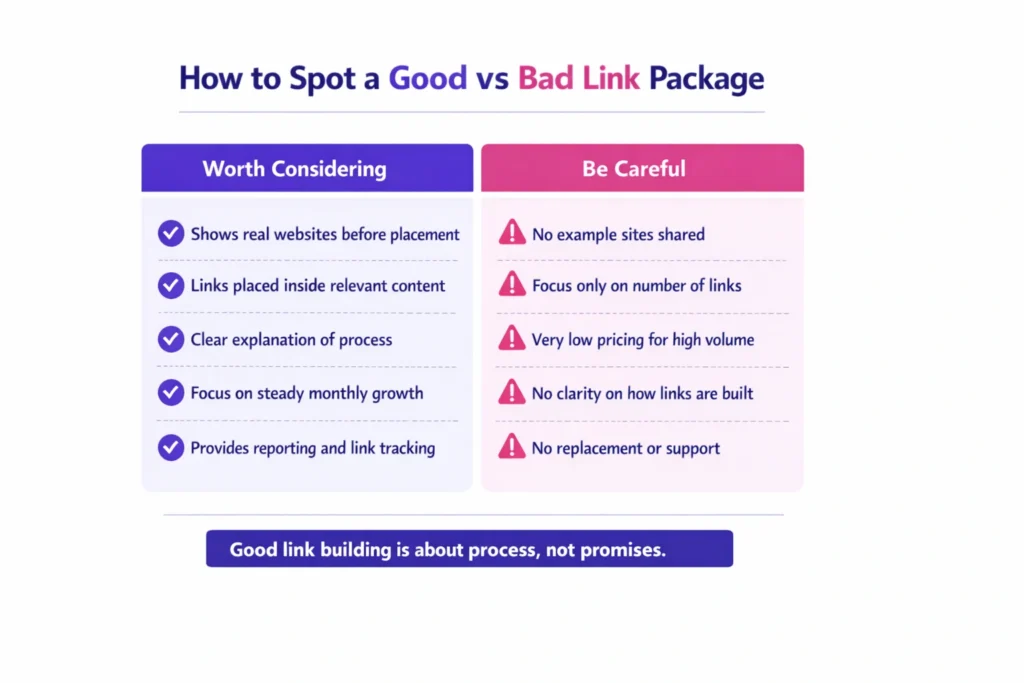
First, ask if you can preview the sites. A reliable link building agency should be comfortable showing examples of where your links might appear. You don’t need a full list upfront, but you should get a sense of the quality and relevance.
Next, find out who is handling the content. Are they writing something original for each placement, or reusing generic articles? The way content is handled makes a big difference in how natural the link looks and how well it performs.
Another important point is whether there’s any kind of replacement or quality guarantee. Links can get removed or pages can change over time. A good backlink service provider will have a process to deal with that, so you’re not left with gaps in your link profile.
I’d also pay attention to how they explain their process. If everything sounds vague or focused only on numbers, that’s usually a sign to be cautious. Clear explanations around outreach, site selection, and reporting are a better indicator that the work is being done properly.
At the end of the day, the right package is the one that matches your current stage. Not the cheapest, not the most expensive, but the one that’s built with the right approach behind it.
Final Thoughts
If you’ve made it this far, you can probably see that not all link building packages are built the same. The difference isn’t just in price, it’s in how the work is done behind the scenes.
Most issues I come across aren’t because businesses chose cheap link building services. It’s because they chose packages that focused only on numbers without any real attention to quality or relevance.
If you’re looking for affordable link building packages that focus on doing things properly, it’s worth taking a closer look at how the process works, what kind of sites are involved, and how consistent the approach is over time.
Get Clear on Your Link Building Strategy
We’ll review your backlinks and show what’s actually helping or not
It’ll give you a clearer idea of what’s included, how the work is handled, and whether it’s the right fit for your website.
At the end of the day, the goal isn’t just to build links. It’s to build something that actually supports your website and helps turn traffic into real enquiries.
FAQs
How much does link building cost for a small business?
Link building cost can vary a lot depending on quality and approach. For smaller businesses, you’ll usually see entry-level packages starting from a few hundred dollars per month, while more structured campaigns can go higher. The key thing to understand is that pricing reflects effort. Manual outreach, content creation, and better websites naturally cost more than bulk links.
Are cheap link building packages worth it?
They can be, but only if the focus is on quality and relevance. Cheap packages that rely on bulk links or random sites rarely help. But affordable link building packages that use proper outreach and real websites can still deliver steady improvements over time. The difference is in how the links are built, not just the price.
Are cheap backlinks safe for SEO?
This depends entirely on the source. Cheap backlinks built on low-quality or irrelevant sites are often ignored by Google or carry very little value. In some cases, they can even create problems later. Links built through proper outreach and placed within relevant content are generally much safer and more effective.
How many backlinks do I need per month?
There’s no fixed number that works for every website. Some businesses see progress with just a few strong links each month, while others in competitive industries need a more consistent approach. In most cases, a steady flow of relevant links works better than trying to build a large number all at once.
Why are some backlinks so expensive?
The cost usually comes down to effort and quality. Getting a link on a real website with traffic involves outreach, content, and sometimes negotiation. Higher-quality sites are harder to access, which is why those links cost more. In contrast, cheaper links are often easier to place because they don’t require the same level of work.
What is included in a link building package?
Most link building packages include a mix of outreach, content writing, and link placement. Some also include things like link audits, reporting, and competitor analysis. The difference between packages usually comes down to how much effort goes into each of these areas and the quality of the websites involved.
How do I know if a backlink is high quality?
A good backlink usually comes from a website that is relevant to your industry, has real traffic, and places your link naturally within content. If a link looks forced, comes from an unrelated site, or sits on a page filled with other outbound links, it’s unlikely to add much value. In most cases, relevance and context matter more than metrics alone.
Deepak is a seasoned SEO strategist with over a decade of hands-on experience helping businesses across 50+ industries grow their online visibility. He specializes in result-driven SEO, combining technical expertise with high-converting website design and ongoing optimization to deliver sustainable, long-term growth.
Recent Blogs
- Common WordPress Mistakes That Stop You Getting Leads
- Why a Good-Looking Website Doesn’t Convert
- Does SEO still work for small businesses in 2026?
- Why Your Website Isn’t Generating Leads and How to Fix It
- Why SEO traffic doesn’t turn into enquiries
- How Long Does SEO Take for a Small Business?
- Why a Slow WordPress Site Kills Your Enquiries