
Why Ongoing SEO Matters More Than a One-Time Website Fix
This guide explains why ongoing SEO is essential for maintaining rankings, attracting consistent traffic, and generating enquiries over time. Learn how regular updates, content improvements, technical maintenance, and continuous optimization help businesses stay visible and competitive in search results.

Deepak Sharma
SEO Consultant
June 17, 2026 | 6 min. read

What Is Ongoing SEO?
Many business owners assume SEO is something you do once.
You update a few pages, add some keywords, fix a few technical issues, and then expect your website to keep bringing in traffic for years. Unfortunately, that isn’t how search works.
Ongoing SEO is the process of continuously improving and maintaining your website so it stays visible in search results. It involves reviewing content, updating important pages, monitoring performance, fixing issues, and looking for new opportunities to attract the right visitors.
A simple way to think about it is website maintenance for your visibility on Google.
Search engines are constantly changing. Your competitors are updating their websites. Customer search habits evolve over time. If your website stays exactly the same while everything around it moves forward, it’s very easy to lose ground.
In my experience, websites that perform well over the long term are rarely the ones that received a single round of SEO work years ago. They are usually the ones being reviewed, improved, and updated on a regular basis.
I’ve seen businesses publish a few pages, achieve some early rankings, and then wonder why enquiries start slowing down months later. In many cases, the issue isn’t that the website is bad. It’s simply that nothing has been done to keep it moving forward.
Continuous SEO helps keep your website relevant. Whether that’s updating existing content, improving page quality, targeting new search terms, or fixing technical issues, each improvement gives search engines fresh signals that your site is active and useful.
Rather than relying on a one-time fix, ongoing SEO helps your website stay healthy, competitive, and better positioned for long-term growth.
The next question is why this ongoing work matters so much when a website may already be ranking well today.
Why SEO Is an Ongoing Process (Not a One-Time Fix)
One of the biggest misconceptions I come across is the idea that SEO is something you do once and then forget about.
A business invests in a website, publishes a few pages, makes some SEO improvements, and expects those rankings to stay in place indefinitely. While that would certainly make life easier, search visibility doesn’t work that way.
SEO is an ongoing process because the online environment never stands still.
Google Keeps Changing
Search engines regularly update how they evaluate and rank websites. Some updates are minor, while others can significantly change what appears on the first page.
Google makes thousands of changes to Search every year, including multiple major core updates. In 2023 alone, Google reported more than 4,700 improvements to Search.
Why it matters:
This supports the idea that SEO cannot be treated as a one-time task. Search engines continuously evolve, which means websites need ongoing monitoring, updates, and optimization to maintain visibility.
Source: Google Search Quality & Ranking Systems
I’ve seen websites that ranked well for years suddenly lose visibility after an update because their competitors had continued improving while they stood still. The businesses that tend to weather these changes best are the ones that consistently review and improve their websites rather than relying on work done years ago.
What worked twelve months ago may not be enough today.
When analyzing reviews and comparisons across various sites, you might notice one thing: websites that consistently update their content enjoy better online visibility compared to those that remain unchanged.
Your Competitors Aren't Standing Still
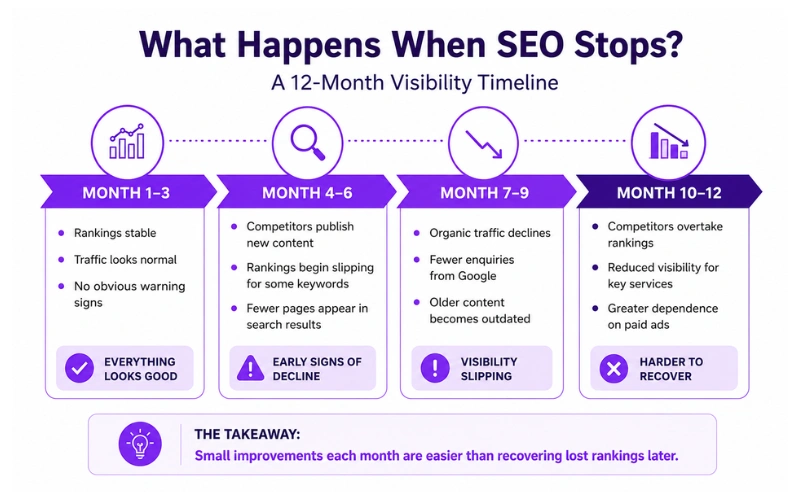
Even if your website is performing well right now, other businesses are trying to reach the same customers. They’re publishing new content, improving service pages, updating their websites, and looking for ways to increase their visibility.
From working with different businesses, I’ve found that rankings are often less about who made the biggest improvement once and more about who keeps making small improvements over time.
When you stop investing in your website, competitors can gradually take over the positions you’ve worked hard to achieve.
Search Habits Change
The way people search today is different from how they searched a few years ago.
More people browse on mobile devices. Search queries have become longer and more specific. Voice search has changed how questions are phrased. Google also displays information differently than it once did.
As customer behaviour changes, your website needs to adapt.
For example, a page that answered a customer’s question perfectly two years ago may no longer match what people are searching for today. Regular reviews help ensure your content continues to meet real user needs.
AI Search Results
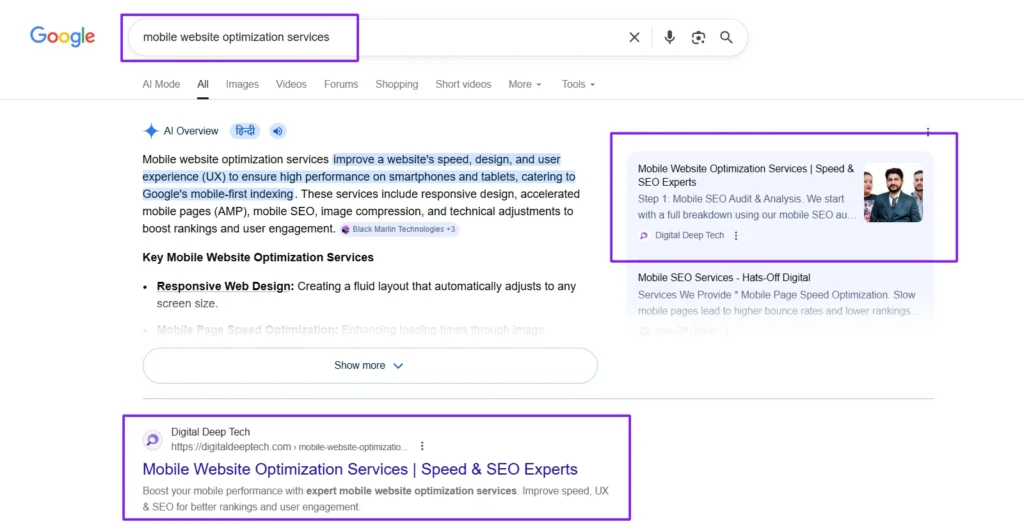
Nowadays, AI has completely transformed the way questions are answered. Search engines display AI results at the top based on website content. Therefore, it is crucial to publish useful, opinion-based, and unique content on your website so that it appears in AI search results.
Consistent SEO efforts help your website’s content rank at the top of search results. I am sharing a screenshot showing a page from our website appearing in AI search results.
Websites Naturally Deteriorate Over Time
A website isn’t something you build once and leave untouched. Pages become outdated. Service information changes. Links break. Images slow down pages. New technical issues appear without anyone noticing.
In my experience, many websites that struggle to generate enquiries aren’t suffering from one major problem. They’re dealing with dozens of small issues that have accumulated over time.
Individually, those issues may seem minor. Together, they can have a noticeable impact on visibility, user experience, and conversions. Regular maintenance helps prevent these problems from building up and becoming harder to fix later.
Small Improvements Add Up
The most important thing to understand is that SEO works best as an ongoing effort.
A one-time SEO project can create improvements, but those gains often fade if nothing happens afterwards. Ongoing work allows you to build on previous progress, strengthen your position, and adapt as search engines and customers continue to evolve.
That’s why businesses that treat SEO as a long-term activity often see more sustainable results than those looking for a single fix.
So if SEO isn’t a one-time task, what exactly should be happening each month? Let’s look at the activities that make up an effective ongoing SEO strategy.
Benefits of Ongoing SEO Maintenance
If you’ve ever wondered whether ongoing SEO maintenance is really worth the effort, it’s worth looking at what happens when a website is consistently looked after versus when it’s left untouched.
In my experience, the difference isn’t usually seen overnight. It becomes noticeable over months and years. One website continues attracting enquiries, while another slowly loses visibility and struggles to understand why.
Here are some of the biggest benefits of maintaining SEO over the long term.
Stronger and More Stable Rankings
Search rankings are never guaranteed.
Even if your website reaches page one today, there’s no guarantee it will stay there. Search engines change, competitors improve their websites, and customer search habits evolve.
Regular updates help protect the rankings you’ve already earned. This might involve improving existing pages, updating information, refining content, or identifying new keyword opportunities.
I’ve seen businesses lose valuable rankings simply because they assumed their previous SEO work would continue delivering results indefinitely. Unfortunately, search visibility often fades when websites stop evolving.
Consistent Organic Traffic
For many businesses, organic search is one of the most reliable sources of website visitors.
The advantage of ongoing SEO services is that they focus on building steady traffic rather than short-term spikes.
When new content is added, existing pages are improved, and opportunities are regularly reviewed, your website has more chances to appear in front of potential customers. Over time, these improvements can create a steady flow of visitors who are actively searching for the services you offer.
A Better Experience for Visitors
SEO isn’t only about rankings. A large part of ongoing optimization involves improving the experience people have when they visit your website. That could mean making pages load faster, fixing broken links, improving navigation, or ensuring the website works properly on mobile devices.
From working with different businesses, I’ve found that websites often struggle to generate enquiries not because they lack traffic, but because visitors have a poor experience once they arrive.
Small improvements to usability can make a significant difference in how long people stay on your site and whether they decide to get in touch.
The Ability to Respond to New Opportunities
Every industry changes. New services emerge. Customer questions evolve. Search trends shift throughout the year. Businesses that regularly review their SEO can respond much faster when new opportunities appear.
For example, if customers suddenly start searching for a new service or asking a specific question, you can create content around that topic before competitors fully react. This flexibility helps keep your website relevant and allows you to capture demand as it develops.
Increased Trust and Authority
People trust businesses that demonstrate expertise.
One way to do that is by regularly publishing useful information, updating outdated content, and providing accurate answers to common questions.
Over time, search engines begin to see your website as a reliable source of information within your industry.
I’ve noticed that businesses with well-maintained websites often find it easier to gain visibility because they’ve built trust gradually rather than trying to achieve quick wins.
I am sharing my experience here. My website initially had no traffic, no authority, and poor keyword rankings. For the past three months, I consistently published informative content on my website, www.digitaldeeptech.com. I published blog posts and new service pages without building any backlinks.
This resulted in three outcomes:
- The website’s authority improved.
- Traffic increased as my service pages began appearing in AI search results.
- Keyword rankings improved; as shown in the screenshot, the keywords have reached the top 10 rankings.
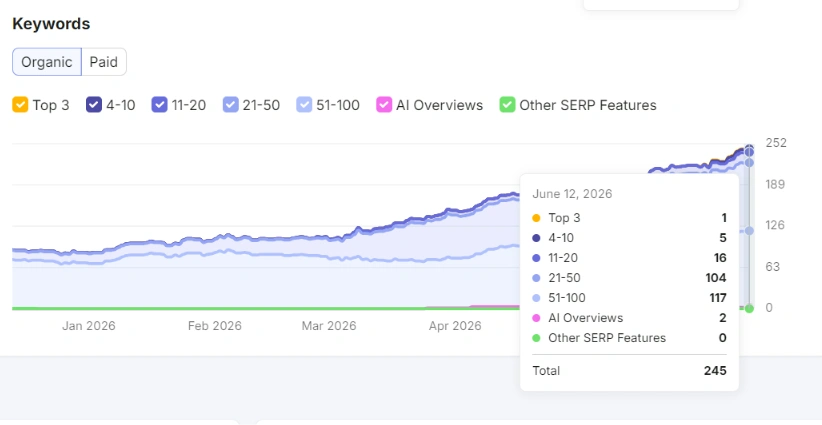
Authority isn’t built in a week. It’s built through consistent effort over time.
Better Long-Term Return on Investment
One of the biggest advantages of ongoing monthly SEO services is that they continue building on previous work. With paid advertising, visibility often disappears the moment you stop spending.
SEO works differently. The improvements you make today can continue delivering value months or even years later if they’re properly maintained. While SEO requires patience, it often becomes one of the most cost-effective marketing channels for businesses that stick with it long enough to see the benefits accumulate.
The goal isn’t just to increase rankings. It’s to create a website that continues attracting relevant visitors and enquiries long after the initial work has been completed.
Understanding these benefits is helpful, but it also raises an important question. What does ongoing SEO actually involve on a month-to-month basis?
| Area | One-Time SEO | Ongoing SEO | Why It Matters |
|---|---|---|---|
| Content Updates | Optimized once and rarely reviewed. | Regularly updated and improved. | Fresh content stays relevant and competitive. |
| Keyword Targeting | Targets keywords at launch. | Adjusts as search trends change. | Helps attract visitors searching today, not last year. |
| Technical SEO | Initial issues are fixed. | Continuous audits and maintenance. | Prevents problems that can hurt rankings and enquiries. |
| Competitor Monitoring | Little or no ongoing review. | Tracks competitor activity regularly. | Helps maintain visibility in competitive markets. |
| Algorithm Updates | May become outdated over time. | Adapts to search engine changes. | Protects rankings when Google updates its systems. |
| Traffic Growth | Often slows after initial gains. | Builds steadily over time. | Creates more consistent organic traffic. |
| Lead Generation | Can improve temporarily. | Supports long-term enquiry growth. | More opportunities to turn visitors into customers. |
| Long-Term Value | Short-term improvement. | Ongoing business asset. | Delivers sustainable visibility and return on investment. |
Key Components of an Ongoing SEO Strategy
Once business owners understand that SEO requires ongoing attention, the next question is usually:
“What are you actually doing every month?”
It’s a fair question. Good SEO isn’t about making random changes to a website. It’s about consistently improving the areas that help your site remain visible, useful, and competitive. While every website is different, most ongoing SEO maintenance includes the following activities.
Regular Content Updates
Content is one of the first things that becomes outdated. Services evolve, pricing changes, customer questions shift, and competitors publish new information. If your website never changes, it can gradually become less relevant.
That’s why regular content updates are such an important part of ongoing website maintenance. This could mean publishing new blog posts, improving service pages, updating statistics, adding frequently asked questions, or expanding existing content with more useful information.
In my experience, some of the best SEO gains come from improving content that’s already on a website rather than constantly creating new pages. Sometimes a page only needs a few meaningful updates to start performing better again.
📊 Ahrefs found that only 5.7% of newly published pages reach Google's top 10 results within one year.
Why it matters:
This shows that SEO success rarely comes from publishing content once and walking away. Most pages require ongoing improvements, content updates, internal linking, and authority building before they become strong traffic drivers.
Source: Ahrefs
Ongoing Keyword Research
Many people think keyword research is something you do once at the beginning of an SEO campaign. The reality is that search behaviour changes all the time.
New phrases emerge. Customer priorities shift. Competitors begin targeting different topics. What brought visitors to your website last year may not be the same thing people are searching for today.
Regular keyword research helps identify new opportunities and ensures existing pages continue targeting the terms that matter most to potential customers. This helps keep your content aligned with real search demand rather than relying on outdated assumptions.
Technical Website Checks
Not all SEO work is visible. Some of the most important improvements happen behind the scenes.
Websites naturally develop issues over time. Pages break, redirects fail, images slow down loading speeds, and technical errors appear without anyone noticing. Part of ongoing SEO management involves regularly checking for these problems and fixing them before they affect performance.
I’ve reviewed websites that lost visibility simply because technical issues had been quietly building up for months. Last month, I checked a client’s website in Google Search Console. I noticed an issue: some pages had been crawled but not indexed by Google. I noted down those pages and began updating their content, adding internal links, and building backlinks. Now, after a month of continuous SEO work, those pages are ranking well.
Most business owners never noticed the problems because everything looked normal on the surface. Regular audits help catch these issues early and keep the website running smoothly.
Building Authority and Trust
Search engines look at more than what’s on your website. They also pay attention to signals that indicate whether your business is trusted and respected online. This is where link building and off-page SEO play a role.
That doesn’t mean chasing hundreds of low-quality links. In fact, those often cause more harm than good. A better approach is earning mentions, links, and visibility from relevant websites within your industry. Over time, these signals help strengthen your website’s authority and make it easier to compete for valuable search terms.
For local businesses, this can also include maintaining an accurate Google Business Profile and ensuring business information remains consistent across the web.
Tracking Performance and Making Adjustments
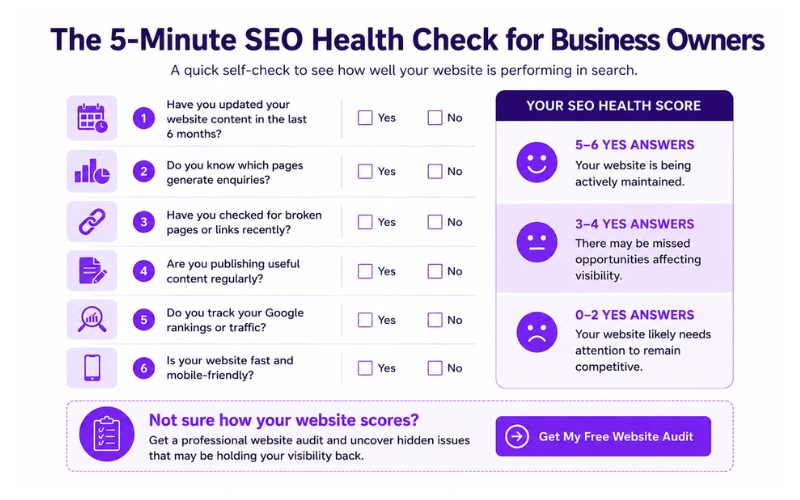
One of the biggest mistakes I see is businesses making changes without measuring the results. Good SEO is guided by data, not guesswork. That’s why ongoing monitoring is such an important part of the process.
By reviewing traffic trends, rankings, enquiries, and user behaviour, it’s possible to see what’s working and where improvements are needed.
For example, a page that attracts plenty of visitors but generates very few enquiries may need stronger messaging or a better user experience. A page that’s slowly losing visibility may need updated content or a new angle. These insights help guide future decisions and prevent time being wasted on activities that aren’t producing results.
Avoiding Common SEO Mistakes
Part of maintaining strong search visibility is avoiding practices that create problems.
I’ve seen websites hurt their own performance by forcing keywords into every sentence, neglecting mobile users, or publishing content purely for search engines rather than real people.
The most effective SEO strategies focus on helping visitors first. When content is useful, easy to navigate, and answers genuine questions, it tends to perform better over the long term.
The goal isn’t to outsmart search engines. The goal is to create a website that genuinely deserves visibility because it provides value to the people searching.
Looking at these activities individually can make SEO seem like a collection of separate tasks. In reality, they work together as part of a long-term strategy designed to keep your website growing and generating opportunities over time.
Do You Need Ongoing SEO Maintenance?
If your website is meant to attract customers, generate enquiries, or compete in search results, ongoing SEO maintenance is usually necessary. That doesn’t mean you need a massive monthly campaign or constant redesigns. It means your website should continue evolving as your business, your customers, and search engines change.
A website that stays untouched for years often becomes less accurate, less competitive, and less visible over time.
When ongoing SEO becomes especially important
- Your business changes regularly: If you add new services, target new locations, change pricing, or adjust your positioning, your website needs to reflect those changes. Search engines and customers both rely on current information.
- You’re in a competitive market: In industries where competitors are actively investing in SEO, standing still usually means falling behind. Even strong rankings can slip if competitors keep improving while your site remains the same.
- Your traffic or enquiries are declining: A gradual drop in organic traffic is often a sign that your website needs attention. Content may be outdated, technical issues may have appeared, or competitors may be answering customer questions more effectively.
- You rely heavily on paid ads: Paid ads can work well, but they stop the moment you stop paying. Ongoing SEO helps build a more sustainable source of visibility and enquiries over time
What ongoing SEO management usually includes
A typical ongoing SEO setup often involves:
- Regular technical checks and fixes
- Content updates and new content creation
- Keyword tracking and strategy adjustments
- Link-building or authority-building efforts
- Performance reporting and recommendations
The exact mix depends on your business and goals, but the key is consistency. Small improvements made regularly tend to outperform large one-time efforts that are never revisited.
SEO and website maintenance go together
It’s also worth remembering that SEO is closely connected to general website upkeep. Things like plugin updates, backups, page speed, mobile usability, and fixing broken features all affect how users experience your site. And user experience plays a big role in SEO performance.
I’ve seen websites with decent content struggle simply because the site was slow, outdated, or difficult to use on mobile devices. Good ongoing website maintenance supports good SEO.
In my experience working with various clients over the past decade, I have observed that they frequently require website updates – such as publishing new blog posts, creating service pages, and updating existing content like case studies and pricing details.
Before implementing these updates, it is crucial to conduct SEO research and understand user intent. Subsequently, optimizing the content in accordance with SEO best practices helps the website rank for new keywords and achieve better rankings through the fresh content.
Do you need an agency or specialist?
Not every business needs a large agency. Some companies handle parts of SEO internally, especially if they already have someone managing content and website updates.
But if SEO isn’t a core skill in your business, outside support can save a lot of time and prevent costly mistakes. An experienced SEO consultant or agency brings tools, technical knowledge, and the ability to spot issues that are easy to miss.
The important thing is not who does the work. It’s that the work happens consistently. A website that is actively maintained, updated, and improved has a much better chance of staying visible and generating enquiries than one that was optimized once and then left alone.
Final Thoughts: Treat SEO Like an Ongoing Business Asset
If there’s one thing I hope you take away from this article, it’s that SEO isn’t something you finish. It’s something you maintain.
Many business owners invest significant time and money into launching a website, only to assume the work ends there. Then months later, they’re left wondering why rankings have slipped, traffic has slowed down, or enquiries have become less consistent.
In most cases, the problem isn’t that the website was built incorrectly. It’s that nothing happened after launch.
A website is a business asset, just like your reputation, customer relationships, or service quality. The more attention you give it, the more value it can create over time.
In my experience, the businesses that get the most from SEO aren’t necessarily the ones with the biggest budgets. They’re usually the ones that stay consistent.
They continue improving their content, monitoring performance, fixing issues, and adapting when things change.
Small improvements made month after month often outperform large one-off projects that are never revisited. The good news is that ongoing SEO doesn’t require constant major changes. Often, it’s the accumulation of smaller actions that produces the strongest long-term results.
Not Sure If Your SEO Is Stalling?
Get a clear review of issues affecting visibility and enquiries.
Updating important pages. Publishing helpful content. Improving user experience. Fixing technical issues before they become bigger problems. These activities may seem minor individually, but together they help create a website that continues attracting the right visitors and generating opportunities for your business.
So instead of viewing SEO as a project with an end date, think of it as an ongoing investment in your website’s visibility, credibility, and growth. Because the businesses that continue showing up in search results years from now will rarely be the ones that optimized their website once.
They’ll be the ones that never stopped improving it.
FAQs
What is ongoing SEO?
Ongoing SEO is the continuous process of improving and maintaining your website’s visibility in search results. It includes updating content, monitoring performance, fixing technical issues, and adapting to changes in search behaviour.
Unlike a one-time SEO project, ongoing SEO focuses on long-term growth. The goal is to help your website remain competitive and continue attracting relevant visitors over time.
Why is SEO considered an ongoing process?
SEO is ongoing because search engines, competitors, and customer behaviour are constantly changing. What helps a page rank today may not be enough six months from now.
Google regularly updates its search systems, competitors improve their websites, and new search trends emerge. Ongoing SEO helps your website adapt to these changes instead of gradually losing visibility.
Does my business need ongoing SEO maintenance?
If your website plays an important role in generating enquiries, leads, or sales, then ongoing SEO maintenance is usually beneficial. Most businesses operate in competitive markets where standing still often means falling behind. Regular updates help keep your content accurate, your website healthy, and your search visibility stable as your business and industry evolve.
What's the difference between one-time SEO and ongoing SEO?
One-time SEO focuses on fixing immediate issues such as page optimization, technical errors, or initial keyword targeting. It can improve a website, but the impact often decreases over time if no further work is done.
Ongoing SEO builds on those improvements through regular updates, monitoring, and optimization. It helps protect and strengthen rankings over the long term.
What do ongoing monthly SEO services typically include?
Most ongoing monthly SEO services include content updates, keyword research, technical website checks, performance monitoring, and recommendations for improvement. Some strategies may also include link-building, local SEO work, or creating new content. The exact tasks depend on the website’s goals, industry, and level of competition.
How long does it take to see results from ongoing SEO?
Most businesses start seeing meaningful SEO improvements within three to six months, although timelines vary depending on competition, website history, and current performance.
SEO is a gradual process rather than an instant solution. The businesses that usually see the strongest results are those that stay consistent and focus on long-term improvements.
What is ongoing website maintenance and how does it help SEO?
Ongoing website maintenance involves regularly updating, monitoring, and improving your website to keep it secure, functional, and user-friendly.
This includes tasks such as updating plugins, fixing broken links, improving page speed, and resolving technical issues. A well-maintained website provides a better experience for visitors and supports stronger SEO performance.
Deepak Sharma is an SEO consultant with over 10 years of experience helping small businesses improve their visibility on Google and generate more enquiries. He focuses on practical, long-term SEO strategies, ongoing website improvements, and real-world optimizations that help businesses stay competitive and continue growing online.
Relevant Blogs
- 27 Important Questions to Ask an SEO Company Before Signing Any Contract
- How to Find the Best SEO Company for Hotels (2026 Guide)
- 17 Affordable SEO Tools from Lowest to Highest Prices
- The Ultimate Guide to Programmatic SEO Tools
- Why Website Speed Still Shapes SEO More Than Most Strategy Changes
- Top 6 Free Keyword Research Tools in SEO