How to Choose the Right google ads agency Costa Mesa
Choosing the right Google Ads agency in Costa Mesa takes more than comparing prices or promises of more traffic. Businesses need an agency that understands their goals, targets the right audience, tracks meaningful conversions, and focuses on generating quality leads or sales. This guide covers the key things to look for, from keyword research and local targeting to landing page experience, campaign management, reporting, and account ownership, so you can make a confident decision before investing in paid advertising.

Santosh Sharma
SEO Operations Lead
Nov 16, 2026 | 6 min. read
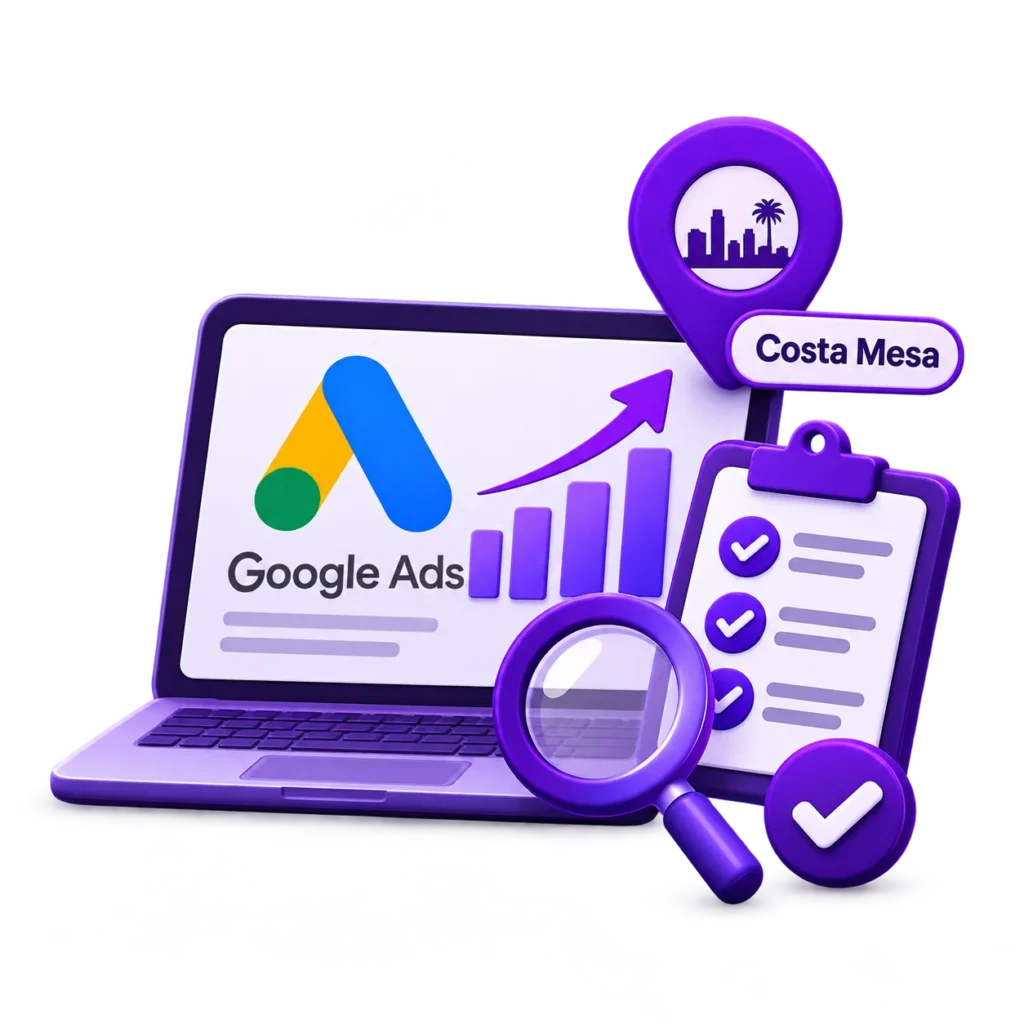
Table of the content
- Start With Your Actual Advertising Goal
- Look for Relevant Google Ads Expertise
- Ask How Keyword Research Is Handled
- Make Sure Conversion Tracking Comes First
- Understand How the Agency Measures Performance
- Pay Attention to Landing Page Strategy
- Ask What Happens After the Campaign Launches
- Watch for Unrealistic Promises
- Clarify Pricing and Account Ownership
- Choose Communication Over Salesmanship
- Making the Final Decision
Choosing a Google Ads agency Costa Mesa can feel surprisingly difficult when nearly every agency promises more traffic, better leads, and a stronger return on ad spend.
The real question isn’t whether an agency knows how to launch a paid search campaign, but whether it can turn advertising dollars into measurable business growth.
For a Costa Mesa business, that means looking beyond polished presentations and asking practical questions about strategy, targeting, conversion tracking, reporting, and ongoing campaign management.
A capable google ads agency Costa Mesa should be able to explain exactly how it plans to connect search intent with the products or services customers are actively looking for.
Start With Your Actual Advertising Goal
Before comparing agencies, define what you expect Google Ads to accomplish for your business.
A dental practice might want more appointment requests, while a local home services company may care primarily about qualified phone calls.
An e-commerce retailer, meanwhile, could be focused on profitable purchases and maintaining a specific return on ad spend.
Those differences matter because a campaign designed around clicks will look very different from one built around revenue, booked consultations, or cost per qualified lead.
A good paid search partner should ask about these goals before recommending budgets, keywords, or campaign structure.
If the conversation immediately jumps to monthly ad spend without discussing what a successful customer action looks like, that is worth questioning.
Look for Relevant Google Ads Expertise
Google Ads includes far more than bidding on a handful of keywords and writing two lines of promotional copy.
Modern PPC management can involve Search campaigns, Performance Max, Shopping ads, remarketing, audience targeting, negative keywords, automated bidding, location settings, conversion tracking, and landing page optimization.
The right agency does not necessarily need experience with a business identical to yours, but it should understand the economics behind your type of customer journey.
For example, a company selling a $40 consumer product online requires a different acquisition strategy from a remodeling contractor trying to generate leads for projects worth tens of thousands of dollars.
Ask potential agencies how they would approach your sales cycle, average customer value, geographic market, and typical conversion process.
Their answers should demonstrate strategic thinking rather than simply listing Google Ads features.
Ask How Keyword Research Is Handled
Keyword selection is still one of the foundations of successful search advertising.
The strongest campaigns focus not simply on high-volume searches, but on queries that indicate meaningful commercial intent.
Imagine a Costa Mesa fitness studio offering private training sessions.
A broad phrase such as fitness tips may generate plenty of searches, but someone searching personal trainer near Costa Mesa is likely much closer to making a purchase.
An effective PPC agency should distinguish between informational traffic and searches that are likely to produce customers.
It should also continuously review search terms and add negative keywords to prevent the budget from disappearing into irrelevant clicks.
Local Targeting Deserves Extra Attention
Geographic targeting is particularly important for businesses that serve customers within a defined area.
A restaurant, dental office, contractor, salon, or professional service provider usually gains little from paying for clicks generated far outside its realistic service radius.
Ask how the agency approaches location targeting and whether campaigns will be segmented around specific cities, neighborhoods, or service areas when appropriate.
Small targeting decisions can have a noticeable impact when every click costs money.
Make Sure Conversion Tracking Comes First
One of the biggest mistakes in paid advertising is judging success primarily by impressions and clicks.
Those numbers show activity, but they do not necessarily show business results.
Suppose a campaign generates 1,500 clicks in one month but only three legitimate inquiries.
Another campaign produces 450 clicks and 28 qualified leads at a sustainable acquisition cost.
The second campaign clearly creates more value even though its traffic numbers look less impressive.
A reliable agency should track meaningful actions such as calls, contact form submissions, purchases, booked appointments, or other conversions tied to the business objective.
Without accurate conversion tracking, optimization becomes guesswork because neither the business nor the agency can confidently identify which keywords, ads, and campaigns are producing results.
Understand How the Agency Measures Performance
Reporting should answer business questions rather than overwhelm clients with advertising terminology.
You should be able to understand how much was spent, what that investment produced, where conversions came from, and what the agency plans to improve next.
Useful PPC metrics may include cost per click, conversion rate, cost per acquisition, conversion value, impression share, search terms, and return on ad spend.
The metrics that matter most will depend on your business model.
For a lead-generation company, 40 leads at $80 each may sound encouraging until the sales team reveals that only five were genuine prospects.
That is why strong campaign management looks beyond the advertising dashboard and considers lead quality whenever possible.
Pay Attention to Landing Page Strategy
Even an excellent advertisement cannot compensate indefinitely for a weak landing page.
If someone clicks an ad for emergency plumbing and lands on a generic homepage filled with unrelated services, the visitor has to work harder to find what was promised.
That friction can reduce conversion rates and increase acquisition costs.
A thoughtful agency should review what happens after the click and identify obvious problems with messaging, page speed, mobile usability, calls to action, forms, or offer clarity.
Message Consistency Matters
The advertisement and landing page should feel like parts of the same conversation.
If an ad promotes a free consultation, the landing page should make that consultation immediately visible rather than forcing visitors to search for it.
If an ad focuses on a particular service, the destination page should continue discussing that service in clear language.
This consistency reassures visitors that they reached the right place and makes the next action easier.
RReady to Turn More Google Searches Into Customers?
Build a smarter digital marketing strategy with Digital Deep Tech. Let’s improve your online visibility, attract the right audience, and generate more qualified leads for your business.
Ask What Happens After the Campaign Launches
Google Ads management should not be treated as a one-time setup project.
Search behavior changes, competitors adjust bids, new search terms appear, and individual advertisements can become more or less effective over time.
Ongoing optimization may involve adjusting bids, testing ad copy, reviewing search terms, refining audiences, reallocating budgets, improving landing pages, and pausing keywords that consistently waste money.
Ask how frequently campaigns are reviewed and what types of optimizations are normally made.
An agency should be able to describe a clear management process rather than vaguely promising that campaigns will be monitored.
Watch for Unrealistic Promises
Guaranteed rankings, guaranteed lead volumes, or claims of instant profitability should be treated cautiously.
Paid search can produce results quickly compared with many marketing channels, but performance still depends on competition, pricing, customer demand, landing pages, budgets, and the strength of the underlying offer.
A trustworthy advertising partner should be comfortable discussing those limitations.
It should also be willing to explain what happens when a campaign underperforms and how the strategy would be adjusted.
That conversation often reveals more about an agency than a presentation filled with best-case results.
Clarify Pricing and Account Ownership
Before signing an agreement, understand exactly what you are paying for.
Ask whether management fees are fixed, percentage-based, or structured around another pricing model, and determine whether creative work, landing pages, tracking setup, or reporting carry additional charges.
You should also clarify who owns the Google Ads account, campaign data, conversion tracking setup, and creative assets.
Businesses benefit from maintaining access to their advertising history because years of search terms, conversion information, and campaign performance can become valuable marketing data.
Transparency at the beginning prevents unnecessary disputes later.
Choose Communication Over Salesmanship
The best agency relationship is usually built around clear communication rather than impressive jargon.
You should feel comfortable asking why a campaign changed, why a certain keyword was paused, or why the budget is being shifted from one campaign to another.
Good strategists can explain complicated advertising decisions in straightforward language.
They should also be willing to tell you when an idea is unlikely to work instead of agreeing with every request simply to keep the relationship comfortable.
Making the Final Decision
Choosing the right paid search partner ultimately comes down to strategy, transparency, measurement, and fit.
Compare agencies based on how well they understand your business goals, how seriously they approach conversion tracking, and whether they can explain their decisions without hiding behind vanity metrics.
Ask specific questions about keyword research, geographic targeting, landing pages, reporting, optimization, fees, and account ownership before committing.
The strongest partner will not simply promise to generate more clicks.
It will have a credible plan for turning relevant searches into valuable customer actions while continually using real campaign data to improve performance.

Santosh Sharma is part of the SEO team at Digital Deep Tech, helping businesses improve their search visibility and connect with the right audience online. He focuses on creating useful, search-friendly content and sharing practical digital marketing insights that businesses can apply to build a stronger online presence and achieve sustainable growth.
Relevant Blogs
- Why Ongoing SEO Matters More Than a One-Time Website Fix
- 27 Important Questions to Ask an SEO Company Before
- How to Find the Best SEO Company for
- Google Business Profile Mistakes Losing You Leads
- How to Choose the Best Voice SEO Company in 2026?
- SEO for Fitness Businesses: How Gyms & Trainers Get Clients from Google