
How to Build an SEO Campaign That Actually Brings Leads, Not Just Rankings
Learn how to build an SEO campaign that focuses on more than search rankings. This guide explains how to connect keyword research, website improvements, content, conversion paths, local SEO, and lead tracking so your organic traffic has a better chance of turning into real business enquiries.

Deepak Sharma
SEO Consultant
Sept. 26, 2026 | 6 min. read
Table of the content
- Introduction
- What Is an SEO Campaign?
- Start With the Business Goal, Not the Keyword List
- My First Step: Understand the Website Before Changing It
- Build a 3-6 Month SEO Roadmap
- Connect Google Search Console and Analytics
- Build an SEO KPI Dashboard That Your Client Can Actually Understand
- Don't Report Every SEO Activity as a Result
- How I Structure an SEO Campaign
- A Real Example: Turning Local SEO Into More Enquiries
- Why SEO Campaigns Fail Even When Rankings Improve
- Consistency Matters More Than Constantly Changing Strategy
- How to Prioritize SEO Work
- SEO Campaign vs. SEO Strategy: What's the Difference?
- What a 6-Month Lead-Focused SEO Campaign Can Look Like
- The Goal Isn't More Traffic. It's More Valuable Traffic.
- FAQs
- Final Thoughts: Build SEO Around the Business, Not the Ranking Report
Introduction
Getting a website to rank is not the same as getting a business more customers.
A page can rank in Google’s search results, attract thousands of visitors, and still produce very few enquiries. I’ve seen this problem repeatedly: businesses celebrate ranking improvements while the phone stays quiet and contact forms remain empty.
A better SEO campaign starts with a different question:
What does the business actually want SEO to achieve?
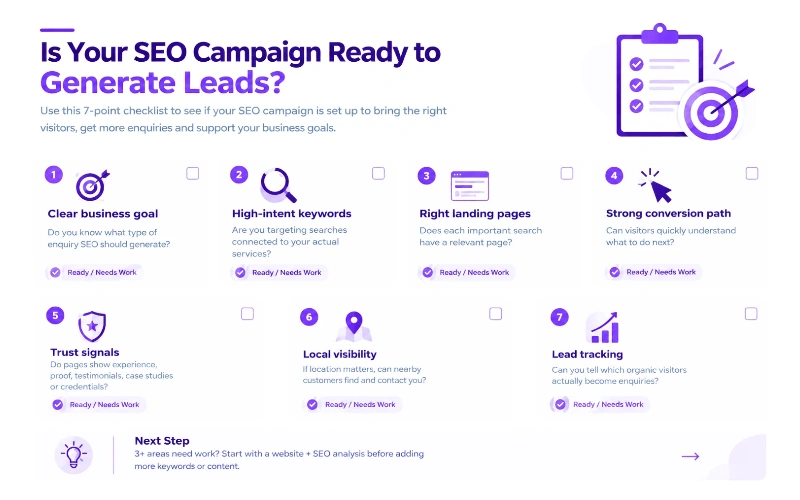
For many service businesses, the answer is qualified enquiries. That means the SEO strategy cannot stop at keywords and rankings. It needs to connect search demand with the right pages, useful content, clear calls to action, conversion tracking, and ultimately business results.
I’ve spent more than 10 years working on SEO campaigns, and one lesson has become very clear to me:
there is no single SEO factor that creates organic growth.
The campaign has to fit the website, business, competition, audience, location, services, existing authority, and current SEO condition.
This guide explains how I approach an SEO campaign, from the first website analysis through the 3-6 month roadmap and ongoing SEO measurement.
What Is an SEO Campaign?
An SEO campaign is a structured plan for improving a website’s visibility in organic search and achieving specific business objectives.
Typical SEO campaign activities include:
- Website and technical SEO analysis
- Keyword research
- Search intent analysis
- Competitor research
- Website structure improvements
- Existing content optimization
- New service pages
- Blog content
- Internal linking
- Link building
- Local SEO
- Conversion optimization
- Performance tracking
Most traditional SEO campaign guides focus heavily on rankings, traffic, content, and backlinks. Those are important, but they are not the final destination.
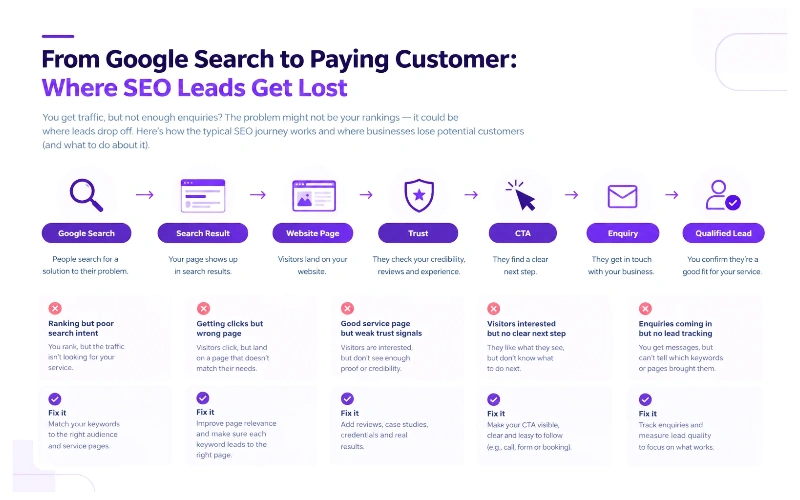
For a lead-generation business, the actual journey looks more like this:
Search → Ranking → Click → Relevant page → Trust → CTA → Enquiry → Qualified lead → Customer
If your SEO campaign improves only the first two steps, you haven’t solved the whole problem.
76% of B2B buyers say they avoid suppliers with a poor website experience
Why it matters:
Getting an SEO visitor to your website is only part of the job. The website still needs to make visitors comfortable enough to consider contacting the business. This directly supports the blog’s focus on turning search traffic into enquiries rather than treating rankings and traffic as the final goal.
Source: Gartner, Quick Answer: Design Websites With Features That B2B Buyers Want
Start With the Business Goal, Not the Keyword List
One of the easiest mistakes to make is opening an SEO tool and immediately starting keyword research.
I prefer to start with the business.
Before deciding which keywords to target, I want to understand:
- What services does the business want to sell?
- Which services are most profitable?
- Who is the ideal customer?
- Which locations matter?
- What type of enquiries are valuable?
- What does a qualified lead look like?
- Which services already generate business?
- Which services need more visibility?
- What is the sales process after someone contacts the business?
- What has already been done for SEO?
- What has worked or failed in the past?
This changes the entire campaign.
For example, imagine a service business has 50 keywords it could target.
A typical SEO campaign might prioritize them based on search volume.
A lead-focused campaign asks a different question:
Which searches are most likely to bring the right potential customer to the business?
A keyword with 200 monthly searches from highly relevant prospects can be more valuable than a keyword with 10,000 searches from people who will never become customers.
That is why search volume should not be the only factor in keyword selection.
My First Step: Understand the Website Before Changing It
This is one of the biggest lessons I’ve learned during my SEO career.
When I start working on a website, I don’t want to immediately start publishing blogs or building backlinks.
The first week is primarily about understanding the website.
I review the existing SEO condition, including:
- Website structure
- Existing service pages
- Existing blog content
- Technical issues
- Indexing
- Internal links
- Current keyword visibility
- Search Console data
- Organic traffic
- Competitor visibility
- Existing backlinks
- Search intent
- Conversion paths
- Calls to action
- Target locations
- Business priorities
I also look at the history of the website.
A website that has existed for five years with hundreds of pages requires a different strategy from a six-month-old website with 20 pages.
Likewise, a business already ranking on page two for valuable keywords may need a different approach from a business with almost no organic visibility.
This is why I don’t believe in copy-paste SEO campaigns.
The workflow can be similar. The strategy should not be.
Build a 3-6 Month SEO Roadmap
Once the website analysis is complete, I turn the findings into a roadmap.
I generally plan the next three to six months rather than treating SEO as a collection of disconnected monthly tasks.
The roadmap should answer:
- What needs fixing?
- What opportunities should we target?
- Which pages should be improved?
- Which new pages should be created?
- Which keywords deserve priority?
- What content needs to be published?
- What authority needs to be built?
- What conversion improvements are needed?
- What should be measured?
- What should happen each month?
For example:
| Period | Main Focus |
|---|---|
| Weeks 1-2 | Audit, research, tracking, technical priorities |
| Month 1 | Fix important website issues and improve structure |
| Month 2 | Optimize key service pages and create priority pages |
| Month 3 | Publish supporting content, improve internal linking, begin/expand authority building |
| Month 4 | Review search performance and conversion data, expand successful topics |
| Month 5 | Strengthen pages with growth potential and address content gaps |
| Month 6 | Evaluate leads, rankings, traffic, conversions and plan the next phase |
This isn’t a rigid template.
If a website has serious technical problems, technical work may take priority.
If the website is technically healthy but lacks relevant service pages, content and site architecture may come first.
If rankings are strong but enquiries are weak, conversion optimization may become the priority.
Step 1: Audit the Website and Find the Highest-Value Problems
An SEO audit can produce a huge list of issues.
That doesn’t mean you should fix everything immediately.
A better question is:
Which problems are most likely to affect search visibility, user experience, or business results?
I normally look at several areas.
Technical SEO
Check:
- Crawlability
- Indexing
- XML sitemap
- Robots.txt
- Canonicalization
- Redirects
- Broken links
- Duplicate pages
- Mobile usability
- Page performance
- HTTPS
- Structured data where appropriate
On-Page SEO
Review:
- Title tags
- Meta descriptions
- H1s and headings
- Content relevance
- Search intent
- Internal links
- Image optimization
- Page structure
- Keyword targeting
Website Architecture
Look at:
- Main navigation
- Service hierarchy
- Category structure
- Location pages
- Blog organization
- Internal linking
- Orphan pages
- Important pages that are buried too deeply
Conversion Experience
This is where many SEO campaigns fall short.
Ask:
- Can visitors quickly understand what the company does?
- Is it obvious who the service is for?
- Is there a clear next step?
- Can someone easily call?
- Is the enquiry form simple?
- Are trust signals visible?
- Are service benefits clear?
- Does the page answer common objections?
A technically clean website can still be a poor lead-generation website.
Step 2: Research Keywords Based on Business Value
Keyword research should answer more than:
“How many people search for this phrase?”
It should answer:
“What does this search tell us about the person searching?”
I usually divide keywords into different intent groups.
Informational searches
The person is looking for information.
Examples:
- how does SEO work
- how to improve Google rankings
- SEO campaign checklist
These searches can be valuable for building awareness and topical authority.
But they don’t always produce immediate leads.
Commercial investigation searches
The person is researching solutions.
Examples:
- best SEO company for small business
- SEO agency for service businesses
- SEO campaign services
These searches are closer to a buying decision.
Transactional searches
The person is ready to take action.
Examples:
- SEO consultant near me
- SEO services for small business
- local SEO agency
- SEO strategy consultant
These searches can have strong commercial value even when their search volume is relatively modest.
Don't Let Search Volume Decide Everything
Suppose you’re comparing these two keywords:
| Keyword | Monthly Searches | Intent | Potential Value |
|---|---|---|---|
| SEO | High | Broad | Low for a specific service business |
| SEO strategy services | Lower | Commercial | Potentially much higher |
The first keyword may look better inside an SEO tool.
The second may be much closer to the business’s actual revenue.
This is why I prefer to score keywords using several factors:
Business relevance + search intent + competition + current visibility + conversion potential
Search volume is useful, but it is only one part of the decision.
Step 3: Map Keywords to the Right Pages
Finding keywords is not enough.
You need to decide where each keyword belongs.
For example:
| Search Intent | Better Page Type |
|---|---|
| “SEO services for dentists” | Service/industry page |
| “local SEO services” | Service page |
| “how to improve local SEO” | Blog/guide |
| “SEO campaign” | Educational service/guide |
| “SEO agency near me” | Local/service page |
| “how much does SEO cost” | Commercial guide |
This prevents one of the common problems I see in SEO campaigns: trying to make one page rank for everything.
Your homepage shouldn’t have to rank for every service.
A blog post shouldn’t have to sell every service.
A service page shouldn’t be stuffed with unrelated informational topics.
Each important search intent should have an appropriate destination.
Step 4: Fix the Website Structure Before Publishing Hundreds of Blogs
More content isn’t automatically better SEO.
If the website structure is confusing, adding another 50 blog posts may only create more pages to manage.
For a service business, I usually want a clear structure such as:
Homepage → Core Services → Specific Services → Supporting Content
For example:
SEO Services
→ Local SEO
→ Technical SEO
→ On-Page SEO
→ SEO Strategy
→ Keyword Research
→ Content Optimization
Then supporting blog content can answer questions related to those services.
Internal links connect the content together.
This gives both users and search engines a clearer understanding of how the website’s topics relate to each other.
Step 5: Improve Existing Pages Before Creating Everything From Scratch
One of the most overlooked SEO opportunities is the content you already have.
Before creating a new page, check whether an existing page already has:
- Search impressions
- Clicks
- Rankings
- Relevant backlinks
- Historical traffic
- Existing topical relevance
Google Search Console can show the queries, pages, clicks, impressions, CTR, and average position associated with your site’s search performance.
It can also help identify pages with high impressions but relatively low CTR, which may create opportunities to improve titles, snippets, or content alignment.
For example, if a page is already appearing for valuable searches but sitting around positions 8-20, improving that page may be more efficient than starting an entirely new article.
Look for opportunities such as:
- Updating outdated information
- Improving search intent alignment
- Strengthening the introduction
- Adding missing subtopics
- Improving headings
- Adding internal links
- Improving CTAs
- Adding useful examples
- Clarifying service information
- Consolidating overlapping content
SEO is often about improving assets you already own.
Step 6: Create Service Pages That Can Actually Generate Leads
For a lead-generation campaign, service pages are extremely important.
A blog can attract someone who wants information.
A service page can attract someone who is considering buying.
A good service page should answer questions such as:
- What is the service?
- Who is it for?
- What problem does it solve?
- What does the service include?
- Why does the business need it?
- What makes the approach different?
- What should the customer expect?
- What are the next steps?
It should also make the conversion path obvious.
Don’t make someone search through your website to figure out how to contact you.
Step 7: Create Content Around Real Search Questions
Blog content still has an important role in an SEO campaign.
But I don’t recommend publishing articles simply because a keyword has search volume.
Start with the questions your potential customers actually have.
For example, an SEO agency targeting small businesses could create content around:
- How much does SEO cost for a small business?
- How long does SEO take to work?
- Why is my website getting traffic but no leads?
- How do I choose the right SEO keywords?
- What should an SEO campaign include?
- How can local SEO generate more enquiries?
- What should I track from an SEO campaign?
The goal isn’t to create a large blog archive.
The goal is to build a useful collection of content that supports the customer journey.
Step 8: Connect SEO Traffic With Conversion Optimization
This is where I believe many SEO campaigns miss an important opportunity.
Imagine you increase organic traffic from 1,000 to 3,000 visitors per month.
That sounds excellent.
But if enquiries remain at 10 per month, the campaign hasn’t necessarily created the business improvement you expected.
Now imagine traffic increases from 1,000 to 2,000 visitors, but enquiries increase from 10 to 30.
The second scenario may be much more valuable.
That is why SEO and conversion optimization should work together.
Look at:
- CTA placement
- Contact forms
- Phone numbers
- Booking buttons
- Service page messaging
- Trust signals
- Testimonials
- Case studies
- Pricing information where appropriate
- Page layout
- Mobile experience
- User objections
Sometimes the next SEO improvement isn’t another keyword.
It is improving what happens after the visitor arrives.
A Simple SEO Lead Funnel
For a service business, I think about the SEO funnel like this:
Search query
↓
Relevant Google result
↓
Landing page
↓
Useful information
↓
Trust
↓
Clear CTA
↓
Enquiry
↓
Qualified lead
↓
Customer
Each stage can have a problem.
For example:
- Wrong keyword → wrong visitor
- Poor title → no click
- Irrelevant landing page → quick exit
- Weak content → low trust
- Poor CTA → no action
- Bad form → abandoned enquiry
- No tracking → you don’t know what worked
An SEO campaign should try to identify where the actual bottleneck is.
Step 9: Use Local SEO When Location Matters
For local service businesses, location can fundamentally change the SEO strategy.
A business serving customers in one city doesn’t necessarily need to compete nationally for broad keywords.
Instead, the campaign may focus on:
- Local service pages
- Google Business Profile
- Location-specific search intent
- Local citations where relevant
- Reviews
- Local content
- Service + location queries
- Internal links between service and location pages
The important thing is to avoid creating thin location pages simply by changing the city name.
A useful location page should contain genuine information relevant to customers in that area.
Step 10: Build Authority With Relevant Links
For local service businesses, location can fundamentally change the SEO strategy.
A business serving customers in one city doesn’t necessarily need to compete nationally for broad keywords.
Instead, the campaign may focus on:
- Local service pages
- Google Business Profile
- Location-specific search intent
- Local citations where relevant
- Reviews
- Local content
- Service + location queries
- Internal links between service and location pages
The important thing is to avoid creating thin location pages simply by changing the city name.
A useful location page should contain genuine information relevant to customers in that area.
Step 11: Track Rankings, But Don't Make Them the Goal
Rankings are useful.
They tell you whether your visibility is improving for the queries you’re targeting.
But rankings alone don’t tell you whether the campaign is producing business.
Google Search Console provides useful search-performance data including clicks, impressions, CTR and average position. Google recommends looking at trends in clicks and impressions rather than relying on position alone.
I would divide SEO metrics into three levels.
Level 1: Visibility metrics
Track:
- Impressions
- Rankings
- Search visibility
- Indexed pages
- Keyword coverage
These tell you whether the website is becoming more visible.
Level 2: Traffic metrics
Track:
- Organic clicks
- Organic sessions
- Landing pages
- New organic users
- Country
- Device
- Non-branded search growth
These tell you whether visibility is turning into visits.
Level 3: Business metrics
Track:
- Form submissions
- Phone calls
- Bookings
- Quote requests
- Qualified leads
- Sales opportunities
- Revenue influenced by organic search
These tell you whether SEO is contributing to the business.
Level 3 is where a lead-generation SEO campaign should ultimately prove its value.
Connect Google Search Console and Analytics
Search Console tells you what happens in Google Search.
Analytics helps you understand what happens after people reach your website.
When Search Console and Google Analytics are connected, you can analyze organic search queries and landing pages alongside Analytics information such as user behavior and key events.
That connection helps answer more useful questions.
For example:
Which pages are getting organic traffic?
Then:
Which of those pages are generating enquiries?
Then:
Which search topics are associated with those pages?
And finally:
Should we invest more resources in that topic?
That is much more useful than reporting:
“We increased rankings by 32%.”
Build an SEO KPI Dashboard That Your Client Can Actually Understand
An SEO report shouldn’t overwhelm a business owner with 40 metrics.
A simple monthly dashboard could include:
| KPI | Why It Matters |
|---|---|
| Organic clicks | Measures search traffic from Google |
| Organic impressions | Shows search visibility |
| Target keyword movement | Shows progress for strategic terms |
| Non-branded visibility | Indicates reach beyond existing brand awareness |
| Organic conversion rate | Shows how effectively traffic converts |
| Organic leads | Direct business outcome |
| Qualified leads | Measures lead quality |
| Top-performing pages | Shows where SEO is creating value |
| New content published | Tracks execution |
| Relevant links earned | Tracks authority development |
Search Console can also distinguish branded and non-branded queries, making it easier to understand whether growth is coming from people already familiar with the brand or from broader search discovery.
Don't Report Every SEO Activity as a Result
There is an important difference between an activity and an outcome.
For example:
Activity: Published 8 blogs.
Outcome: Three of those pages started ranking for relevant commercial queries and generated qualified organic enquiries.
Or:
Activity: Built 15 backlinks.
Outcome: Priority service pages gained visibility and started attracting more relevant organic traffic.
Or:
Activity: Optimized 10 pages.
Outcome: Organic clicks and enquiries increased for the targeted service area.
Activities are useful to report because they explain the work.
But outcomes explain the value.
How I Structure an SEO Campaign
After years of working on different websites, my overall process has become fairly consistent.
The process is consistent.
The strategy is not.
My basic framework is:
1. Website analysis and audit
Understand the website’s current condition.
2. Build a 3-6 month roadmap
Prioritize opportunities and define monthly objectives.
3. Improve the website and structure
Fix important technical issues and make the site easier to understand and navigate.
4. Create or improve service pages and content
Build pages around valuable search intent rather than publishing content for the sake of volume.
5. Build quality backlinks and authority
Strengthen important pages through relevant authority-building activities.
6. Focus on local SEO when appropriate
Improve visibility for location-based searches where the business model depends on local customers.
7. Track progress and adjust
Use performance data to determine what should happen next.
This process works because it gives the campaign direction.
But the actual priorities change from project to project.
A Real Example: Turning Local SEO Into More Enquiries
One of my recent projects was Bare Brilliance Aesthetics.
The client wasn’t simply looking for better keyword rankings.
The actual objective was more local SEO enquiries.
So I didn’t build the strategy around rankings alone.
I analyzed the website and then worked on several parts of the customer journey.
The work included:
- Improving the website
- Improving the design
- Strengthening CTAs
- Creating new service pages
- Publishing blog content around relevant customer searches
- Continuing SEO optimization
- Building the overall local search presence
The important lesson wasn’t simply that the rankings improved.
The business started receiving more than 20 calls per month within about three months.
That result reinforced something I’ve learned repeatedly:
SEO becomes much more useful when you understand what the business actually wants before deciding what to optimize.
The keyword is only one part of the campaign.
The page, offer, trust, CTA, location, and tracking all matter too.
Why SEO Campaigns Fail Even When Rankings Improve
A campaign can look successful inside an SEO reporting tool and still disappoint the business.
Here are some common reasons.
1. The campaign targets the wrong keywords
Traffic increases, but visitors aren’t potential customers.
2. The website lacks the right service pages
The business ranks for informational topics but doesn’t have strong commercial destinations.
3. The content answers questions but doesn't guide the visitor
People read the article and leave.
4. CTAs are weak
The visitor is interested but doesn’t know what to do next.
5. Leads aren't tracked correctly
The business gets enquiries, but nobody knows which channel or pages influenced them.
6. The strategy is too generic
The same six-month plan is used for every client.
7. SEO work isn't consistent
A campaign starts strongly, then publishing, optimization, reporting, or link acquisition stops.
8. The business expects immediate results
SEO normally requires sustained work. Some improvements can appear relatively early, while competitive searches may take much longer.
9. The campaign focuses on activity instead of priorities
Publishing 20 articles isn’t automatically better than publishing five highly relevant ones.
10. The website itself doesn't convert
SEO can bring the visitor.
It cannot compensate indefinitely for a confusing offer or poor conversion experience.
Consistency Matters More Than Constantly Changing Strategy
SEO doesn’t mean making random changes every week.
You need enough consistency to determine whether your work is producing results.
At the same time, you need enough flexibility to change direction when the data shows that something isn’t working.
For example:
If a topic is gaining impressions and clicks, you may want to expand it.
If a page receives impressions but very few clicks, review its search-result presentation and intent alignment.
If a page gets traffic but no enquiries, investigate the page’s relevance and conversion path.
If a keyword is highly competitive and produces little business value, it may not deserve continued priority.
Google Search Console allows you to compare periods, filter by country and device, analyze pages and queries, and identify significant performance changes.
The goal is not to blindly follow the original six-month plan.
The goal is to use the roadmap as a direction while allowing actual data to influence the next decision.
How to Prioritize SEO Work
When everything looks important, I use a simple question:
What improvement has the strongest combination of business value, SEO opportunity, and realistic effort?
For example:
| Opportunity | Business Value | SEO Opportunity | Priority |
|---|---|---|---|
| Fix critical indexing issue | High | High | Very High |
| Improve high-value service page | High | High | Very High |
| Publish unrelated low-volume blog | Low | Low | Low |
| Improve CTA on high-traffic page | High | Medium | High |
| Build relevant authority to priority page | High | Medium/High | High |
| Rewrite an already strong page with no clear problem | Low | Low | Low |
This prevents the campaign from becoming a long checklist where every task gets equal attention.
They don’t deserve equal attention.
SEO Campaign vs. SEO Strategy: What's the Difference?
These terms are often used interchangeably, but I find it useful to separate them.
SEO strategy is the overall direction.
It answers:
- Who are we targeting?
- What do we want to achieve?
- Which markets matter?
- Which topics and services should we prioritize?
- How will we compete?
SEO campaign is the organized execution of that strategy.
It answers:
- What are we doing this month?
- Which pages are we improving?
- Which content are we publishing?
- What technical work is being completed?
- What authority work is happening?
- What are we measuring?
In simple terms:
Strategy decides where you’re going.
The campaign organizes how you get there.
What a 6-Month Lead-Focused SEO Campaign Can Look Like
Here’s an example framework for a service business.
Month 1: Understand and Fix
- Website audit
- Competitor research
- Keyword research
- Search intent mapping
- Analytics and tracking review
- Technical priorities
- Website structure improvements
- Initial service-page optimization
Month 2: Strengthen Commercial Pages
- Optimize priority service pages
- Create missing service pages
- Improve CTAs
- Improve internal linking
- Address important technical issues
- Start publishing supporting content
Month 3: Build Search Coverage
- Publish high-value content
- Strengthen topical clusters
- Continue on-page optimization
- Build relevant links
- Improve local SEO where applicable
- Review early performance
Month 4: Optimize Based on Data
- Identify rising pages
- Improve pages with high impressions and low CTR
- Improve pages receiving traffic but few conversions
- Expand successful content topics
- Strengthen priority pages
Month 5: Build Authority and Conversion Strength
- Continue relevant link acquisition
- Improve commercial content
- Strengthen internal links
- Review lead quality
- Improve conversion paths
Month 6: Evaluate and Plan the Next Phase
- Compare organic visibility
- Compare clicks and traffic
- Analyze rankings
- Review organic enquiries
- Review qualified leads
- Identify strongest pages
- Identify missed opportunities
- Build the next 3-6 month roadmap
The Goal Isn't More Traffic. It's More Valuable Traffic.
There is nothing wrong with traffic.
Traffic is useful when it represents the right audience.
But a business owner generally doesn’t wake up thinking:
“I hope I get another 5,000 visitors this month.”
They usually want something closer to:
“I need more people who are looking for my service to contact me.”
That difference should influence the entire SEO campaign.
Instead of asking only:
How do we get more traffic?
Ask:
How do we get more of the right people to the pages that can help them take the next step?
That is a much stronger foundation for lead-generation SEO.
Want a More Strategic SEO Campaign?
If your website is getting some visibility but you’re not sure whether your SEO work is actually moving the business forward, Digital Deep Tech’s SEO Strategy Services can help you identify the highest-value opportunities, build a practical roadmap, and connect SEO work with your broader business goals.
FAQs
What is an SEO campaign?
An SEO campaign is a structured set of activities designed to improve a website’s organic search visibility and achieve defined business goals. It can include technical SEO, keyword research, content, on-page optimization, link building, local SEO, conversion optimization, and performance measurement.
How do I create an SEO campaign?
Start by understanding the business goal and auditing the website. Then research competitors and keywords, map search intent to pages, identify technical and content priorities, create a 3-6 month roadmap, execute the work, and measure both search performance and business outcomes.
How long does an SEO campaign take to work?
There is no fixed timeline. Results depend on factors such as the website’s history, technical condition, competition, existing authority, content quality, target market, and consistency of execution. Some early visibility improvements can appear relatively quickly, while competitive keywords and significant lead growth may require substantially more time.
What should I measure in an SEO campaign?
Track metrics at three levels: visibility, traffic, and business outcomes. Useful measurements include impressions, clicks, rankings, organic traffic, landing pages, organic conversion rate, enquiries, qualified leads, and revenue where reliable attribution is available.
Are keyword rankings still important for SEO campaigns?
Yes, rankings are useful because they help you understand search visibility. But they shouldn’t be treated as the final business objective. A ranking improvement is more meaningful when it contributes to relevant traffic, enquiries, qualified leads, or another defined business outcome.
How can SEO generate more leads?
SEO can generate leads by targeting searches made by potential customers, creating relevant landing pages, improving search visibility, and making the website easier to convert. Keyword selection, page relevance, trust, CTAs, website usability, and conversion tracking all play a role.
Should every SEO campaign include blogging?
No. Blogging can be valuable when it supports the audience and business goals, but not every website needs a large volume of blog content. Some businesses may benefit more from improving service pages, location pages, technical SEO, existing content, or conversion paths.
How important is conversion optimization for SEO?
Very important for lead-generation websites. SEO can bring qualified visitors to the site, but conversion optimization helps those visitors take the next step. Improving CTAs, forms, trust signals, page messaging, and user experience can increase the value generated from existing organic traffic.
What is the difference between SEO traffic and SEO leads?
SEO traffic refers to visitors arriving through organic search. SEO leads are visitors who take a valuable action, such as submitting a form, calling the business, booking a consultation, or requesting a quote. Traffic can increase without a corresponding increase in leads.
How often should an SEO campaign be reviewed?
Performance should be monitored regularly, but strategic decisions shouldn’t be changed randomly every few days. A monthly review is useful for most ongoing campaigns, with deeper quarterly or multi-month analysis to identify meaningful trends and decide where the next phase of work should focus.
Can a small business run its own SEO campaign?
Yes. A small business can handle many SEO activities internally, particularly basic content, website improvements, Google Business Profile management, and performance monitoring. More technical or competitive campaigns may benefit from specialist support, especially when mistakes could affect an established website.
Final Thoughts: Build SEO Around the Business, Not the Ranking Report
A successful SEO campaign isn’t a collection of keywords, blog posts, technical fixes, and backlinks.
Those are components.
The real campaign is the system connecting them.
You start by understanding the business.
Then you understand the website.
Then you identify the search opportunities.
Then you build the roadmap.
Then you improve the pages, content, technical foundation, authority, and conversion paths.
Finally, you measure what happened and use that information to decide what comes next.
My approach has remained consistent for years: the process is structured, but the strategy is customized.
Different websites have different histories.
Different businesses have different goals.
Different markets have different competitors.
And different audiences search in different ways.
So I don’t believe an SEO campaign should begin with a fixed list of tasks.
It should begin with understanding what you’re working with.
And if the goal is lead generation, don’t stop when the ranking report looks better.
Follow the searcher all the way from Google to the enquiry.
That is where SEO starts becoming a business strategy rather than just a ranking exercise.
Deepak Sharma is an SEO consultant with over 10 years of experience helping small businesses improve their visibility on Google and generate more enquiries. He focuses on practical, long-term SEO strategies, ongoing website improvements, and real-world optimizations that help businesses stay competitive and continue growing online.
Relevant Blogs
- 27 Important Questions to Ask an SEO Company Before Signing Any Contract
- How to Find the Best SEO Company for Hotels (2026 Guide)
- 17 Affordable SEO Tools from Lowest to Highest Prices
- The Ultimate Guide to Programmatic SEO Tools
- Why Website Speed Still Shapes SEO More Than Most Strategy Changes
- Top 6 Free Keyword Research Tools in SEO