
How AI Search Changed the Way We Measure SEO Success
SEO success is no longer just about ranking higher on Google. As AI changes how people discover and evaluate information, businesses need to look at visibility, traffic quality, engagement, conversions, and real business results together.

Santosh Sharma
SEO Operations Lead
Sept 21, 2026 | 6 min. read
Table of the content
- The SEO Question We Had to Stop Asking
- Why Rankings Alone No Longer Tell the Full Story
- What Changed When AI Entered the Search Journey?
- The New SEO Scorecard
- Stop Reporting “Traffic.” Start Reporting Traffic Quality
- Measuring AI Visibility Without Fooling Yourself
- The Metrics We Didn't Abandon
- Build an SEO Dashboard Around Business Questions
- How SEO Measurement Is Changing
- The New Definition of SEO Success
The SEO Question We Had to Stop Asking
For years, almost every SEO review started with the same question: “What position are we ranking for?” It made sense. When search was largely a page of organic results, moving from position six to position two was a clear sign that a page was gaining visibility. But search has become less linear. The user can now pose conversational questions and receive AI-generated summaries, recommendations, comparisons and links to sources prior to browsing a website.
The old model was: Keyword → Ranking → Click → Traffic. The emerging model looks more like: Query → Visibility → Mention or Citation → Consideration → Qualified Visit → Conversion.
That doesn’t make rankings irrelevant. They remain an important SEO signal. But the value of SEO for visibility, attracting the right audience and business outcomes is no longer limited to these alone.
Why Rankings Alone No Longer Tell the Full Story
A ranking can tell you where a page appears. It cannot, by itself, tell you whether the traffic is valuable. A page might rank highly for a broad informational query and generate substantial traffic while attracting very few potential customers.
Another page might rank lower for a specific commercial query but attract visitors who are much closer to requesting a demo or making a purchase.
Then there is AI-assisted discovery. A buyer may ask an AI search platform for recommendations, see a company mentioned or a website cited, and continue researching without clicking the source immediately.
This is why SEO reporting needs to look beyond position numbers. Connecting SEO data with a CRM such as HubSpot can also help teams connect acquisition with contacts, opportunities, and revenue rather than stopping at rankings and sessions. The question becomes: What did that visibility actually lead to?
What Changed When AI Entered the Search Journey?
Traditional search followed a relatively simple path: Search → scan results → click → evaluate the website. AI-assisted search can compress parts of that journey: Ask a question → receive a synthesized answer → investigate selected sources.
This creates several forms of visibility. A brand can be:
- Mentioned in an AI-generated answer
- Cited as a source
- Linked to from an answer
- Included in a comparison
- Discussed as a potential solution
- Discovered without an immediate website visit
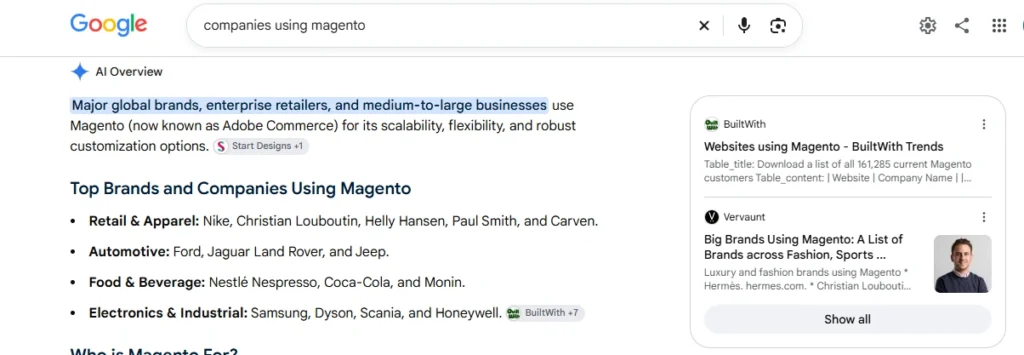
Being ranked on page one and being cited in an AI response are different forms of visibility. One measures conventional SERP presence; the other reflects how a brand or source is incorporated into an AI-generated response. That means SEO measurement needs to account for both.
The New SEO Scorecard
Traditional SEO reporting hasn’t become irrelevant. It simply needs to be expanded.
1. Search Visibility
We still track:
- Organic rankings
- Search impressions
- Organic clicks
- CTR
- Featured snippets and other SERP features
These metrics remain useful for understanding conventional search performance.
2. AI Visibility
AI visibility is still developing as a measurement category. Where measurement is possible, track:
- Brand mentions
- AI citations
- URLs cited
- Frequency of appearance
- Queries generating visibility
- Platforms where the brand appears
A mention and a citation should not automatically be treated as the same thing. They represent different types of visibility.
3. Qualified Organic Traffic
Instead of celebrating traffic growth on its own, ask:
- Which pages generated the growth?
- What search intent produced it?
- Did visitors match the target audience?
- Did they visit commercial pages?
- Did the traffic generate meaningful actions?
A 30% increase in traffic means little if the additional visitors have no relationship to the business.
4. Engagement and Intent
Next, look at what people do after discovering the content.
Depending on the business, useful signals include:
- Engaged sessions
- Key page visits
- Pricing or product-page visits
- Returning visitors
- Demo or contact-page visits
- Content-assisted conversions
5. Business Outcomes
SEO ultimately needs to connect with:
- Leads
- Qualified leads
- Demo requests
- Sales opportunities
- Pipeline
- Revenue attribution
The resulting model is straightforward: Visibility → Engagement → Intent → Conversion → Revenue
Stop Reporting “Traffic.” Start Reporting Traffic Quality
Traffic growth can look impressive while hiding a weak commercial result. Suppose organic sessions increase by 40%, but demo requests remain unchanged. SEO may have expanded reach without increasing qualified demand. Now think of all the organic traffic growing by only 10% while the number of qualified leads is up 30%.
Those results are quite a different matter. The point isn’t that traffic growth doesn’t matter. It is that traffic needs context. The same applies to rankings. Moving up the results page matters, but what happens after someone discovers the page matters too.
Measuring AI Visibility Without Fooling Yourself
AI visibility is harder to measure than a conventional ranking because responses can vary by platform, prompt, context, and time. That makes one-off testing unreliable. A better approach is to create a consistent set of relevant prompts and monitor them over time.
For example:
- Category: “Best [solution] for [industry]”
- Problem: “[problem] solutions for [audience]”
- Education: “How does [category] work?”
- Comparison: “[product] vs. [alternative]”
For each prompt, record:
- Was the brand mentioned?
- Was an owned URL cited?
- Which page was cited?
- How was the brand described?
- Which competitors appeared?
If applicable, keep an eye on multiple AI environments, don’t take one platform as the definitive example of AI search. Most importantly, search for patterns. One AI response is not an SEO benchmark. Repeated visibility across a consistent query set is much more meaningful.
The Metrics We Didn't Abandon
Moving beyond rankings doesn’t mean throwing traditional SEO metrics away.
Traditional Metric | What It Still Tells Us |
Keyword rankings | Conventional search visibility |
Impressions | Search exposure |
Organic clicks | Website acquisition |
CTR | SERP performance |
Backlinks | Authority and discovery |
Organic conversions | Business impact |
The goal isn’t to replace these metrics. It is to put them into a broader measurement system. Google’s guidance for AI search also continues to emphasize foundational SEO practices rather than suggesting marketers abandon established SEO fundamentals.
Build an SEO Dashboard Around Business Questions
Instead of organizing dashboards around SEO tools, organize them around business questions.
- Can people find us?
Rankings, impressions, search visibility, AI mentions and citations.
- Do they choose us?
CTR, organic visits, brand searches, and measurable AI referral traffic.
- Do they engage?
Meaningful interactions, key page visits, and returning visitors.
- Do they take action?
Leads, demo requests, enquiries, and other conversion events.
- Does SEO help to generate revenue?
Qualified leads, opportunities, pipeline and revenue attribution.
This simplifies reporting on SEO efforts for non-marketing teams as every metric answers a business question.
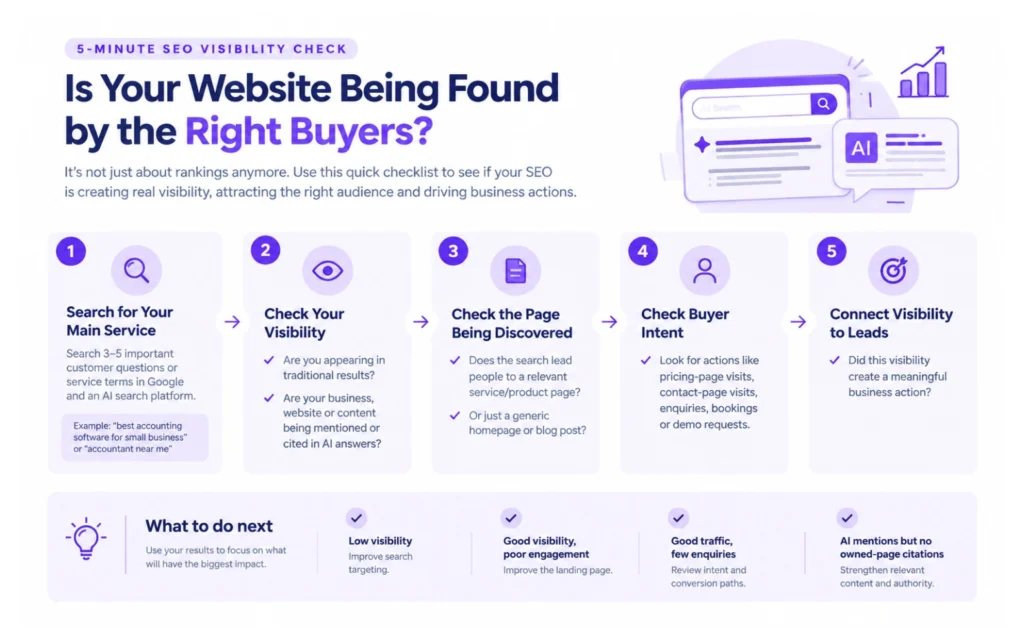
How SEO Measurement Is Changing
The biggest change isn’t a new tool. It’s how we approach work. The better question isn’t simply, ‘How do we get this page ranked #1?”, we start with the audience and the problem. Now, our process is:
Audience questions → intent understanding → useful content creation → topical relevance deepening → improved discoverability → monitoring SERP and AI visibility → measuring qualified traffic and conversions → improve based on evidence.
The objective hasn’t changed. We still want our content to be discovered. What has changed is how we define successful discovery.
The New Definition of SEO Success
We didn’t stop caring about rankings. We stopped treating rankings as the finish line. A ranking tells us where a page appears. It certainly doesn’t imply that the right visitors were discovered, engaged with it, or even became a customer.
Today’s SEO metrics need to bring discoverability, visibility, and qualified traffic together in a smooth flow of understanding of the actual business impact. That changes how people discover and evaluate information. AI search hasn’t made SEO measurement less important. It has made the search journey more complex and expanded what marketers need to observe. The question is no longer simply: “Where do we rank?” It is: “Where are we being discovered, what influence are we having, and what happens after someone finds us?”
See What Your SEO Is Missing
Get practical insights into your visibility, traffic quality, and conversion opportunities.

Santosh Sharma is an SEO strategist at Digital Deep Tech, helping businesses improve their search visibility through practical SEO, content strategy, and AI Search optimization. His work focuses on adapting SEO strategies to changing search behaviour, measuring meaningful visibility, and turning organic discovery into qualified traffic and business opportunities.
Relevant Blogs
- How to Measure AI Visibility in ChatGPT & AI Overviews
- Why Ongoing SEO Matters More Than a One-Time Website Fix
- 9 Reasons Your Website Isn’t Showing on Google
- Modern Web Design Trends That Actually Improve UX
- How to Choose the Best Voice SEO Company in 2026?
- SEO for Fitness Businesses: How Gyms & Trainers Get Clients from Google