Beyond Rankings: How to Measure AI Visibility in ChatGPT & AI Overviews
AI visibility is becoming an important part of modern search. This guide explains how businesses can measure whether their website is being cited by AI platforms, identify visibility gaps, and use those insights alongside traditional SEO.

Santosh Sharma
SEO Operations Lead
Aug 13, 2026 | 6 min. read
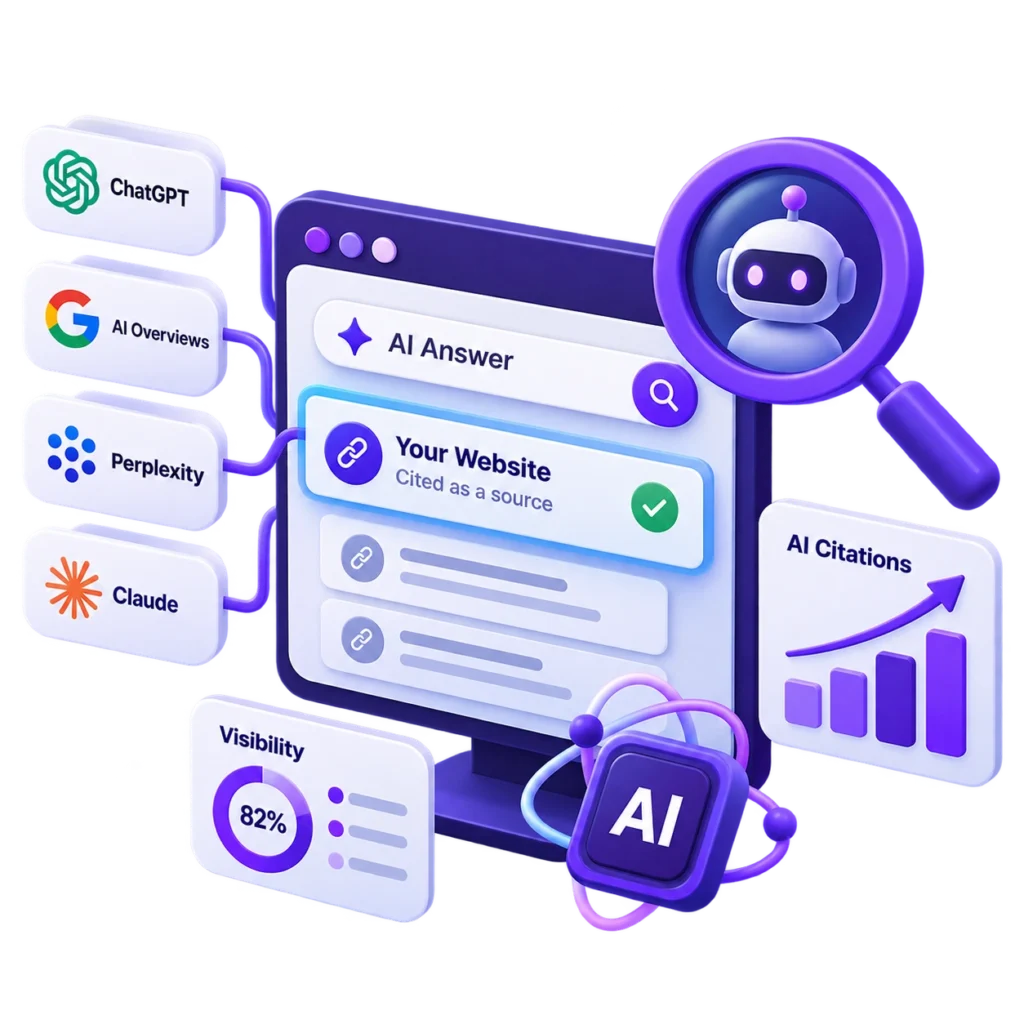
Table of the content
For fifteen years, the question in SEO was simple: where do I rank? You checked your position for a keyword, watched it climb, and counted the clicks. But that question is quietly becoming the wrong one. When someone asks ChatGPT, Claude, Perplexity, or Google’s AI Overviews a question, they often get a complete answer without ever seeing a list of blue links.
The AI reads the web, synthesizes an answer, and sometimes cites a handful of sources. If your site is one of those sources, you win visibility, authority, and referral traffic. If it isn’t, you’re invisible, no matter how well you rank in the classic sense. This shift has a name, Generative Engine Optimization (GEO), sometimes called AI visibility. And it comes with an uncomfortable question most site owners can’t yet answer, Is an AI actually citing me and how would I even know? I’ve spent the last stretch building a tool to answer exactly that question and this article is what I’ve learned about measuring AI citations in practice.
The ranking paradox
Here’s the tension. You can rank #1 on Google for a term and still be completely invisible from the AI-generated answer that now sits above those rankings. Google’s AI Overviews pull from sources that aren’t always the top organic results. ChatGPT and Claude draw on training data and, increasingly, live web results that follow their own logic. Perplexity cites sources openly, but which ones it picks is far from a mirror of the classic SERP.
So “rank #1” and “gets cited by AI” are two different games with two different scoreboards.
The problem is that almost everyone is still only watching the first scoreboard.
What AI visibility actually means
Classic SEO optimizes a page to rank in search results. GEO focuses on making useful information more likely to be referenced, quoted, or linked within an AI-generated answer. The important metric isn’t simply where a page ranks, but whether an AI system recognizes the content as useful enough to include as a source.
That matters because user behavior is changing. When an AI answers a question directly, the user may never visit a traditional search results page. Being one of the sources an AI system relies on can therefore create a different kind of visibility, even when it doesn’t result in an immediate click.
Why classic metrics don't capture it
Your rank tracker, your impressions, your click-through rate none of them tell you whether ChatGPT mentioned your brand yesterday. There’s a measurement gap:
- Rank trackers watch the traditional SERP, not the AI answer box.
- Analytics shows traffic that arrived, not answers where you were cited.
- AI answers are non-deterministic – ask the same question twice and the sources can differ, which makes casual spot-checking unreliable.
To measure AI visibility you need to query the AI engines themselves, systematically, and record whether your domain shows up. That’s a different kind of measurement than SEO has traditionally done and it’s the gap I set out to close.
How to measure AI citations in practice
Whether you build your own process or use a tool, the method comes down to a few repeatable steps.
1. Build a keyword and prompt set.
Start from the questions your audience actually asks. For each keyword, you need more than one phrasing, because people don’t all ask the same way. When I use AuditAI, I use two prompt variants per keyword: a recommendation prompt (“what’s the best tool for X?”) and a comparison prompt (“X vs Y, which should I use?”). These two intents can surface citations differently, so testing both gives a fuller picture than relying on a single query.
2. Query multiple engines, not just one.
ChatGPT, Claude, Perplexity, and Google’s AI Overviews each build answers differently. A site cited by Perplexity may be absent from an AI Overview for the same query. Measuring across all four is what turns a hunch into data.
3. Record whether your domain is cited - and where.
For each prompt, on each engine, log whether your site appears as a source, and how prominently. Repeat over time, because the answers shift as the models and the web change.
4. Read the patterns.
Over enough prompts you start to see which content types get cited, which engines favor which sources, and where you’re completely absent. That last one is the useful part: it shows you exactly where there’s work to do.
A note of honesty here, since this article is about measurement rather than bragging: when I run my own domain through this process today, I’m not yet being cited by these engines for my target terms. That’s not a failure of the method, it’s the method working. Measurement tells you the truth, and the truth for a young site is usually “not yet.” Knowing precisely where you stand is the entire point. You can’t close a gap you can’t see.
AI Visibility Should Complement SEO, Not Replace It
AI visibility is becoming an important part of search, but it shouldn’t be treated as a replacement for traditional SEO.
A business still needs a technically sound website, useful content, relevant backlinks, strong internal linking, clear page structure, and pages that genuinely answer its customers’ questions. Those fundamentals help search engines understand a website and give AI systems better information to work with.
The difference is that businesses now have another visibility layer to watch.
A page might rank well in Google but never appear in an AI-generated answer. Another page might rank lower but become a cited source because it provides a clearer explanation, stronger evidence, or a better answer to the specific question being asked.
That’s why AI citation tracking works best alongside normal SEO reporting.
Instead of asking only, “Where do we rank?”, businesses can start asking three questions:
- Are we visible in traditional search results?
- Are our pages attracting qualified organic traffic?
- Are AI platforms using our website as a source when people ask relevant questions?
Looking at all three gives a more complete picture of search visibility.
For smaller businesses and service providers, this doesn’t mean rewriting an entire website for every new AI platform. Start with the questions your customers already ask, identify the pages that answer those questions, and measure whether those pages are being discovered and cited.
The goal isn’t to optimize for AI at the expense of SEO. It’s to create content that is useful to people, easy for search engines to understand, and clear enough for AI systems to reference when it genuinely deserves to be part of the answer.
Turning measurement into action
Once you can see where you’re not visible, GEO becomes a normal optimization loop rather than guesswork:
- Answer questions directly and early in your content, so an AI can lift a clean, quotable statement.
- Structure for extraction – clear headings, concise definitions, lists, and tables that map to how questions get asked.
- Back claims with specifics data, sources, and first-hand experience, which is exactly the kind of material generative engines tend to trust and cite.
- Re-measure. Because AI answers change, GEO isn’t a one-time fix. It’s a monitor-and-adjust cycle, the same way rank tracking became a routine.
If you want the deeper version of this – what AI visibility is, and how sites earn citations in the first place – I wrote a longer walkthrough on how to earn AI visibility that goes further than I can here.
A simple example
Suppose a small web design agency wants to understand its AI visibility.
Instead of tracking only a keyword such as “web design agency,” it could test questions that reflect real customer intent, such as “What are the best web design agencies for small businesses?” or “Which web design agency is best for a small business website?”
The agency could then record whether its domain appears as a cited source, which page is being referenced, how often it appears, and which competitors are being cited instead.
Over time, those observations can reveal useful patterns. Perhaps the agency is frequently cited for technical questions but rarely appears for service recommendations. Or perhaps competitors are being cited because they have more detailed comparison pages or stronger supporting evidence.
That turns AI visibility from something you occasionally check into something you can actually learn from.
What building the tool taught me about getting cited
The most useful thing measurement gave me wasn’t a dashboard, it was a reality check about how hard citation actually is. A few lessons stood out, and they’ve changed how I think about the work. Getting cited is not easy, and it’s not quick. My honest expectation going in was that good content plus the right structure would be enough, it isn’t. The engines lean heavily toward sources they already treat as authoritative, which means the old, unglamorous fundamentals still matter arguably more than in classic SEO.
Authority still matters. The sites that earn citations often have signals of trust behind them, including relevant backlinks, strong topical coverage, useful content, and a history of being referenced by other credible sources. That doesn’t mean a site needs a huge domain or thousands of backlinks before it can appear in an AI answer, but it does mean that building genuine authority remains an important part of the process.
For newer websites, this is especially important. If measurement shows that your content isn’t being cited yet, the answer isn’t necessarily to rewrite everything for AI. It may be a sign that the site needs more useful content, stronger evidence, better internal connections between related topics, and relevant links from other trusted websites.
The two work together: measurement shows you where the visibility gap exists, while ongoing SEO work helps close it.
The two work together.
Structure is the other half. Once the authority is in place, the technical groundwork is what makes your content easy for an engine to lift and quote. The things that moved the needle in my testing:
- Structured data / schema markup – helping engines understand what a page actually is and what each part means.
- A clear FAQ section – question-and-answer format maps almost perfectly onto how people prompt an AI, which makes those answers easy to extract.
- Emerging AI-readable conventions – Some site owners are experimenting with formats such as txt to make important site information easier for AI systems to understand. It is still an emerging practice rather than a guaranteed way to improve AI citations, so it should be treated as something to monitor and test rather than a magic switch.
None of these are magic switches. But together they lower the friction between “your content exists” and “an engine can confidently quote it.” Authority gets you considered; structure gets you extracted.
The combined takeaway from building this: AI visibility rewards the same patience SEO always has. You earn authority over time through links and trust, you make your content machine-readable through structure, and you measure continuously so you know which of the two is holding you back.
The takeaway
Rankings aren’t dead but they’ve stopped being the whole story. As AI Overviews and chat assistants absorb more of the search journey, the sites that thrive will be the ones that treat citation as a metric worth tracking – and start measuring it before their competitors do.
The uncomfortable first result, for most sites, will be “we’re not being cited yet.” That’s fine. That’s the starting line. You measure, you adjust, you measure again. The one thing you can’t afford is to keep watching only the old scoreboard while the game moves to a new one.
See Where Your Website Can Improve
Get a clear look at SEO and AI visibility opportunities holding you back.

Santosh Sharma is an SEO strategist at Digital Deep Tech, helping businesses strengthen their online presence through practical SEO, content strategy, and emerging AI search optimization. His work focuses on creating search-friendly digital experiences that improve visibility and connect businesses with the audiences they want to reach.
Relevant Blogs
- Why Ongoing SEO Matters More Than a One-Time Website Fix
- 27 Important Questions to Ask an SEO Company Before
- How to Find the Best SEO Company for
- Google Business Profile Mistakes Losing You Leads
- How to Choose the Best Voice SEO Company in 2026?
- SEO for Fitness Businesses: How Gyms & Trainers Get Clients from Google