SEO

How long SEO takes for a small business and what realistic results look like over time.

How Long Does SEO Take for a Small Business?

Wondering how long does SEO take to work for small business websites in 2026? This guide breaks down what really happens after you start SEO, what early progress looks like, and how small businesses should set realistic expectations without relying on guesswork or empty promises.

Deepak Sharma - SEO consultant

Deepak Sharma

SEO Consultant

Jan 20, 2026  |  6 min. read

SEO timeline icon representing gradual growth and long-term results for small businesses.

Most small business owners ask this question after they’ve already tried something and felt disappointed. Money was spent, time passed, and the website still isn’t bringing enquiries. At that point, frustration is completely understandable.

The problem is that small business SEO expectations are often set without any real explanation. You’re told it will “take time,” but no one explains when SEO starts working or what progress should actually look like in the early stages. Without that context, it’s easy to assume nothing is happening.

This post is here to reset that. Not with promises, but with clear, honest answers about how long SEO takes to show results and what’s normal along the way. Once you understand the process, it becomes much easier to judge whether things are moving in the right direction.

Why SEO Takes Time for Small Businesses

SEO feels slow because it’s not something you switch on and see instant movement. There’s no button to press and no quick spike the next morning. What’s really happening is quieter and takes a bit of patience, which is why many business owners feel stuck early on.

One reason why SEO takes time is that search engines need to trust your website before they show it to more people. If the site is new, that trust hasn’t been earned yet. SEO for new websites usually moves slower because there’s no history, no consistency, and often a few basics that need fixing before anything else can work properly.

Another issue is the foundation itself. Many small business sites look fine on the surface but have unclear pages, weak content, or confusing structure underneath. Sorting that out doesn’t create instant traffic, but it’s necessary. This is where real SEO progress over time begins, even if it’s not obvious right away.

In the early months, the work is mostly about putting things in the right place so growth can happen later. It may feel invisible, but it’s the stage that makes the next one possible.

What I analyse in 2026:

Local competition matters. Mostly, I see that local businesses from various industries have little SEO knowledge and often do not hire any SEO agency. There are many reasons behind this, and budget for local SEO is one of them. By targeting the right keywords with low competition but high customer demand, it takes less time to rank on Google and in AI-driven searches.

Only about 2.35% of website visitors convert into leads on average.

That means roughly 97 out of every 100 visitors leave without taking action, like filling a form or clicking to call. This shows how small the window is for turning interest into contact.
Source: Contentsquare Digital Experience Benchmark Report 2026

Common Timeline Mistakes That Slow SEO Results

One of the biggest mistakes I see is expecting ranking improvements within a few weeks. That expectation usually comes from comparing SEO to ads, where results show up fast. SEO doesn’t work that way, and treating it like a short-term fix almost always leads to disappointment.
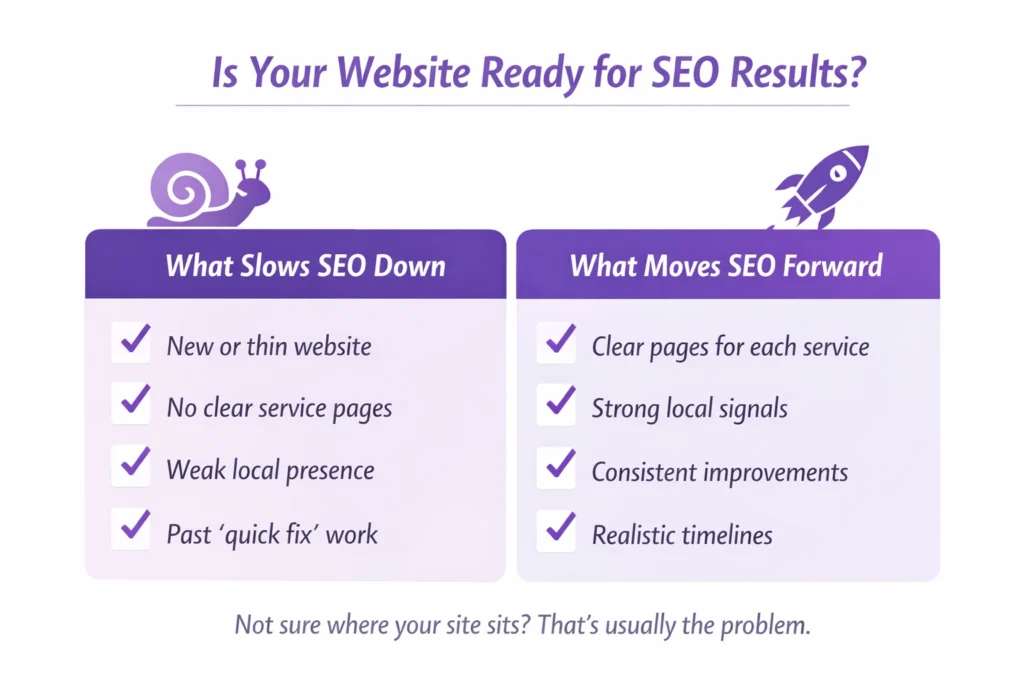
Checklist infographic helping local businesses understand if their website is ready for SEO results and what factors slow or improve rankings.

Another common issue is focusing on keywords alone. Business owners are often told that if the right words are added, traffic will follow. In reality, pages need to make sense, answer real questions, and work properly for local searches. Without that, even good keywords won’t move the needle.

Many people also stop too early. The first SEO results are rarely dramatic. They show up as small signs, a page moving up slightly, a few more impressions, better visibility in local searches. Organic traffic growth usually comes later, after those early signals stack up.

This is where short-term vs long-term SEO really matters. The early work can feel slow, but quitting at that stage often means walking away just before things start to turn.

The Right SEO Strategy That Works in 2026 for Small Businesses

  1. Properly optimize your Google Business Profile.
  2. Optimize your website for the local audience.
  3. Publish one blog per week addressing local customers’ pain points.
  4. Create local area pages—more content means more keywords to rank.
  5. Build quality backlinks and local business listings.

I follow these five simple steps to rank local businesses in 2026 and track results in Google’s AI overview.

What a Realistic SEO Timeline Looks Like

A realistic SEO timeline for small businesses looks very different from what most people are told at the start. It’s not a straight line and it’s rarely dramatic in the early months. Progress tends to show up quietly before it shows up clearly.
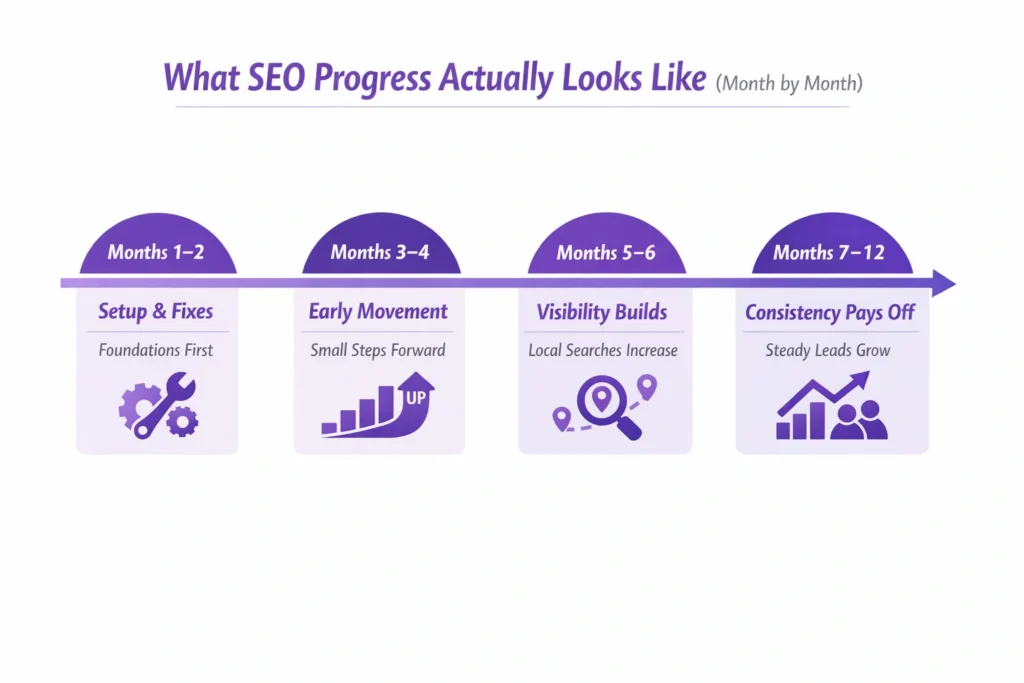
Month by month SEO timeline showing what progress looks like for a small business, from setup and fixes to consistent enquiries over 12 months.

In the beginning, the SEO results timeline is usually about getting the basics right. Pages become clearer, the site structure starts to make sense, and search engines understand what the business actually offers. You may notice small ranking movement, but not a flood of traffic yet. That’s normal.

For local businesses, things often move a bit faster. When location pages are set up properly and the Google Business Profile is in good shape, visibility can improve sooner than national or broader searches. That’s often when people start asking how long until small business SEO shows results, because early signs begin to appear.

Over time, consistency is what makes the difference. Steady improvements, useful content, and patience lead to a small business SEO timeline for results that builds on itself instead of starting over every few months.

What I have seen in the last 10 years:

SEO has not changed, or you could say it has evolved. As we discussed above, if the website is new, it normally takes 3 to 6 months to rank for local keywords. But if your website is old—up to 10 years—and has good authority, then ranking is not hard. The right SEO strategy can give the website the wings to rank in up to 3 months.

53% of mobile visitors will abandon a page if it takes longer than 3 seconds to load. Slow load times also increase bounce rates and cut conversion opportunities.

Many small business sites load slowly or aren’t mobile-friendly. When more than half of mobile visitors leave before the page finishes loading, you lose most of your potential leads before they ever see your offer.
Source: Site Qwality Website Speed Crisis Report (2025)

Example: How SEO Progress Builds Over Months

Here’s a situation I often see with a local service business called Bare Brilliance. In the first month, nothing looks different from the outside. No extra calls, no sudden jump in traffic. At this stage, many owners start wondering how long SEO take to start working for a small business like theirs does.

In the first two months, I optimized the website for local search queries, fixed technical issues, optimized the Google Business Profile, and improved UI and UX with the help of our website developer.

By around the third month, small changes begin to show. A couple of service pages move onto page first. The site starts appearing more often in local searches, even if enquiries are still limited. It’s not exciting yet, but it’s progress.

Around month six, things feel different. The business starts getting calls from local searches that weren’t there before. By the end of the year, SEO often becomes a steady source of enquiries rather than something they question every month. The client appreciated the results.

This isn’t a rare success story. It’s how SEO usually unfolds when the work is done properly and given enough time to settle.

Get clarity before you decide

If you’re still unsure whether your website is on the right path, that’s completely fair. Every business is different, and timelines can vary based on what’s already in place and what needs fixing.

Get Your SEO Timeline Explained Clearly

See what SEO progress should look like for your business and location.

If you want an honest view of how long SEO is likely to take for your business, and what progress should look like at each stage, get in touch. We can walk through your website together and set expectations that actually make sense for you.

FAQs

How long does SEO take to start working for a small business?

For most small businesses, early signs usually appear within two to three months. This doesn’t mean leads or sales yet. It’s more about visibility. Pages start getting impressions, rankings move slightly, and search engines begin to understand the site better. That early movement is often the first signal that SEO is working.

When people ask how long SEO takes to show results, they’re usually thinking about calls, enquiries, or form submissions. For many small businesses, that stage arrives around four to six months. Timing depends on competition, location, and the condition of the website when work begins.

SEO usually starts bringing leads once rankings improve and trust builds over time. This often happens after several months of steady progress. Leads don’t arrive all at once. They tend to grow gradually as more pages appear in the right searches and more people find the site naturally.

SEO takes time because search engines don’t take risks on new or unclear websites. They need to see consistent signals that a site is useful, reliable, and relevant. That trust builds slowly, especially for small businesses that are still strengthening their online presence.

Yes, SEO for new websites usually takes longer. A new site has no track record, no history, and often needs structural fixes before it can grow. Once those basics are in place, progress becomes more consistent, but patience is important early on.

SEO is a long-term approach. Short-term tactics may cause brief movement, but they rarely last. Long-term SEO builds steady growth, stronger rankings, and more reliable enquiries over time, especially for local businesses working within a defined area.

Often, yes. The local SEO results timeframe can be shorter because competition is limited to a specific area. When location pages and local profiles are set up properly, small businesses sometimes see visibility improvements sooner than with broader, non-local searches.

How Long Does SEO Take for a Small Business? Read More »
Banner explaining why SEO traffic doesn’t convert into enquiries

Why SEO Traffic Doesn’t Turn Into Enquiries

If you’re wondering why my website traffic doesn’t turn into enquiries, this guide breaks it down in plain language. It explains what usually goes wrong after visitors land on your site and what small, practical changes can help turn traffic into real enquiries.

Freelance content writer in India

Priya Sharma

Content Writer

Jan 14, 2026  |  6 min. read

Icon illustrating SEO traffic with low enquiry conversion

You’re doing the work. Your site is getting visitors from Google, but the phone doesn’t ring and the contact form stays quiet. This is one of the most common frustrations I hear. It’s also why many people start asking why websites fail to produce sales, even when traffic looks fine. In most cases, the issue isn’t effort or visibility. It’s what the visitor experiences once they arrive.

The Real Reason Traffic Isn’t Turning Into Leads

In many cases, the website is attracting visitors, just not the right ones. Google is doing its job by sending people your way, but those people may be early in their research or looking for something slightly different from what you offer. That’s usually where things start to break down.

I see this often when a site ranks for broad topics but doesn’t clearly spell out who it’s actually for. Someone lands on the page, scans it for a few seconds, and can’t tell if you solve their specific problem. They don’t dislike the site. They just don’t see a reason to get in touch.

This is also where how to get right website traffic matters. It’s not about more visitors. It’s about attracting people who already feel like you’re a good fit. When the message and the visitor’s intent don’t line up, traffic increases but enquiries don’t.

Most business owners assume that if people are arriving, the hard part is done. In reality, that’s only halfway. What comes next depends on clarity, relevance, and whether the site makes it easy for the right person to recognise themselves in what they’re reading.

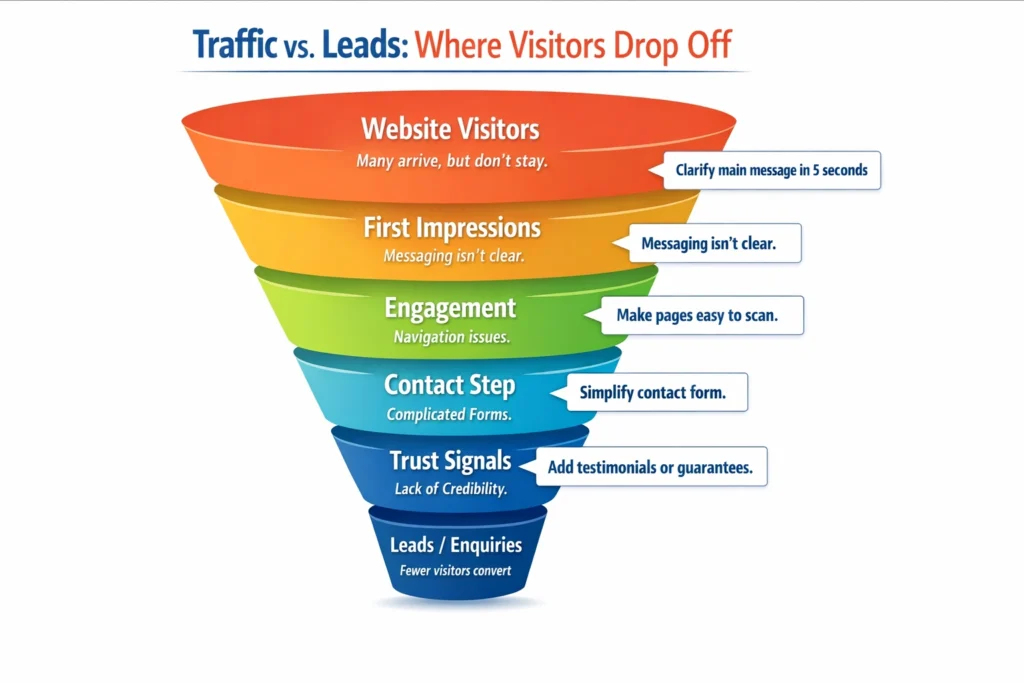
Only about 2.35% of website visitors take an action like filling a form or booking a call, meaning roughly 97 out of 100 people leave without converting.

This shows that getting traffic is only the first step. The vast majority of visitors don’t become leads unless the site guides them clearly toward action.
Source: Website Conversion Rate Statistics

Mistakes That Stop Visitors From Enquiring

One of the biggest assumptions I see is that once traffic arrives, enquiries will follow on their own. Many owners believe the website will naturally do the job of converting your website traffic into sales without much guidance. Unfortunately, it rarely works that way.

Traffic vs leads funnel infographic showing where website visitors drop off before becoming enquiries and how to improve conversions.

A common mistake is talking too much about the business and not enough about the visitor. Pages list services, credentials, and features, but they don’t explain how those things help someone with a real problem. Visitors end up unsure whether to take the next step.

Another issue is asking for too much, too soon. Long forms, vague contact buttons, or requests for detailed information can feel like a commitment. When someone is still deciding, that friction is often enough to stop them.

There’s also a tendency to keep adding more content instead of fixing what already exists. Traffic grows, but the core pages stay unclear. At that point, the site is busy but not effective. These small missteps add up and quietly block enquiries before they ever happen.

How to Make Your Website Convert

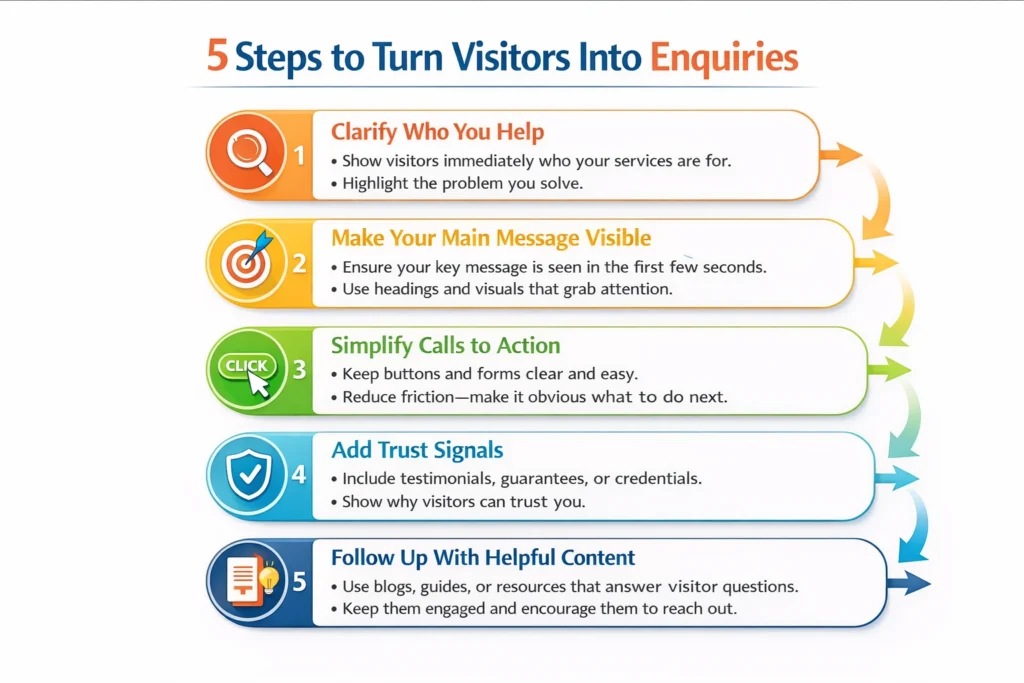
If you’re trying to figure out how to convert website traffic into leads, start with the basics most sites overlook. When someone lands on your page, they should quickly understand who you help, what problem you solve, and what to do next. If that isn’t clear within a few seconds, they’ll move on.

5-step website conversion infographic explaining how to turn visitors into enquiries using clear messaging, CTAs, and trust signals.

Your main pages should guide the visitor, not just inform them. Use simple language. Explain the problem you solve in the same words your clients use. Make the next step obvious, whether that’s a short contact form, a clear call to action, or an invitation to start a conversation without pressure.

Trust matters just as much as clarity. Real examples, brief explanations of how you work, and reassurance around what happens after someone gets in touch can remove hesitation. People don’t avoid enquiring because they’re not interested. They hesitate because they’re unsure.

This is how you start to convert website traffic into sales without chasing more visitors. When the right people feel understood and guided, enquiries happen naturally. The traffic you already have becomes far more valuable.

UI and UX (Website Structure Also Matters)

Another important factor is UI and UX. Your website should be designed for both your target audience and search engines. Speed matters too—pages need to load quickly on desktop and mobile because visitors usually spend only a few seconds deciding if they’ll stay. A clean layout and fast loading time make it easier for them to engage.

Sites that take over 3 seconds to load see much higher abandonment, with visitors rapidly leaving and conversions dropping sharply. Faster-loading sites keep more people engaged and reduce bounce rates.

If a site is slow or confusing, visitors leave before they even see your message. Fixing load time and clarity can prevent this early drop-off.
Source: Web Design Statistics 2026

Google also values EEAT, which means your website should not just show your services, but also demonstrate your experience, expertise, authority, and trustworthiness.

Real Example from a Client Project

A Salon service business I worked with was getting steady traffic every week, but enquiries were rare. On the surface, everything looked fine. Rankings were solid and visitors were spending time on the site. Still, nothing was coming through.

When we looked closer, the issue was clear. The homepage talked about the company, not the customer. The contact page felt formal and asked for too much information. Visitors had no clear reason to reach out at that moment.

Once the messaging and content were updated to focus on the client’s problem, and the contact step was simplified, things changed. This is often how to turn website traffic into sales—not by adding more pages or chasing more visitors, but by making it easy for the right person to say yes and start a conversation.

What we focused on

  1. Analyzed the website structure and user journey.
  2. Optimized content for both customers and Google.
  3. Simplified the CTA structure to make it clear and easy to use.
  4. Published regular blogs addressing the problems customers face.

Result

  1. Traffic remained stable, but sales improved.
  2. The website now looks professional and builds trust.
  3. Continued blog publishing helped improve search rankings.

Get clarity before you decide

If your site is attracting visitors but enquiries aren’t coming through, start by looking at the pages that matter most. Small changes in messaging, layout, or calls to action can make a big difference. Clear, simple steps help visitors understand why they should get in touch.

Check How Your Website Converts Today

Quickly see what stops visitors from turning into real enquiries.

I can take a quick look at your website and share clear feedback, sometimes through a short video so you can see exactly what I’m referring to. The goal isn’t to sell you anything. It’s to help you understand what’s really happening on your site and whether focusing on SEO makes sense for your situation right now.

Focusing on converting your website traffic into sales isn’t about adding more content or spending more on traffic. It’s about making it obvious and easy for the right people to take the next step. Review your key pages from a visitor’s perspective and remove anything that could cause hesitation. Even small adjustments can turn passive visitors into real enquiries.

FAQs

Why is my website getting traffic but no enquiries?

This happens more often than you think. Visitors arrive, but the page doesn’t clearly show them why they should contact you or how to take the next step. Simple things like unclear messaging, hidden contact options, or long forms can stop people from enquiring. Fixing these points can help convert visitors into leads.

Usually, it’s not. Most of the traffic coming from search engines is fine—it’s real people looking for solutions. The problem is often how the website handles that traffic. If pages aren’t guiding visitors effectively, even good traffic won’t result in enquiries. Making small improvements can help turn visits into action.

In most cases, improving the website experience is faster and more effective than chasing extra traffic. Focusing on how to convert website traffic into leads ensures the visitors you already have are more likely to reach out. Sometimes a few simple adjustments can make a big difference.

Only if they’re completely off-target. Often, the issue isn’t keywords at all, but how the site communicates with visitors. When done right, even existing traffic can start converting. Learning how to turn website traffic into sales is about guiding visitors, not just chasing new ones.

Why SEO traffic doesn’t turn into enquiries Read More »

Does SEO still work for small businesses in 2026 and is it worth the investment

Does SEO still work for small businesses in 2026?

Many small business owners are asking if SEO is still worth it for small businesses in 2026. This article explains what’s changed, why results feel harder to see, and when SEO still brings real leads instead of just traffic.

Santosh Sharma

Santosh Sharma

Content Writer

Jan 08, 2026  |  6 min. read

3D SEO icon showing search growth and visibility for small businesses in 2026

If you’ve been wondering whether SEO still makes sense in 2026, you’re not alone. I hear this question almost every week. A lot of business owners are asking things like is SEO dead in 2026 or why SEO is dead in 2026 because what used to feel predictable now feels messy and uncertain.

Search results look different. Ads take up more space. Answers show up before you even click a website. It’s fair to question whether putting time and money into SEO is still worth it for a small business, especially when enquiries aren’t coming in the way you expected.

For local businesses, the doubt can feel even stronger. When visibility drops or leads slow down, it’s easy to assume local SEO isn’t working anymore. But in most cases, the problem isn’t that SEO has stopped working. It’s that the rules around how people search and decide have changed quietly.

To understand whether SEO is still worth it for your business, it helps to look at why this confusion exists in the first place.

Why SEO feels harder than before

The short answer is that SEO didn’t suddenly stop working. What changed is how people search and how Google shows results. Most expectations, though, are still based on how things worked years ago.

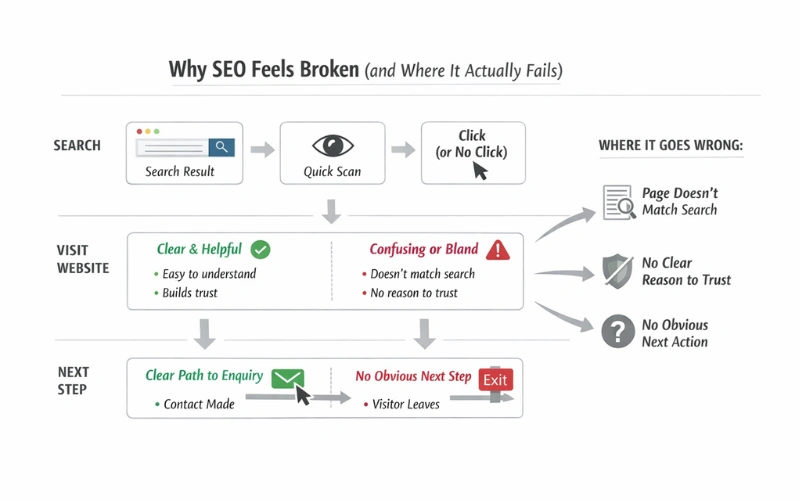
Why SEO Feels Broken Small Business in 2026

Today, someone might scan a result, read a quick answer, compare a few options, and leave without ever clicking the first link. That makes it feel like SEO isn’t doing its job. Business owners then start asking, does SEO work for small business anymore, when the real issue is that success is being judged the wrong way.

Another reason this feels broken is how SEO was sold. Many small business owners were promised traffic. Reports focused on rankings and visitor numbers, not on whether the website actually helped someone take the next step. Traffic went up, but enquiries didn’t, so trust in SEO dropped.

This is why SEO is important for small business in a different way than before. It’s no longer just about being visible. It’s about showing up in the right places and making it clear why someone should contact you when they land on your site.

For most small business owners, SEO still plays a role. But it only works when it’s aligned with how real people search and decide today, not how search worked in the past.

In 2025, about 58.5% of Google searches in the U.S. and 59.7% in the EU ended without clicking through to any website.

This means most people looked at search results but didn’t visit any external sites, making traditional SEO traffic less reliable on its own.
Source: Top SEO Statistics for 2025 — SMAMarketing

Common mistakes small business owners make

One of the biggest mistakes I see is expecting SEO to work quickly. It’s often treated like a switch you turn on and leads start coming in. When that doesn’t happen in a few weeks, frustration sets in and confidence drops.

Another common issue is judging success by traffic alone. More visitors look good on a report, but traffic doesn’t pay the bills. If people are landing on your site and leaving without getting in touch, the numbers don’t mean much. Enquiries are what matter.

A lot of small businesses also get stuck with generic SEO services for small business that look the same for everyone. The same checklist, the same monthly tasks, no real understanding of the business behind the website. Local businesses face this even more with local SEO services for small business that promise visibility but ignore what happens after someone clicks.

Website clarity is often overlooked too. Pages try to say everything at once or focus too much on the business instead of the visitor’s problem. When messaging isn’t clear, people hesitate and move on.

Finally, many owners stop too early. SEO gets cut just as small improvements start to build because results feel slow or unclear. Working with an SEO consultant for small business only makes sense if there’s patience to let the right changes settle and do their job.

Organic click‑through rates (CTR) for queries with AI summary features dropped by about 61% from mid‑2024 to late‑2025.

This shows that when search engines show direct answers, users are much less likely to click to a website.
Source: Google AI Overviews drive 61% drop in organic CTR — SearchEngineLand

What makes a real difference

What works today is simpler than most people expect. It starts with knowing exactly who the site is for and what problem it’s meant to solve. When SEO for small business tries to appeal to everyone, it usually connects with no one. Clear focus makes it easier for the right people to recognise themselves and stay.

Pages also need to match why someone landed there in the first place. If a visitor is searching for a specific service or answer, the page should meet that need quickly and clearly. This is one of the most overlooked parts of SEO strategies for small business. Relevance matters more than volume.

Another practical fix is making the next step obvious. If someone is interested, they shouldn’t have to hunt for how to get in touch or what happens next. Simple wording, clear buttons, and reassurance at the right moment remove hesitation.

It’s also important to measure the right thing. Rankings can move up and down, but leads tell the real story. One of the biggest benefits of SEO for small business is attracting people who are already looking for help. If those people aren’t reaching out, something in the journey needs adjusting.

Finally, consistency beats quick wins. Steady improvements, reviewed over time, work better than jumping from one idea to the next. That’s usually how you improve SEO for small business in a way that lasts and actually supports the business.

A real example from a local business

I see this a lot with local service websites. On the surface, everything looks fine. The site is clean, the content reads well, and traffic numbers look healthy. But when you dig a little deeper, the traffic isn’t coming from the right places. For local businesses, that’s a problem. You don’t need everyone. You need the right people in the right area.

In one case, the question wasn’t does SEO work for small business. It was whether the website was set up for local intent at all. We started by reviewing the site content and how a local visitor would move through the pages. The information was there, but it wasn’t written with a local searcher in mind.

We adjusted key pages to reflect location-specific needs, looked at what people in that area were actually searching for, and made the next steps clearer. We also focused on trust, adding real examples of past work and publishing regular blogs that answered common local questions.

Over time, the traffic became more relevant. Enquiries started coming from people who were a good fit. Local visibility improved, and conversations turned into real work. For many SEO for small business owners, that’s what progress really looks like. Consistent effort, clearer intent, and results that make sense for the business.

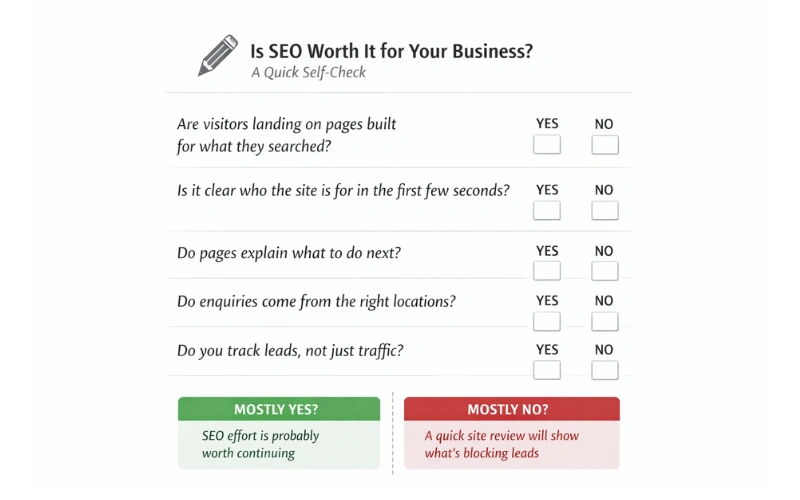
Is SEO worth it for your business? A quick self-check

Get clarity before you decide

If you’re still unsure whether SEO is worth it for small business in 2026, the fastest way to get clarity is to look at your own site through fresh eyes. Not a long report. Not a sales call. Just an honest review of what’s helping and what’s quietly getting in the way.

Is SEO Worth It for You?

Get a quick, honest review of what’s helping or blocking leads.

I can take a quick look at your website and share clear feedback, sometimes through a short video so you can see exactly what I’m referring to. The goal isn’t to sell you anything. It’s to help you understand what’s really happening on your site and whether focusing on SEO makes sense for your situation right now.

Once you have that clarity, you can decide what to fix, what to ignore, and how far you want to take things.

Does SEO still work for small businesses in 2026? Read More »
SEO Outsourcing: A Complete Guide for Businesses

SEO Outsourcing: What You Need to Know

Learn the basics of SEO outsourcing, its benefits, problems, and key factors to consider. Learn how collaborating with the right SEO experts can help you save time, reduce costs, and improve long-term results.

Freelance content writer in India

Reviewed by Priya Sharma

Content Writer

Sept 14, 2025  |  6 min. read

The Potential Risks of SEO Outsourcing

Every business wants an online presence. Before making a purchase, most customers search for information first. Search Engine Optimization (SEO) helps your business seen on the search engine. SEO gets businesses ranked higher on Google and attracts free, organic traffic.

Why Businesses Choose to Outsource SEO

The challenge is that many companies do not have the skills, time, or budget to handle SEO planning/activity. Outsourcing to freelancers or agencies can fill this gap. They give businesses professional search visibility and allow them to focus on their core work.

Since 93% of online experiences begin with a search engine, being visible when a customer is looking for information is important. If your business doesn't appear in results, competitors who invest in SEO will.

SEO outsourcing gives small businesses the chance to compete with bigger companies.  Amazon, for example, integrates resources and capabilities from both in-house teams and external agencies to manage millions of product listings.

Why Businesses Choose to Outsource SEO

SEO outsourcing is not limited to large companies. Small and startups use it too. It allows them to focus on what they do best, while experts handle technical tasks such as link building, keyword research, content optimization, and analytics. This approach is often less expensive than hiring full-time employees, while still providing access to professional-grade tools and up-to-date knowledge.

Search engines frequently update their algorithms. Outsourcing ensures your company remains competitive and aligned with the latest trends. Indian tech startups, including Nykaa and Zomato, rely on SEO agencies to strengthen their position against international brands.

The Advantages of Outsourcing

The Advantages of Outsourcing SEO

Outsourcing SEO provides significant value. Outsourced teams offer scalability to intensify campaignsduring major product launches or busy seasons without the delay of new hires. They also provide diversity of expertise, combining technical SEO expert, content writers, link builders, analysts, etc. into a single coordinated effort.

 This breadth of skills produces a well-rounded strategy that many internal teams cannot match. An example is Flipkart. They are working with multiple digital agencies to optimize product-based SEO and local content opportunities, providing it a stronger competitive position against Amazon. 

Things to Consider Before Outsourcing SEO

While outsourcing offers many advantages, businesses should carefully consider the following factors:

  • Timeframe: SEO takes time. Results typically appear only after three to six months before any changes happen in terms of search rankings. 
  • Provider evaluation: Evaluating an SEO provider requires more than cost comparison—case studies, testimonials, and experience in relevant industries should all be reviewed. 
  • Communication: The better the communication, the better the trust will be built, which ultimately creates a better quality of service. Clear expectations, reporting schedules, and feedback systems reduce the risk of misunderstandings.
  • Cost clarity: Rates can vary widely, so pricing and deliverables should be confirmed in advance.

Specialization is also worth considering. For instance, textile exporters in Surat often hire agencies with expertise in global buyer behavior, which helps them market their products effectively to international audiences.

The Benefits of Outsourcing SEO

The Benefits of Outsourcing SEO

There are clear advantages to outsourcing. Many companies report increases in organic traffic and conversion rates as a byproduct of improved rankings. Outsourcing is usually less expensive than keeping in-house SEO experts. Firms now have immediate access to the best talent and strategies.

Given the costs, outsourcing is an efficient decision on many levels. Some more advantages of outsourcing SEO are that it provides ongoing devotion to website performance, which most in-house teams may not deliver. For example, the Indian EdTech startup, Byju’s, partnered with international SEO agencies to optimize its content for global customers to expand its activities/target the US and UK markets.

The Potential Risks of SEO Outsourcing

Despite the benefits, outsourcing carries risks if the wrong partner is chosen. Agencies that rely on unethical or outdated tactics can reduce return on investment, harm search rankings, and damage a company’s reputation. Lack of transparency, poor-quality backlinks, or unrealistic promises are common warning signs.

US department store JCPenney is a well-known example. The company faced severe penalties from Google after its agency engaged in manipulative practices. This demonstrates why businesses should start with trial projects to test the approach of the agency, transparency, communication, and partnerships before committing to long-term contracts.

How to Outsource SEO Effectively

How to Outsource SEO Effectively

For companies looking to outsource SEO, they should approach outsourcing in a structured way.  Goals must be defined clearly, whether the priority is increasing organic traffic, raising keyword rankings, or improving conversions. Providers should be vetted carefully, with reviews and case studies examined for credibility.

Communication plans should include regular reports and meetings to track progress. Companies should sign service level agreements (SLA’s) to avoid misunderstandings and access to analytic dashboards to legitimize data as well. Training internal teams alongside the agency also strengthens collaboration and maximizes results.

A checklist can be helpful when evaluating potential SEO partners. Organizations should confirm:

  • The size and expertise of the agency’s team
  • The range and quality of SEO tools they use
  • Proven results and case studies within similar industries
  • Their approach to link building and content development

Ready to Make Your SEO Strategy Work Globally?

Let’s uncover the right keywords for your international audience — no guesswork, just results.

Conclusion

SEO outsourcing is not simply a way to reduce costs. It’s a growth strategy that blends flexibility, expertise, and resources to help businesses  compete in crowded markets. Global leaders like Amazon, Airbnb, Flipkart, and Nykaa depend on outsourcing, as do countless small businesses seeking to reach wider audiences.

The greatest advantage is sustainability. Outsourced SEO creates steady website traffic, strengthens brand loyalty, delivers long-term and attainable growth. By investing early, businesses can secure a stronger digital presence and achieve higher returns on their time, money, and effort.

SEO Outsourcing: What You Need to Know Read More »
How Can SEO and Social Media Work Together

How SEO & Social Media Boost Website Visibility

At Digital Deep Tech, we’ve seen firsthand how SEO and social media work hand-in-hand to put businesses in front of the right audience. Ranking on the first page builds trust and drives clicks, while a strong social media presence keeps your brand visible, shareable, and engaging. Together, they don’t just boost website visibility — they create opportunities for long-term growth.

Freelance content writer in India

Written by Priya Sharma

Content Writer

Aug 8, 2025  |  6 min. read

How SEO and Social Media Boost Website Visibility

The internet is shaping businesses across every industry, and if you aren’t getting your website on the first page, you’re missing out on a lot of opportunities. More than likely, your ideal customers or clients are choosing from the businesses that have reached the top spots and established a strong web presence in general. And you know how they accomplish this? SEO and social media — that’s how.

How People Search the Web

There’s no nice way to put this because the statistics are rather grim if you own a business that ranks on the 3rd, 4th, 5th — or even the second page — of the SERPs.

But, here’s the truth…

Statistics indicate that 71 percent of people only check the first page of the results. So, no matter how much better your company is than the others, if you’re not hitting in this range, you’re more than likely losing business to the competition. Some studies show this percentage is even higher, in the 90-percent range, to be exact.

The people who are looking beyond the first page are often the ones who are inquisitive and want to delve deeply into a topic. They’re looking for alternate viewpoints and additional facts, rather than for a business to handle their plumbing or landscaping or a vet for their pet.

When people search the web for a business that sells the products they need or services they desire, they’re typically sticking with the first-page results. Some are trusting that Google’s algorithm will steer them in the right direction.

On the other hand, some are looking for answers, and they want them now! They’re busy and don’t want to scour through dozens of businesses all offering the same thing and claiming to be the best or provide what the reader is looking for.

Sometimes, the person is just overwhelmed by all the options. Limiting it to the first 10 results is less stressful and more manageable.

And who’s to say some aren’t just lazy and don’t want to put in the work or spend that time looking?

Getting Your Name Out There

Some people find a business, stick with it for all their needs in that area, and spread the word. Others then follow suit and use that company. But word-of-mouth marketing isn’t as common with the prevalence of the web nowadays, especially with the younger generations who grew up turning to the web for nearly all their educational needs outside of the classroom.

When you have strong SEO that gets your company’s name on the first page, you’re getting more exposure.

But there’s another part of the equation that can also help — social media. Did you know that the average person spends 141 minutes on social media each day? And while these platforms were once a place just to keep in touch with friends and family and meet new people, they’re now a prime source for businesses to throw their lines and gain visibility.

If you have a strong social media presence, people will share your posts and get your name out there even more. Moreover, when you create engaging content, you’ll have people interacting with your business, which makes your company seem more personable.

A Little Word of Advice — Providing Value Matters

Think about 10 years ago. The Google SERPs were filled with page after page of the exact same content, just regurgitated in different words. There was very little variation because reaching the top was about keyword density and placement, not how much value a page brought to the audience. And if you remember, the keywords didn’t even have to make sense in the piece, making it so the reader, more than likely, didn’t get anything from the piece.

The search engine algorithms aren’t so generous with poor quality content nowadays. If it doesn’t provide the reader with anything and only uses keywords naturally in the piece, it’s not going to rank anywhere near the top.

So, as you’re planning your pieces and writing them (or hiring a company to do it for you), you must consider the reader with every piece and give them something useful they can take away from the blog or web content. But sprinkling some keywords throughout is still important, or you’ll miss the mark and not rank, and therefore, not get the visibility you desire.

The same concept can be applied to social media. You need to provide viewers something that’s going to make them want to look at what you’re posting, whether it’s educational, entertaining, or promotional.

As you see, SEO and social media can boost your website’s visibility. You can even use your social media to promote your website and drive more traffic to your site. With these two being so important in today’s marketing landscape, using them to your advantage — and properly — is in your business’s best interest. And don’t forget about local SEO if you have a brick-and-mortar location or are offering services to your community.

Ready to Make Your SEO Strategy Work Globally?

Let’s uncover the right keywords for your international audience — no guesswork, just results.

About Author: Priya Sharma is a dedicated content writer at Digital Deep Tech, passionate about turning complex marketing ideas into simple, relatable stories. She loves crafting content that helps businesses connect with real people and build lasting trust.

How SEO & Social Media Boost Website Visibility Read More »
White Label Local SEO Strategy

Top 10 Strategies for White Label Local SEO Success

White Label Local SEO Strategy

Introduction

White label local SEO service is now the game-changer for agencies and businesses alike in this dynamic world of SEO. With my experience both as a local business SEO expert and founder of Digital Deep Tech, I have worked with numerous agencies, helping them scale and expand their service offerings through white label SEO. Whether an agency is looking to outsource or a business is seeking better visibility locally, knowing how to use white label services effectively can be really helpful for you.

I shall talk about the top 10 strategies to successfully offer small business SEO services. These are from my experience of helping businesses achieve success in local rankings, along with real-world examples.

What is White Label Local SEO?

So, before we go ahead with the strategies, let’s just define what white label local SEO is. White label local SEO is basically a deal where an agency outsources its local SEO service to a third party, and that third party provides the service under the agency’s brand. That way, agencies can augment their product lines without having to develop in-house SEO staff to still provide top-quality results for their clients.


Let’s dive deeper into proven techniques for maximizing these services’ success.

what is local SEO?

1. Going Deep into Local Keyword Research

Local SEO relies a lot more on keyword research than probably any other form of marketing. I see companies get lost and simply unable to rank just for the simple reason they’re working off the wrong keywords. To be successful, white label SEO companies must zero in on hyperlocal keywords that reflect the search intent of a local user.

Example of case study: I was working with a plumbing company in Parramatta targeting general, competitive keywords such as “Sydney plumbing services.” However, local keyword targeting to “emergency plumber Parramatta” resulted in a 45% increase in local traffic within three months.

Key Takeaways:

  • Use tools like Google Keyword Planner and SEMrush for local keyword discovery.
  • Target neighborhood or city-specific keywords that most of your client’s customers might search for.

2. Google Business Profile (GBP) Optimization

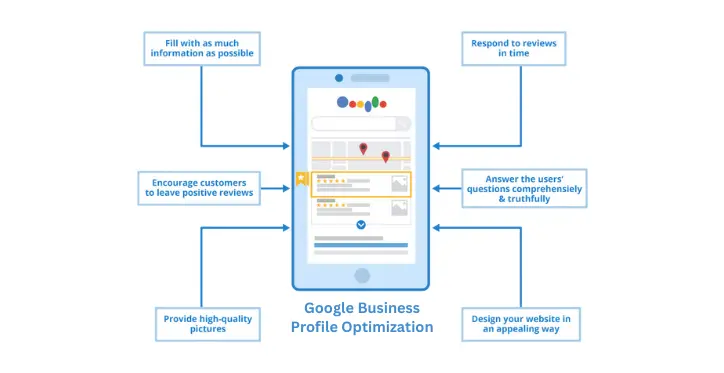
Google Business Profile is an important feature in any local SEO strategy. For white label services, the GBP of your client needs to be optimised fully for a local search.


From my experience, updating categories and detailing the business description and uploading specific images boost local rankings.


Action Steps:

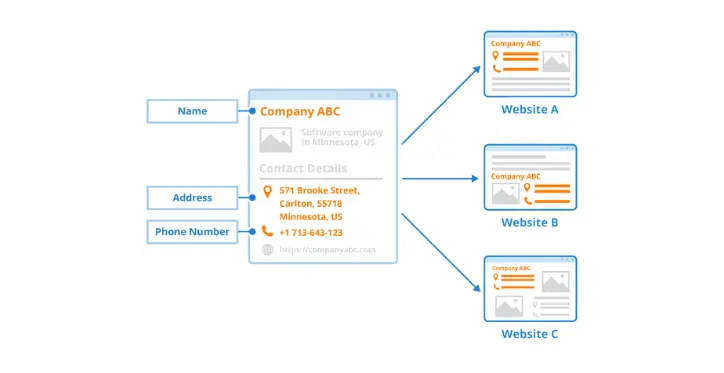
  • Ensure all business information (name, address, phone number) is accurate and consistent across all platforms.
  • Encourage reviews, as businesses with more positive reviews tend to rank higher in local search results.
  • Use Google Posts for posting updates or other promotions.

3. NAP Consistency across Online Directories

One of the most overlooked aspects of local SEO is consistency NAP, Name, Address, Phone Number information appears the same everywhere online. Inconsistent NAP data confuses search engines and hurts local rankings.


A white label provider must check regularly for accuracy of NAP data across all relevant listings.


Example: A café that I had worked with was in Cronulla. Its listings online consisted of different phone numbers in various listings. After this correction, they witnessed a 20% increase in their search visibility.

Tools Required:


  • Moz Local: Check NAP consistency.
  • Yext: manage listings.

3. Low Performing Website

More than 60% of local search is done on mobile devices. If a website is not mobile-friendly, then it’s probably losing considerable traffic and conversions.


White label SEO companies should emphasize responsive design and make sure the website loads quickly on mobile devices. I’ve always found optimization of mobile UX directly correlates to higher local rankings.


Things to Optimize

  • Use tools such as Google’s Mobile-Friendly Test to identify where improvements are needed.
  • Optimizing images and reducing the server’s response time improves the page speed.


Case Study: I recently optimized a local dental clinic’s website for mobile, and within the period resulting in a 35 percent increase in appointment bookings through mobile searches.

5. Building Local Citations

white label local SEO services

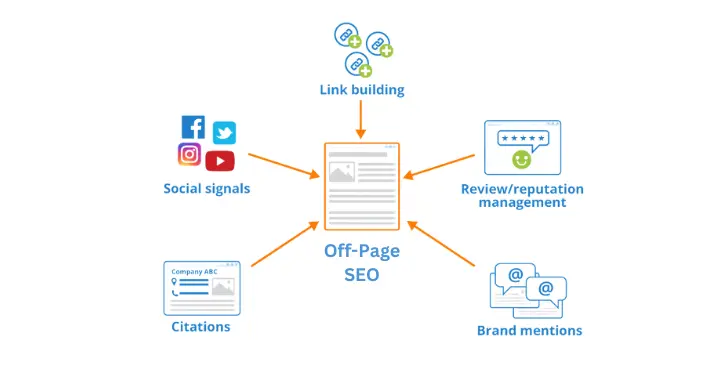
It is a mention of the business on another website usually in NAP format. The citations play a huge role in assisting with ranking a business in local SEO. For white label SEO companies, getting a citation for the business on high-authority directories and local websites is of paramount importance.


Local citations from high-authority websites have really helped with visibility on local searches.


Directories to Use

  • Yelp
  • Yellow Pages
  • Your local Chamber of Commerce website
  • Industry-specific directories

Let's Discuss Your Project

Get a free one-month consultation and share your vision for digital marketing with us.

6. Local-Centric Content Creation

I would always advise agencies to focus on generating content that the target audience of their clients need or even better, want to engage with. Good examples would be posting related to some community events, how-to guides related to local issues, or case studies on some local clients.


For example, a roofer I worked with in Newtown really saw a huge spike in organic search traffic after we published a suite of blog posts titled “Roof Repair Tips for Newtown Residents,” targeting highly relevant local search terms.


Local Content Key Tips

  • Include local landmarks, events, and news in your content to make it geographically relevant.
  • Use local keywords naturally throughout the content.

7. Building High Quality Local Backlinks

Google Business Profile Optimization

Backlinks remains one of the strongest ranking signals in SEO. For local SEO, it’s the quality and relevance of the links rather than just the quantity of them.


White label SEO providers should concentrate upon building links from authoritative, locally-relevant websites. This might involve outreach to bloggers, news outlets, and community organizations.


Actual Scenario: I worked with a small law firm in Surry Hills. I managed to get guest posts on local blogs and news sites, which increased search visibility by 50% after only a few months.

8. Service Page Development for Local Areas

A location-specific service page must be present for those operating businesses servicing different locations. Each page will be optimized with terms, content, and meta descriptions unique to the region it services.


Local-centric white-label SEO services must make sure these pages are structured appropriately, then avoid the typical duplicate content issues while maximizing the relevance for the local area.


Example: A landscaping company I worked with in Sydney had a generic service page. By creating individual pages for each of their service areas, for example, “Landscaping in Blacktown” and “Landscaping in Manly,” we saw a 60 percent increase in organic traffic.


Key Elements to Include:

  • Unique local content for each service page.
  • Local schema markup to boost the chances of appearing on the map in search results.
Voice Search Optimization

9. Schema Markup for Local SEO

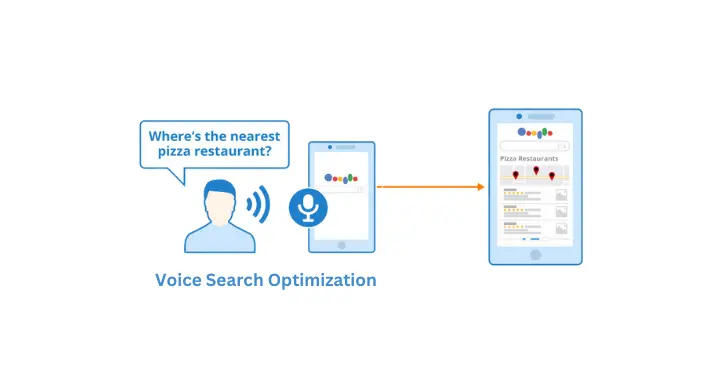
Schema markup is the structured data that will make Google and other such search engines understand what is happening in your content. Furthermore, schema markup in this case may turn out to be a ‘winner’ for local SEO provided it has highlighted key information such as an address, phone number, business hours, and service areas.


Actionable Step: Verify that the white label SEO provider is using Local Business schema on each page of the website where it would be applicable to enhance the ranking in local search results.

Off page SEO optimization

10. White Label SEO Performance Tracking and Reporting

One of the most critical aspects of white label local SEO is to monitor and report. Without periodic analysis, there is no way of knowing what is working and what is not.


I always recommend Google Analytics, Google Search Console and local SEO tracking software like BrightLocal. I keep tabs on performance. I also do regular reporting so that my clients are aware and it helps build trust.

Conclusion

By implementing these top 10 strategies, you can be sure that the white label local SEO services are measurable to clients. Whether you are a business owner or an agency, taking the right steps will enable one to stand in the good local search results and attract more traffic to their website.

If you want to amplify your local SEO, just reach out to my digital team at Digital Deep Tech so that we can come up with a plan of attack.

FAQs

1. What is white label SEO?

This type of white label SEO is considered a service wherein an agency outsources its SEO services to another third-party provider, who would then do the job under that agency’s brand.

White labeling SEO lets you expand your service offerings without you having to build a team in-house. This would allow you to save both time and resources while still earning results.

NAP and Google Business Profile must be optimized, mobile-friendly, and local links should be used.

Local SEO leads to more significant changes in 3 to 6 months, depending on competition and the level of the market.

Look for a company that has a history of delivering results, that reports in an open and transparent manner, and has experience in your niche market.

Absolutely, white label SEO is ideal for small businesses wanting to increase their level of local presence without having to hire more in-house SEO employees.

Traditional SEO is the process of promoting a company’s online footprint compared to other general/ larger search results. Local SEO, by contrast, seeks to improve on a company’s online footprint based on local-related search efforts.

Make sure the business has accurate information, ask others to leave reviews, add pictures, and keep it fresh by using Google Posts.

Same name, address, and phone number use across all of your online directories; it’s called NAP consistency. Heterogeneous information can sometimes hurt your local rankings.

Backlinks from quality local sites give an indication to the search engine that your business is trustworthy and relevant. Improving your local search rankings is the result of that activity.

Hire SEO Expert

About the Author

Deepak Sharma is the founder of Digital Deep Tech and a renowned SEO and digital marketing expert with over a decade of experience. Passionate about helping businesses enhance their online presence, Deepak specializes in creating SEO strategies that drive traffic and generate leads.

Follow me on LinkedIn —>

Top 10 Strategies for White Label Local SEO Success Read More »

local SEO challeges

Top 7 Local SEO Challenges and How to Fix Them

local SEO challeges

Table of the content

Introduction

This can be one of the most important aspects of digital marketing for any business if it targets a specific geography. However, this also comes with its own unique set of challenges that can often frustrate even the most seasoned marketers. I’m Deepak Sharma, the founder of Digital Deep Tech provides white label local SEO services. And in this blog post, I will walk you through some of the biggest local SEO challenges businesses face-and more importantly-how to solve them effectively.

Now let’s dive right into the problems, how they affect your business, and most importantly, the actionable solutions you can apply right now.

1. Challenge: Inconsistent NAP Information (Name, Address, Phone Number)

Why Does NAP Consistency Matter?

Ensure that all NAP information on your website and other platforms, such as social media, Google My Business, and local directories is consistent. Having different NAP information will confuse not only the customers but also search engines about your credibility. Google heavily relies on this data to confirm your business existence, and even minor variations like “Street” being abbreviated as “St.” can contribute to a low ranking in search results.


Solution: Conduct a NAP Audit and Standardize Your Information


First, audit any and every online directory your business is listed in. Moz Local and BrightLocal can scan across multiple directories and platforms to look for any sort of inconsistency in your NAP. Once you identify them, update them everywhere. To keep things consistent long-term, maintain a central document for the official NAP format of your business. This will keep things organized for future updates and changes.

what is local SEO?

2. Challenge: Un-optimized Google My Business Profile

How an Un-optimized GMB Hurts Your Ranking?

That’s really the heart of a local SEO strategy. Many business owners set this up once and never think about it or fill it out with minimal information. Huge mistake. No, leaving your GMB profile not fully optimized is leaving tremendous traffic and leads to others. And, if your GMB profile is actually incomplete or out-of-date, that will be negatively impacting your local search visibility and ranking in the local pack.

Solution: Fully Optimize Your Google My Business Profile

Here’s my recommendation for you to make the most from GMB:

  • Fill in All Fields: Update your company name, address, phone number, website, and working hours.
  • Add Photos and Videos: Businesses with photos get 42% more requests for directions and 35% more click-through to their website than those without.
  • Use Keywords Wisely: Even though GMB has fewer fields, a primary and secondary keyword should be subtly included in your business description.
  • Post Regularly: Use the post feature of GMB to update promotions or announcements. This will keep your profile fresh and active.

A Moz study reported that Google My Business signals account for 25% of the top-ranking factors of local SEO. If you want better visibility, then this is one indispensable step.

3. Challenge: Your Website Has Low-Localized Content

Why Location-Specific Content is a Game-Changer?


The largest local SEO mistake a business can make is by creating generic content that is not specific to the location they are targeting. Many businesses miss the point of this, meaning they never connect with the local audiences or rank in their country’s search results. Without localized content, Google can’t quite associate your business with the location you’re targeting as easily, making it even harder for you to pop up on searches for services nearby.


Solution: Location-Specific Landing Pages and Content


The best way to do this is by establishing landing pages for each geographic region that you service.  Being a plumber in Sydney, you would develop a different page for key suburbs of Sydney, like North Sydney, Parramatta, or Bondi Beach, but include keywords “Plumbing services in North Sydney.”


These pages must carry:


  • Location-specific keywords
  • Local events, news or customer stories.
  • You should also show customer reviews based on that location.


You can also leverage localized blog posts as a way to engage your community and improve your search ranking. Information suitable for local readers, such as guides on what’s happening in the local scene or specific tips only relevant to that region, can give your business a local advantage over your competition.

4. Challenge: Inadequate Citation Building and Management

Bad Citations Can Wreck Your Local Rankings


Citations, or other sites mentioning your business, comprise a huge part of local SEO. When your business isn’t listed in enough trusted local directories-or worse, if the information is bad-this will severely impact your business’s local search rankings. Poor-quality or inadequate numbers of citations tell Google that your business isn’t nearly as trustworthy or relevant as others.


Solution: Create Quality Local Citations


When this happens, the best cure is to keep building citations in better local directories relevant to your business. A simple way to begin is by adding your business to:


  • Google My Business
  • Bing Places
  • Yelp
  • Local business associations or chambers of commerce


Ensure that your NAP is the same on all these platforms. WhiteSpark and BrightLocal are great for citation management and will also help you find new opportunities for local citations. Citations don’t just give a boost to your SEO; they increase your business’s online authority.

5. Challenge: Not Collecting and Managing Reviews Effectively

Why Reviews Are Critical for Local SEO?


Online reviews are one of the highest impact levers for both rankings and user trust. A BrightLocal study claims that 87% of consumers check online reviews for local businesses, and businesses with positive reviews get perceived as more credible. On the other hand, not managing reviews or, worse, having negative reviews with no response can break your reputation and your ranks.


Solution: Actively Manage Your Reviews


Here’s how you can make reviews a competitive edge:


  • Ask satisfied customers for a review
  • Follow up on services completed with emails or texts asking happy customers to leave a review.
  • Respond to all reviews, good or bad. Thank people for positive ones and address negative reviews professionally. A well-crafted response to a negative review can showcase your commitment to customer satisfaction.
  • It can infuse local keywords into the responses to be slightly more relevant locally.

Just remember, Google wants to showcase business places with many, fresh, and high-quality reviews. Promoting and reviewing can help increase rankings quite effectively.

6. Challenge: Slow or Unresponsive Mobile Experience

white label local SEO services

Mobile Responsiveness is Non-Negotiable


We are living in a mobile-first world. As of 2024, more than 60% of all searches are conducted from mobile devices. So, if your users would like to find a restaurant near their location or plumbing service in the city, they likely do that on the go. So, when they do not see something adapted well to their mobile device, it’s single slide, and Google does not have good things to say about your ranking.


Solution: Optimize Your Website for Mobile and Speed


You have to make sure that your website provides an absolutely smooth mobile experience. Here’s what you have to pay attention to:


  • Responsive Design: Ensure it looks pretty good on all devices
  • Page Load Speed: If your page loads in over 3 seconds, then you lose 40% of users, says Google.
  • Mobile-Friendly Content: Ensure that the content on your website is readable on a small screen.


Use Google’s Mobile-Friendly Test to see how you’re doing, and change your ways if it reveals issues. If that doesn’t get your site ready, consider a professional audit and redesign with a view to giving mobile usability priority.


Let's Discuss Your Project

Get a free one-month consultation and share your vision for digital marketing with us.

7. Challenge: Overlooking Local Backlink Building

More often than not, local SEO optimization overlooks backlinks. High-quality local backlinks or authoritative domain backlinks can make a huge difference in your rankings. The lack of these local backlinks means that Google will argue that your business isn’t very connected or relevant to the local area and pushes you even further behind your competitors who’ve earned some level of local authority.


Solution: Build Local Backlinks through Intentional Outreach


Here’s how to go about local blacklining:


  • Partner with Local Businesses: This can be guest blogging or cohosting an event for backlinking.
  • Host or Participate in a Local Event or Charity: When hosting your local events, your business is listed on the website of the event you will participate in along with a backlink.
  • Get Featured in Local Press: For example, you can reach out to your local newspapers or blogs and get your business featured or interviewed for backlinking.


This generates those backlinks as a vote of confidence from local authorities and plays a vital role in enhancing both your domain authority and your local rankings.

Conclusion

The closest geolocation customers to attract your business from is a big challenge when talking about local SEO. Some of the core problems from the list above, such as NAP consistency, GMB optimization, localization of content, and mobile responsiveness, give you a rather significant uplift in ranking within the local search. From my personal experience of helping many businesses lift their local SEO, I can ensure you that those problems above directly affect your digital presence.


Let’s make sure your business doesn’t fall behind in the race of local SEO!

Frequently Asked Questions (FAQs)

1. What is Local SEO?

Local SEO is the process of optimizing your website to increase traffic, leads, and brand awareness coming from local search. This targets customers in a certain geographic area.

GMB is a local SEO game-changer. It means that your business is much more likely to be shown in Google Maps and search results.

NAP stands for name, address, phone number. NAP consistency translates into the trust of information about your business from search engines as well as customers. Unrelated data can have an adverse effect on the rankings.

This can be achieved by encouraging satisfied customers to leave feedback and easily accessible review platforms like Google or Yelp.

Citations refer to the mention of your business name, address, and phone number on other websites where they help build your online authority.

Implement responsive design, optimize your website for speed, and mobile friendly content. We these Tools such as Google’s Mobile-Friendly Test allow you to know what needs improvement.

Using quality back links coming from other established local sites and authority improves the worth of your website as well as boosts locality specific rankings in search results.

Tools such as Google My Business Insights, Moz Local, and BrightLocal can help you monitor and enhance your local SEO performance.

If you’re interacting with the geographical location in which you are on social media, then you are directly increasing your chances of online visibility and quality traffic to your website.

It may take as many weeks or months before major changes start to be viewed within the level of competition involved and some strategies used.

Hire SEO Expert

About the Author

Deepak Sharma is the founder of Digital Deep Tech and a renowned SEO and digital marketing expert with over a decade of experience. Passionate about helping businesses enhance their online presence, Deepak specializes in creating SEO strategies that drive traffic and generate leads.

Follow me on LinkedIn —>

Top 7 Local SEO Challenges and How to Fix Them Read More »
30 Days SEO Action Plan

Boost Your Local Business SEO Visibility in 30 Days

30 Days SEO Action Plan

Introduction

Today, small businesses can’t rely solely on foot traffic and word of mouth. Your online presence, in particular local search visibility, has become a growth driver that you cannot afford to ignore. Whether you are a plumber, restaurant owner, or the owner of some retail shop, maximizing your local SEO visibility will drastically increase the number of customers finding their way and ultimately landing at your doorstep.

Being a seasoned white label local SEO expert, I have successfully assisted hundreds of companies climb higher up the Google rankings, garner more local customers, and expand their businesses. In this blog post, I shall guide you through a 30-day actionable plan for boosting your local business’s SEO visibility. I will draw on proven strategies and techniques to help you navigate this journey and get your business noticed online-whether the competition is strong or weak.

Why Local SEO Matters for Your Business

So, as a small business owner, you might have heard about SEO but don’t really know why local SEO for businesses is very important. One of the biggest challenges that a small business may face is how to stand out locally. Especially on search engines like Google.

Without the correct local SEO strategy, you are invisible to most of your future customers searching for your service online. Imagine you operate a coffee shop in Sydney but failed to optimize for local SEO; a search by a customer like “best coffee shop in Sydney” means that your business is off the map, and this customer walks to your competitor’s shop instead.

Imagine losing customers to competitors because you are not showing up on the search results when it really counts. This problem is not one of supplying inferior products or services; it is that customers can’t find you on their Web. That cuts straight to the bottom line.

So, by optimizing for local business SEO, n you’ll be seen more often on Google, reach your local target audience, and eventually drive more foot traffic with sales. Next sections are going to explain how to boost your local SEO for small businesses within just 30 days.

what is local SEO?

Local SEO Basics

Before diving into the 30-day plan, let’s have a quick overview of what local SEO is.


Local SEO is the process of tailoring one’s optimization of their local presence to attract more business through relevant local searches. It occurs on Google and other search engines. If a person types “best bakery near me,” for example, local SEO will help your bakery rise to the top of that search.


There are a number of components within SEO for local businesses, including optimizing your website, claiming your Google My Business listing, managing online reviews, creating citations within directories, and maintaining consistency of name, address, and phone number.


For instance, 46% of all Google searches are for local information and 76% of people who search for something nearby on their smartphone visit the business within a day. If you don’t optimize for local searches, you are really losing out on an enormous number of potential customers.

The 30-Day Small Business Local SEO Plan

If you’re looking for how to get into the local SEO for small business, I have developed a 30-day actionable plan that will guide you in improving your visibility locally:

Week 1: Set the Foundation

  • Claim and Optimize Your Google My Business Listing: By now, you should claim your listing if you haven’t done so already. This is the first step toward enhancing your local presence.
  • NAP Standardization: Ensure the name, address, and phone number of your business are uniform on your website, other social media, and business listings. Inconsistent NAP details cause confusion to search engines and impact your rankings.
  • Mobile Friendliness: Most local searches are from mobile phones; thus, ensure it is a mobile-friendly website and loads quickly.

Week 2: On Page SEO Optimization

  • Keyword Research: Identify search terms that refer to your business locally. Assume you are a plumber in Sydney; some of the relevant terms would include “Plumber in Sydney” or “Best Sydney Plumbers.” Apply these keywords to your website’s title tags, meta description, as well as headers.
  • Include Local Keywords in Content: Optimize your service pages, blogs, and other website content with local keywords.
  • Location-Specific Pages: If you operate in several locations, ensure you create a different landing page for each of the locations with the relevant keywords and contact information.

Week 3: Citations and Listings

white label local SEO services
  • Get listed in the Right Directories: You should share your business information in local business directories like Yelp, TripAdvisor, and industry-specific directories. Listings will help Google affirm that your business exists or is real, thus your rankings will increase accordingly.
  • Social Media Profiles: Create new social media profiles by entering in your NAP details, and include your local keywords into the descriptions.
  • Online Reviews: Ask your customers to post reviews to your Google My Business listing as well as other review sites for which it makes sense. Good reviews can really improve your rankings.

Let's Discuss Your Project

Get a free one-month consultation and share your vision for digital marketing with us.

Week 4 – Link Building

  • Locally Relevant Content Writing: Blog about local events, news, or activities in your community that are relevant to your business. Restaurant owner? Blog about the local food markets nearest your restaurant.
  • Local Backlinks: Connect with local bloggers, local businesses, and attract backlinks. These reputable sources can assure Google you are an authority in your local business area.
  • Track Results: Monitor your website’s performance along with tracking keyword rank by using Google Analytics and Google Search Console.


After 30 days, you’ll be ready with local small business SEO and should start to see enhancements in search visibility.

Optimizing Google My Business for Better Local Visibility

Google Business Profile Optimization

Your Google My Business listing is an essential part of your local SEO strategy. And when you get it right, it can get you ranking at the top of Google Maps and local searches. This makes you even more present to the potential customer in your area.

How to Optimize Google My Business

 Complete all fields for your GMB profile: description of your business, hours, service.

  • Add Photos: You can upload clear photos of your business location, products, and services. Businesses with images get 42% more requests for directions.
  • Post Updates: GMB lets you post updates that help you share with customers, in an effort to show Google that you’re an active business.
  • Respond to Reviews: Actively respond to customer reviews to show the customers that you care about their feedback.
Voice Search Optimization

How to Leverage Business Listings for SEO Benefits

Web citations (or citations) are references to your company’s name, address, and phone number on other sites. Citations can help Google confirm that your business is legitimate and relevant for local search purposes.


Business local SEO success depends on the accuracy and consistency of all the listings that include information about your company. Incomplete and inaccurate information may confuse Google, which can have a negative impact on your rankings.

Off page SEO optimization

Why Do I Need Business Listings?

  • Boosts Local Relevance: Business listings are evidence to the search engines that your business is relevant to the location-based search conducted.
  • Boosts Domain Authority: Getting listed on high-authority websites such as Yelp and Yellow Pages improves your website’s domain authority which can boost your rankings for local searches.

Creating valuable content

Creating valuable content and earning local backlinks remain some of the top-ranking strategies to boost your local SEO rankings.

    • Create Locally Relevant Content: Talk about local events, news, or local interest on your blog. For instance, if you have a fitness center, you could blog on “How to Keep Fit at Local Festivals” or “Local Park Running Areas in Melbourne.”.
    • Build Local Backlinks: Building local backlinks is probably one of the most potent ways to improve your rankings in the local search. Let’s give local bloggers, newspapers, and other businesses some clicks, guest posts, and sponsorships, shall we?

How to Track Your Local SEO Performance

SEO is a long game, but it is nice to be able to see where your efforts are paying off. Here are some key metrics you should be tracking:

Creating valuable content

SEO is a long game, but it is nice to be able to see where your efforts are paying off. Here are some key metrics you should be tracking:

  • Google My Business Insights: This tool will give you data of how people are actually finding your business, what keywords they used in search, and so on and how many people visit your website or request directions.
  • Google Analytics: Track who’s visiting your site, from where, and how long they’re staying on your pages.
  • Keyword Rankings: Through Google Search Console or SEMrush, track what’s improving in your local keyword rankings over time.

Checking these metrics will give you an idea of what works and what doesn’t so that you can know where to invest next.

Conclusion

Boosting your local business in 30 days for SEO isn’t impossible. The right plan, consistency, and a deep understanding of what’s working for your business can help significantly in ranking much higher in local searches and attracting more customers. Just continue with this step-by-step guide and watch the growth of your business online.


Have questions on SEO for local businesses or personal guidance? Then you are welcome to get in touch with me. I am the founder of Digital Deep Tech, and I have already helped local businesses like yours thrive online-and would be glad to help you too!

FAQs

1. What is Local SEO?

Local SEO means the optimization of your online presence to attract more business from the local searches on Google and other search engines.

Local SEO will make it easier for you to increase visibility to local customers, hence easy for them to find you online.

You could feel you’re seeing improvement within a few weeks, but you usually expect to notice really significant changes in 3-6 months.

Because business listings represent points of online mentions of your business information, they do count toward your local relevance and placement.

Google My Business helps your business appear in the results in both Google Maps and online search so customers can find you easily.

Of course, yes, sure, good reviews will surely better your ranking local and drive more customers.

NAP stands for name, address, and phone number. Consistency of this information on all platforms will help to boost your local SEO.

You can optimize your website using local keywords, location-specific pages, and earning local backlinks.

Citations refer to mentions of your business on other websites. The more consistent and accurate your citations are, the better your rankings will be for local searches.

You can technically do Local SEO on your own, but hiring a professional means that your strategy is more effective and results-oriented.

Hire SEO Expert

About the Author

Deepak Sharma is the founder of Digital Deep Tech and a renowned SEO and digital marketing expert with over a decade of experience. Passionate about helping businesses enhance their online presence, Deepak specializes in creating SEO strategies that drive traffic and generate leads.

Follow me on LinkedIn —>

Boost Your Local Business SEO Visibility in 30 Days Read More »
White Label Local SEO Services vs. In-House SEO

White Label Local SEO Services vs. In-House SEO

White Label Local SEO Services vs. In-House SEO

Introduction

In today’s fast-changing digital world, small or even medium businesses at local levels are in constant struggle with gaining proper search engine visibility. As a Local SEO expert and founder of Digital Deep Tech, I understand very well all the burdens small businesses have to bear while trying to optimize their online presence. But they have to take a very serious decision whether to invest in in-house SEO or white label local SEO services. In this blog, I would like to outline the pros and cons of both so you can make a well-informed decision in favor of whatever helps your business grow the best.

Of course, with more than 50% of all searches being local in nature, business owners looking to attract customers to their venues will have quite a lot at stake. This blog will take each approach and delve deeper into the nuances of both, with a solid grounding in industry data and real-world experience.

What is Local SEO?

Before we head to Local SEO Services White Label and In-House SEO differences, let’s define what is local SEO. Thus, Local SEO means the optimization of all online presence of a business to attract more customers as a result of the most popular local searches. These strategies include optimizing Google My Business listings, online reviews, correctness of local citations, and implementation of on-page SEO practices.

what is local SEO?

Why do local SEOs matter?

According to Google, 76% of people who look for something nearby visit a business within one day. Additionally, 28% of these searches turn into a sale. Local SEO is therefore essential in the drive of small businesses for effective visibility in local search results.


For small business owners, understanding local SEO can prove quite important as it can potentially affect foot traffic, online sales, and also the reputation of a brand as a whole. Business owners lose customers to those competitors who are actively engaged in local SEO if they do not optimize for local searches.

The Problem with In-House SEO

Most businesses opt to in-house SEO, believing they will finally control marketing. There are, however usually a number of problems for the business involved:

1. Lack of Expertise

Very few small companies are able to offer the highly specialized knowledge and experience necessary related to the conduction of a comprehensive local SEO strategy. SEO is by no means static, with search engine algorithms constantly in flux. If a company is not constantly keeping up with this, its in-house team will fall far behind.

2. Resource Allocation

A full-time SEO team obviously will cost money and would drain those resources to other areas of the business. Small businesses often have limited budgets, so it might not be possible for them to allocate money for an SEO expert.


A full-time SEO team obviously will cost money and would drain those resources to other areas of the business. Small businesses often have limited budgets, so it might not be possible for them to allocate money for an SEO expert.

3. Time Constraints

white label local SEO services

Search engine optimization is not a one-time task. It must be constantly worked upon with updates. This stretches the scant time to the existing staff, who had to perform a multitude of tasks. For the small business, day-to-day activities will always score over the long-term SEO project.

Let's Discuss Your Project

Get a free one-month consultation and share your vision for digital marketing with us.

How In-House SEO Difficulties Affect You

Sometimes these problems can have fatal consequences. A business, under misunderstanding beliefs, may undertake certain practices that lead to penalties from search engines; of course, it will lead to severe repercussions on its appearance online. The multiple pressure for learning and adaptation in the constantly shifting SEO landscape can sometimes overwhelm stretched teams.


One of the local bakeries I worked with attempted to control their SEO in-house in the beginning. They were able to briefly spike into view and then flatten out because they did not know what was needed to keep altering algorithms. This is a classic symptom of problems that occur when businesses attempt to solely rely on in-house resources.


With failing in-house teams not being able to bring out the best strategies, frustration can run amuck. Precious time and budget are wasted in such scenarios, which inversely hinders growth rather than taking it forward. Also, this brings a feeling of disillusionment among the team members who think they are not moving forward.

White Label Local SEO Services: Benefits

Google Business Profile Optimization

Local SEO white label services are an exciting option for those organizations having trouble with local SEO on their own. Here is the reason why they may be the best option:

1. Availability of Expertise

White label providers specialize in SEO, employing professionals who are abreast of all the latest trends and best practices. Thus, your business will be suitably benefited by expert strategies to promote it properly in local markets. A white label service often offers a richer depth of knowledge compared to what can be obtained through an in-house team, where market engagements may be overlooked.

Voice Search Optimization

2. Cost-Efficient

A white label SEO service is a more cost-effective option than an in-house team. You will save on salaries, training, and employee benefits and therefore conserve resources better. Many white label services offer tiered pricing packages.

Off page SEO optimization

3. Scalability

White label SEO solutions can easily be scaled up to provide business solutions. You can expand your organization, reach new locations or offer more services- the solution providers will adapt to your needs. Such adaptability is perfect for organizations that want to expand operations without hiring multiple people.

4. Core Business Focus

With outsourced SEO, you’ll be able to focus on what you do best-running your business. That means you’ll be able to channel your energy toward customer service, product development, and those areas so crucial for revenue generation.

Consequences of White Label

I have seen thousands of businesses grow and scale when they outsource their local SEO. A small plumbing service that I had consulted for transitioned to white label services. Within six months, its website traffic went up by 150%. It was all because this business implemented proven strategies that this business’s in-house team could not execute so effectively.


Moreover, the efficient process offered by white label service providers will ensure businesses get their campaigns run much faster. Agility may be a huge silver lining in a highly competitive market for local businesses.

Cost Comparison: In-House v/s White Label

While weighing between the options of making SEO an in-house function and using white label services, one should not ignore the fact of cost comparison:


  1. In-house Costs: Hiring, training, and maintaining an in-house team is very cost-prohibitive. You pay salaries and benefits, software tools, and ongoing training. In fact, according to the Bureau of Labor Statistics, the average annual salary for an SEO specialist in the U.S. can be $62,000, excluding the benefits.


  1. White Label Costs: Most white label services will charge you a flat monthly fee for their experience, which may be in hundreds or thousands of dollars, depending on what is included within the scope. This model typically includes advanced tools and analytics that would be far too expensive for most small businesses to purchase individually.

A small business owner decides to manage SEO in-house. They commit a lot of time and resources, yet at the end of the year, not much returns on investment. Where it seems to have been better expenditure is when partnering with a white label service.

More Financial Benefits in White Label Service

Another major thing for white label services is that these services come with extra benefits that add up to the savings:


  • Access to Advanced Tools: Many of these white-label providers include premium SEO tools into the packages and may help you gain all the insights without making expensive subscriptions.
  • Training and Support: Most of the services include training and support, equipping your team to understand local SEO better even if you’re not managing it personally.

Expertise and Scalability

Local SEO is pretty tricky and always in flux. Certainly, good results depend a bit on some degree of expertise. White-label providers often have separate teams for various components of SEO-the technical optimization side and the content creation side. This is knowledge at this depth.

Scalability and Flexibility

A local business needs to be agile enough to respond to market shifts. White-label local SEO solutions are inherently more flexible. For instance, if a business wants to launch a new line of products, the white-label provider can change their strategy overnight by incorporating the change in products; the efforts at local SEO would stay on par with the business’s current goals.


But I do recall one landscaping company I aligned with to expand it into new areas. Utilizing white label local SEO services, they were able to penetrate three new markets within one year, while servicing their core base.

Long-term Growth

The white-label local SEO provider has to be agile in a fluctuating digital marketing landscape. Indeed, market trends change with the preferences of consumers and the way they search. An efficient white label local SEO provider will monitor changes and adjust the plan to keep your business on the fast track to long-term growth and profitability.

How to Select the Ideal White Label Local SEO Service

Upon selecting your white label local SEO provider, consider the following criteria:


  1. Reputation and Experience: You require a well-experienced provider with strong credentials in local SEO. Research the credibility of their reviews, case studies, and testimonials.


  1. Customization: A provider who understands your business well and tailors the service according to your needs is crucial. Unless you have a unique business model, one-size-fits-all approach may not be the best for your business.


  1. Transparency: A good white label service will provide you with pretty clear reporting and analytics that show what’s going on in your campaigns and what ROI is being brought in.


  1. Communication: That’s important. The provider, in terms of responsiveness and willingness to work closely with your team, matters.


  1. All-inclusive Services: You have to find providers who are going to give you everything you need in terms of local SEO services, including GMB optimization, local link building, citation management, and review monitoring.

Building a Successful Partnership

A successful white label local SEO partnership with a provider is built on openness and mutual objectives. Working in harmony as partners can help ensure that your SEO strategy aligns with your business goals

Real Life Examples

As highlighted in the previous case study, a resume writing service noted an increase in website traffic by 150% after transferring services to white label SEO. This was occasioned by a solid local SEO strategy involving optimizing its Google My Business listing, crafting a content marketing approach, and creating good online reviews for the business.

What's Been Learned

These case studies show real-world advantages of white label local SEO services. They have demonstrated just how often expertise, scalability, and a multidisciplinary approach to local SEO will be the difference for small business success.

And with all these insights and strategies thrown around in this blog, you will be able to decide the best course of action for yourself – whether to pursue in-house SEO or outsource it all to a white label local SEO provider. If you have specific questions or need one-on-one guidance on anything, feel free to ask! Here to help your business grow better.

Conclusion

To put it in a nutshell, each in-house SEO and white label local SEO has its pros and cons. For many small businesses, the benefits of outsourcing local SEO usually outweigh the advantages of an in-house team. White label solutions provide clients with access to all expert knowledge, the most cost-effective strategies, and scalable services that would fit their constantly changing requirements.


Being a local SEO expert, I certainly think that your business goals, budget, and resources need to be measured. If you cannot succeed with in-house SEO or just want to do what you do best, that is running your business, then white label local SEO services can help you out.


By taking the time to research your choices and make smart decisions, you can launch your business on the right path in a tough local market. But perhaps most importantly, really good local SEO isn’t about visibility. With the right approach, you will be linked more effectively with your community and driving meaningful engagement that converts.

FAQs

1. What are white label local SEO services?

White-label Local SEO services allow agencies to sell SEO services branded with their respective companies, but without having to manage the work.

I look for suppliers who have a successful track record, open communication, and a solution tailor-fit to the needs of my business.

Yes, they could definitely scale with the growth of your business and add services as those become necessary.

Local SEO is optimized by focusing on searches based on location, while traditional SEO targets keywords without any geographical constraint.

Absolutely! White label providers may help you optimize your GMB listing for accurate details and local search optimization purposes.

Research their skills, existing resources, and time and effort that would be needed to handle SEO properly.

Some of the key metrics include traffic, rankings on a local search engine results page, and call and visit conversions.

It is very important for small businesses to attract local customers, and by many studies’ findings, a significant portion of local searches ends in in-store visits.

Other frequent mistakes are GMB optimization, lack of local citations, and unmanaged online reviews.

There are many business owners who found success by mixing these two model types: tasks are outsourced as a white label service and managed in-house with other areas.

Hire SEO Expert

About the Author

Deepak Sharma is the founder of Digital Deep Tech and a renowned SEO and digital marketing expert with over a decade of experience. Passionate about helping businesses enhance their online presence, Deepak specializes in creating SEO strategies that drive traffic and generate leads.

Follow me on LinkedIn —>

White Label Local SEO Services vs. In-House SEO Read More »
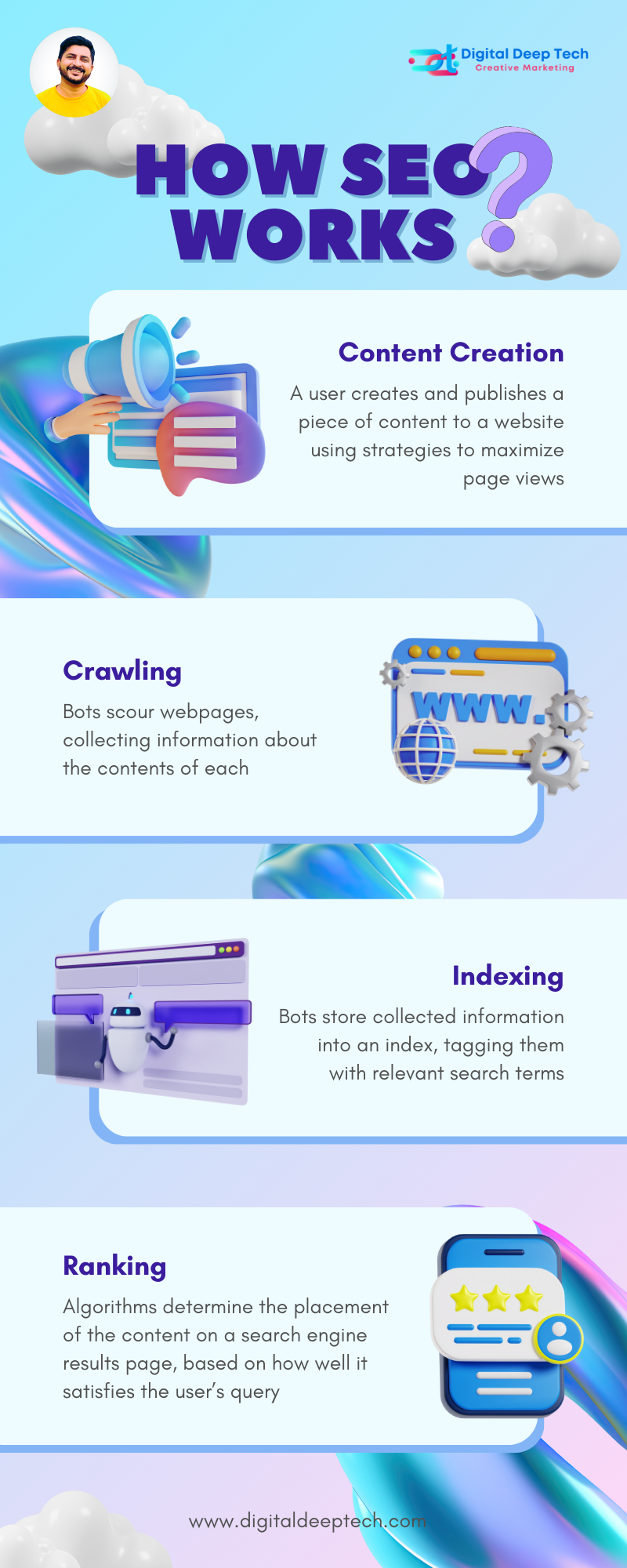
SEO Checklist

The Ultimate SEO Checklist for Startups

SEO Checklist

Why SEO is Important for Startups

Among all else, probably the most ignored of all factors that come into play when launching a startup is search engine optimization, or SEO. Entrepreneurs spend time building the product and looking for customers but, again, never really get down to business: how are their audience members going to find them online?


Usually, people view SEO as too technical, too expensive, or consuming too much of their time. Thereby, lots of startups just forget about it. No problem, they reason. They’ll get to it “later.”


Pretending to do nothing with SEO is the same as opening a store without a sign outside. Now you can envision having this great product without having anyone ever know it exists at all. With no SEO, your website would be like living in the huge web, totally invisible.


To dominate those searchers there will always be competition that has seriously invested in SEO and they will end up at the top of search engines. You, on the other hand, will be very far behind. This translates into lost opportunities, fewer customers, and slower business growth.


I’m Deepak Sharma, the founder of Digital Deep Tech, a white label Local SEO service provider and one with loads of experience working with hundreds of startups over the years. I know firsthand how pivotal SEO is to business success, especially when it’s a local or small business.


Good news? You don’t have to be intricate or pricey, though. Instead, by following this ultimate SEO checklist, you can build a strong foundation to get organic traffic and convert visitors into loyal customers.

Getting Your On-Page SEO Right

Your website is live, but it is not optimized for search engines. This makes it harder for Google to understand your site, and lower your chances of ranking high on search engine results pages (SERPs).

As another barrier to your beautiful website is without on-page SEO. Google algorithms are getting smarter, but they still require hints from your content on your site to rank you correctly. If you fail to pay attention to those hints through optimizing title tags, meta descriptions, or even headings, the site may rank poorly for the keywords that your target audience uses for searching.


what is local SEO?

Solution

On-page SEO falls entirely within your control and is one of the more simple parts of SEO to get right. This is your to-do list to ensure that your on-page SEO is tip-top:


  • Title Tags and Meta Descriptions: Every page should be accompanied by an optimized for the keyword title tag and meta description. Keywords such as affordable SEO for local businesses or small business local SEO might go into these tags, depending on your specific keywords.


  • Headings: You should use descriptive H1, H2, and H3 tags to guide the reader but also assist search engines in following the content structure.


  • Internal Linking: Cross-linking to relevant pages on your website will improve user navigation and increase search engine rankings.


  • Image Alt Text: Each picture on your website should apply alt text to help search engines understand the content of the image.

You can enhance both the user experience and rank with these on-page SEO methods as part of your strategy.

Keyword Research: The Foundation to Success

Many of today’s startups don’t realize how important keyword research is or cannot be bothered with it at all. Using the wrong keywords or not using them at all can easily become a waste of time, resources, and money.


Sometimes, the worst tragedy that can happen to you and your site is attracting the wrong audience or no audience at all in the event that you target the wrong keywords. Imagine that after putting so much effort into blog posts or product descriptions, no one sees it because you didn’t do your research about what is actually being sought after.

Solution

As a startup, you will have to ensure that keyword research is done correctly. Firstly, target long-tail keywords, which are extremely specific phrases with significantly lesser competition than generic ones. For example, “local small business SEO” or “local business SEO services” may be highly less competitive than a generic term like “SEO services.”


Use the Google Keyword Planner or any of these tools: Ubersuggest or Ahrefs to:


Find potential keywords with considerable volume and relatively lesser competition.


Target local keywords if you are targeting a specific local area for instance, local SEO Google My Business, or SEO for small local businesses.


Write your keyword naturally and repetition it within your content, especially in headings, meta-descriptions, and body.


Those start-ups that give keyword research importance will automatically attract the targeted audience right from the starting point and hence be able to enhance their online presence as well as growth.

Mastering Local SEO: Google My Business and Beyond

In most cases, local startups have the problem of visibility within their own geographical area. Engaging with a competitor against the other large business can be really intimidating to them, as the latter dominates all local searches


If your business doesn’t appear in the local search results, you’re missing out on a massive opportunity. Perhaps customers in your city are searching for services that match yours to the tee, but without local optimization, you won’t appear in Google My Business or other listings of local businesses. That’s like giving away all of your potential customers to your competitors.

Solution

white label local SEO services

If you are one of those small businesses or startups that is hoping to grab that highly precious top spot in the local markets, then for sure, local SEO is the most powerful tool for you. Here’s what you should concentrate on:

  • Google My Business : Claim and fully optimize your listing. Make sure that the name, address, and phone number of your business appears exact and uniform everywhere. Use relevant keywords such as “plumbing services in Melbourne” and “roofing contacter in Sydney” in your business description realted to your industry.
  • Local Citations: Get your business listed in reputable, quality local directories (such as Yelp, Bing Places or Apple Maps) with consistent data.
  • Reviews: Find satisfied customers who will talk positively about your business through reviews, for it could affect rankings significantly.
  • Location-Specific Content: Write blog posts, landing pages, and service pages tailored for the local area, such as “plumbing services in Melbourne” and “roofing contacter in Sydney”.

By mastering small business local SEO, you get to play on an even field; it makes it easier for local customers to spot and trust your business.

Let's Discuss Your Project

Get a free one-month consultation and share your vision for digital marketing with us.

Creating Authority with Backlinks

Many startups forget about the significance of backlinks. In the lack of backlinks, your website could be unable to gain the authority required to have a good rank in search engines.


If your site has fewer quality backlinks, Google will not take it seriously enough. Thus, your search engine visibility might be highly restricted. It becomes difficult to compete with well-established businesses if your site has very few to no links pointing to it. Backlinks act like “voting of confidence” from other sites; with which Google sees that your content is trustworthy and worthwhile.


 Baclinks are really a lot of work, but the reward is immense. Here are some strategies I would recommend to startups:

  • Guest Blogging: Write guest articles to other trustworthy blogs in your niche. In the right places, include links pointing back to your website.


  • Business Partnerships: Form relationships with other local businesses and you can exchange links.


  • Content Marketing: Create shareable content that others will love linking to―infographics, how-to guides, or industry reports.

These will make your website authoritative and enable you rank higher in search engines.

Mobile and Speed Optimization

Google Business Profile Optimization

Most startups don’t understand how much it matters to be mobile friendly, considering that the majority of users browse on mobile. Websites which render slow or are not mobile friendly lose traffic very quickly.

Suppose a customer walks into your site and finds it loads slowly or is not user-friendly on their smartphone. Most of them will close the window in just a few seconds, raising your bounce rate and killing your chances of ranking well in Google.

Solution

Mobile-first indexing is now in place so, in simple words, Google will default the mobile version of your website in determining rankings. Here’s how you can be sure your site is optimized:


  • Responsive Design: Your website should perfectly adapt to every screen size.


  • Page Speed: Check on the loading time of your website using tools like Google PageSpeed Insights and eliminate any speed-damaging issues.


  • Mobile Usability: Tap targets: Ensure the buttons are large enough and easy to tap. Legible fonts: Ensure text is legible.


  • Navigation: Should be smooth. For mobile or speed, you’ve optimized thus far, which has improved UX and increased the chances of ranking better in the search engine.
Voice Search Optimization

Analysis SEO Performance

You’ve implemented an SEO strategy but are not quite sure if it’s working. Anything that a campaign does cannot be known without proper tracking and analysis because its components driving results cannot be identified and so can’t be improved.

SEO running blind. Without monitoring your performance, you can’t possibly make any informed decisions on what’s working and what’s not; rather you may waste time and resource on strategies that are not yielding results.

Off page SEO optimization

Solution

There are always these tools to use when tracking SEO endeavors:

  • Google Analytics: you can track traffic, bounce rate, session duration, and conversions;


  • Google Search Console: you can track keyword rankings and see crawling or indexing issues


  • Rank tracking tools: observe changes in the keyword ranking over time with tools Ahrefs or SEMrush

Analyzing such data will enable you to refine your SEO strategy in favor of tactics with the best results.

Conclusion

Follow this comprehensive SEO checklist and you’ll be one step closer to a robust online presence for your startup. Remember that long-term SEO investment can really pay off in the later stages of increased traffic, better rankings, and more customers.

Unlock the potential of your startup with our expert startup SEO services. Get in touch with us today to learn how we can enable you to increase online visibility and attract more customers to create sustainable growth in a competitive marketplace. Grow together!

FAQs

1. Why is local SEO important for small businesses?

Local SEO gets local customers to small businesses by advancing the ranking of those small businesses in Google’s local search.

Google My Business provides free management of your business’s online presence on Google, improving your presence and credibility in searches.

Start by ensuring your Google My Business listing has a consistent NAP information. Also create local citations, and generate location-specific content.

In simple terms, since backlinks are hyperlinks from other websites to your site, they’re in essence a vote of confidence for your website in the eyes of search engines. This enhances your site’s authority and ranking for searches.

SEO is a long-term strategy, and the site might take between 3 to 6 months to increase after wholly turning it on to get the required results, depending on the level of competition and how aggressively you pursue SEO tactics.

Some common mistakes include neglecting keyword research, ignoring local SEO, not optimizing for mobile, and failing to track results.

On-page SEO is the optimization of individual web pages to rank better in the search results. It means optimizing elements like a title tag, meta description, headings, and content.

Local citations are mentions of your business on other websites, such as directories, social platforms, and review sites. They help improve local SEO by increasing trust and authority.

Using tools like Google PageSpeed Insights will point out the problems and help solve them by optimizing images, leveraging browser caching, and minimizing server response times.

Because most internet users browse from mobile, Google favors mobile-friendly sites and, without much doubt, a site that is optimized for mobile browsing can be ranked higher on search results in comparison with its non-mobile optimized counterpart.

Hire SEO Expert

About the Author

Deepak Sharma is the founder of Digital Deep Tech and a renowned SEO and digital marketing expert with over a decade of experience. Passionate about helping businesses enhance their online presence, Deepak specializes in creating SEO strategies that drive traffic and generate leads.

Follow me on LinkedIn —>

The Ultimate SEO Checklist for Startups Read More »

10 Must-Do Local SEO Steps for Fast Website Traffic

10 Must-Do Local SEO Steps for Fast Website Traffic

10 Must-Do Local SEO Steps for Fast Website Traffic

Introduction

Do local SEO if you’re a business owner looking to generate customers in a short period. It’s the easiest and most significant targeted traffic generation method, and when you get it done professionally, it’s sure to push your website to the top on Google search results.


As a local SEO expert and founder of Digital Deep Tech, I have helped businesses gain visibility and generate sales through white label local SEO tactics.


In this section, I’ll take you through 10 must-do steps to get you traffic as fast as possible by leveraging local SEO. These steps assure a driving strong local SEO presence as well as attract intent-to-purchase local customers. Alright, let’s dive into actionable strategies that could put your business on the map.

10 Local SEO Strategies to Attract Fast Website Traffic

Step 1: Optimize Your Google My Business Profile

Most local businesses use GMB, but ignore it and miss potential rankings in the local search.

Can you imagine the scenario: you have a great business, but nobody finds you because your GMB profile isn’t optimized? Losing traffic, and worse, it is getting to the competition.

Local SEO Solution: Optimize your Google My Business profile. GMB is the heart of local SEO. There’s a lot to it, especially when you think about the importance of a Google My Business profile to your ranking on Google Maps and local searches. Make sure that your profile is totally filled out with right NAP details such as business name, address, and phone number.

  • Local keywords such as “best roofing services in Sydney”
  • Quality images related to your business
  • Continue posting posts, offers, and events
  • Feedback from customers, response

In recent times, one of my clients is a roofing business. It increased their traffic by 50% within three months after optimizing its GMB profile.

Sharing GMB posts regularly helps increase engagement, and keywords like “local seo business model” or “local seo and google my business” can increase your chances of ranking for related queries.

what is local SEO?

Step 2: Analyze Website Issues with an SEO Audit

You invest marketing dollars into it, and yet you do not know whether your website is locally SEO friendly or not. You are losing out to the competition as they have audited and corrected their local SEO deficiencies.

Solution: A local SEO audit will spot gaps and opportunities for improvement. To audit your own, pay attention to the following key areas:

  • On-Page SEO: These must be checked to ensure that the title tags, meta descriptions and headers are correct and also optimized with local keywords. Examples would include “Local SEO means SEO for business in [city]” or “Local business website SEO.”


  • Local keyword analysis: Are you targeting the right keywords for local search? Tools such as Google’s Keyword Planner might come in handy in figuring out whether you are using the most appropriate keywords: “SEO checklist for local small business websites” or “local SEO tips small businesses”.


  • Technical SEO: Make sure your site is mobile friendly as well as loads very quickly. Those are two of the most direct issues related to improving your position in local searches.


  • Backlink profile: Quality backlinks from local websites show Google that your business is relevant in your area.


An SEO audit will highlight what needs work, so you can focus your efforts in the areas most likely to make a difference.

Step 3: Target Local Keywords for Your Website

Using the wrong generic keywords or those incorrectly targeted means you won’t be drawing the right kind of local traffic to your site.


Imagine this-you are getting website visitors, but they are not converting into customers because they are not local. It is frustrating and your marketing efforts waste their value.


Solution: Local keyword research is vital. You need to utilize keywords that describe your location and services. Long-tail keywords such as “plumbing service near me” or “best restaurant in Sydney” will help target users who seek services in your locality.


Here’s how you do it:

  • Use the tools and resources, such as Google Keyword Planner and Ubersuggest, to find the keywords related to the city or region that you have chosen.
  • You must then incorporate the chosen keywords organically into your meta tags, headers, and content.
  • You can include city names and services, such as “Digital Deep Tech offers SEO strategy for local business in Sydney.”

For instance, after we optimized our local keywords for the service pages of a client, within two months his local traffic was upgraded by 40%. All this is about relevance and precision.

Step 4: Create Quality, Location-Approved Content

Generalized content is not localized to outreach to the local customers, also failing in the locality searches.


Your content on your site could be great information, but if it doesn’t lend to more specific solving of a problem about your local audience, it really loses to any valuable traffic.


Solution: The concept of location-specific content works great well. Create blog posts or service pages that focus distinctly on the city, neighborhood, or region you’re in. Target questions and problems local customers have to address them in a way demonstrating that you understand their needs.


I often create location-specific guides. For example, “How to Choose the Best Local SEO Agency for Your Sydney Business.” This accomplishes two things: it opens up potential clientele and builds local rankings in search.

Step 5: Build Local Citations and Backlinks

Your website has no authority and thus not ranking high enough in local searches.


You may very well be doing everything right on your website, but without external validation in the form of backlinks and citations, your competitors will continue to outrank you.


Solution: Local Citations and Backlinks Boost your credibility. Citations are online mentions of your business name, address, and phone number, helping improve local search visibility.


Here’s how to get started:

  • Get listed on high-authority business directories such as Yelp, Yellow Pages, and specific niche sites.
  • Reach out to local bloggers or news outlets to feature your business.
  • Partner with other local businesses for backlinks.


For example, I had helped a local pizza shop get backlinks from community food bloggers. The restaurant achieved ranking #1 for “best pizza in Sydney” within months.

Step 6: Improve Mobile-Friendliness for Local Search Results

white label local SEO services

Local searches account for an enormous majority of mobile users, yet your website has not been optimized for mobile devices.


Frustrating customers and losing sales is what happens if your website is not mobile-friendly. Google also penalizes non-responsive sites, affecting your rankings.


Solution: Ensuring that your site becomes mobile responsive is the key to reaping success in the world of local SEO. Here is why:


61% of mobile users are likely to contact a local business with a mobile-friendly site.

Google uses mobile-first indexing, so the mobile usability of your website is going to have a direct impact on how high you rank.


As a matter of fact, I’ve optimized one of my clients’ sites for mobile. And within one month of doing so, his traffic from local keywords increased by 30%.


Also, most of the local searches are voice-based. So optimizing the content for voice search using conversational keywords can give you an extra advantage.

Let's Discuss Your Project

Get a free one-month consultation and share your vision for digital marketing with us.

Step 7: Use Customer Reviews and Testimonials Now

Unless your business has adequate reviews, there isn’t any social proof for the exact business they are looking for.


Even though you may offer the finest services available, the customers might not move ahead with the decision unless they find enough reviews online. Too little review can greatly hound the credibility level of any business.


Solution: Encourage reviews from the customers and, at the same time, put up testimonials on your website. In addition to this, Google reviews help enhance the visibility of your business in local search results also. See what you can do:


  • Ask to leave reviews via email after a service or a sale.
  • Respond to positive and negative reviews.
  • Host your reviews on your web page.


For instance, after working with a local salon, I developed a review strategy that upped their 5-star reviews by 80%. That then jumped them in the rankings, thus increasing more foot traffic to this business.

Step 8: Monitor Competitors and Adjust Your Local SEO Strategy

Google Business Profile Optimization

You do not know what your competitors are doing to have an edge in local rankings.


Lack of watching the competition often leads to missing chances to make your strategy better, hence getting ahead of them.


Solution: Monitor and know their competing strengths and weaknesses. Use instruments such as Ahrefs or SEMrush and see where their backlinks are coming from, what keywords your competitors target, and what type of content works for them.


For example, I helped a client surpass their competitor by identifying gaps in the competitor’s keyword strategy. We focused on long-tail local terms such as “local business seo software” and “seo agency for local business,” generating more traffic.

Step 9: Social Media and Local Outreach

You’re not socially interacting with your local audience on social media, missing an important piece of a significant source of traffic.


Social media is a platform that can be very easily viewed, and if you are not seen on social media, local customers may not even have a clue that your business exists. It is as if they are bonding with your competitors while you lose those crucial interactions.


Solution: Use available social media applications like Facebook, Instagram, and LinkedIn to engage the local audience. Post regularly regarding local events, promotions, and news so that your page is visible and relevant.


The clients frequently utilize the social media for community engagement and I have seen enormous results. In fact, one client increased their local following 300% after using Instagram to connect with customers based nearby.

Voice Search Optimization

Step 10: Monitor the Results and Improve Your Local SEO Strategy

Not tracking the local SEO performance can’t know what is working and what’s not.

You’re putting in all this effort, and you are not quite certain if your strategies are paying off. Unless you track progress, you’ll be missing on those vital opportunities for improvement.

Solution: Track the metrics of local SEO using Google Analytics and Google Search Console. Consider tracking traffic and keyword rankings to understand what works and where adjustments need to be made.

For example, analyzing the search traffic and adjusting the strategy is the way through which I could raise orders online from a local retailer to two times within six months.

Apply these 10 steps to build up your local SEO and get fast, relevant traffic to your business.

Off page SEO optimization

Conclusion

Mastering local SEO is the key to standing out in your community and attracting high-intent customers to your business. Optimizing your Google My Business profile, creating location-specific content, building local citations, and leveraging reviews are some of the important steps to drastically improve your online visibility. All the 10 steps above play a crucial role in elevating the presence of your local SEO, ranking higher, and attracting targeted traffic much faster.


Local SEO is a continuous process. Monitor your efforts, track your results, and adjust and optimize your strategy to stay on top of the curve. With consistent effort and smart tactics, your business can dominate local search results, resulting in sustainable and long-term growth. Ready to take your visibility to the next level? It’s time to put these into action today!

FAQs

1. What is local SEO?

Local SEO is getting your website optimized for location-based searches in order to attract more local customers by improving your ranking.

Google My Business is a service that enables your business to appear in search for local terms and on Google Maps, making it easier for local customers to find you.

Generally, you should begin to experience improvements within 3-6 months, depending on what you do and what else is competing.

Yes, with target-local keywords, reviews, and relevant content, small businesses can really compete.

Local SEO focuses on location-specific searches, while traditional SEO’s focus is on a broader, often national or global rankings.

Use tools such as Google Keyword Planner and see what your competitors rank for locally.

Yes! Reviews are of great importance in creating trust and higher rankings with local searches.

Many facets of local SEO you may handle yourself, but it will go much quicker and produce far better results if you hire an expert.

A citation refers to an online mention of your business’s NAP, including your name, address, and phone number on various websites and directories.

Use local bloggers, new sites, and other business opportunities as partnerships, guest posts, or mentions.

Hire SEO Expert

About the Author

Deepak Sharma is the founder of Digital Deep Tech and a renowned SEO and digital marketing expert with over a decade of experience. Passionate about helping businesses enhance their online presence, Deepak specializes in creating SEO strategies that drive traffic and generate leads.

Follow me on LinkedIn —>

10 Must-Do Local SEO Steps for Fast Website Traffic Read More »

What is SEO

What is SEO? A Beginner's Overview

What is SEO

Introduction

Welcome to first lesson in our 90-day SEO course! Today we’re diving into one of the most important questions any novice entering the digital marketing world: what is SEO? Whether you’re a business owner, freelancer, or just curious about digital marketing, understanding SEO is the key to growing your online presence.

SEO, or Search Engine Optimization, is the way through which websites are found on search engines like Google. But it’s much more than just keywords and rankings. I am Deepak Sharma, a local SEO expert and founder of Digital Deep Tech, and over years, I have helped businesses rank highly and attract organic traffic across the globe. I’ve seen the best, the worst, and downright awful side of SEO, and today, I’ll write everything I learned to guide you through your journey.

By the end of this blog, you’ll gain a solid knowledge of what SEO is, but also more importantly, why it matters now more than ever to get you ahead on the web. I’ll take you through actionable ways you can begin optimizing your own site.

What is SEO?

SEO, short for Search Engine Optimization, is the improving of how a website or web page ranks in search engines by unpaid results; the words “natural,” “organic,” or “earned” are also used to refer to such results.


In the context of simpler terms, let’s think of Google as a library. Every website is considered a book in that library. When users search for something, Google determines which book is most relevant to the users for the search. In simple terms, SEO is how you make sure your “book” is at the top of the stack.


So when I started out in SEO, my initial vision was an easy one: simply use the right keywords. Boy was that wrong. SEO involves so much more than that, and with how it all built, it’s easy to see how-and why-SEO involves optimizing everything from content and structure to links and page speed, and whether or not your site is mobile-friendly at all. Each of these things tell search engines how useful and relevant your content really is and, consequently, will go on to impact your ranking.

what is search engine optimization

Why is SEO Important for Beginners?

As I was saying, SEO is the basis of visibility online. But why should beginners care? Well, think this: 93 percent of online experiences begin with a search engine. If a website isn’t optimized for a search engine, most of that potential visitor and customer audience is left unexploited.


I have worked with small businesses that were totally invisible online before we started doing SEO. For instance, one roofing company was existing for 13 years. They had never ranked for anything local.


We optimized their on-page SEO elements, ensured they were optimized in Google My Business, and secured several high-quality backlinks. They have already risen from 50 visits per month to more than 1,000 per month within six months, all without running a single paid ad. This is the possibility of SEO done correctly.

Why SEO Matters (Data-Driven Insights)

  1. 70% of marketers find SEO to be more effective than PPC, or pay-per-click advertising.
  2. 53% of all website traffic comes from organic search.
  3. 75% of users never scroll past the first page of Google search results. If you’re not on the first page, you’re virtually invisible to most of your audience.


The translation of SEO for a beginner would probably be like having a map in a foreign city. Lost in a foreign city without a map? You are lost. With a map, you know exactly where you are going and how to get there.

Key Concepts and Terms of SEO

Keywords In other words, keywords are just those terms or phrases that the users might search for when they’re looking for anything. For instance, if a user is looking for the best pizza in Sydney, then the phrase best pizza in Sydney is the keyword.

The more optimized your content is for the appropriate keywords, the more possible your site will turn up on the searches for a keyword.


  • On-page SEO: This is about optimizing the content and the HTML source code of your website. It speaks of elements such as meta tags, internal linking, URL structure, and keyword optimization. You should always tell your clients this: “Think of on-page SEO as grooming your storefront.”
  • Off-page SEO: it is an off-site practice basically focused on link building by producing backlinks from other relevant sites. The ultimate objective is that backlinks will act like a vote of confidence between websites, transmitting to the search engines that the content is worthy.
  • Technical SEO: Make the behind-the-scenes architecture of your website better. That’s when you ensure site loading speed, code clarity and error-free code. That makes such a vast difference, just as it often does in a local SEO expert like myself.
  • SERPs: Shorthand for Search Engine Results Pages, referring to the pages a search engine actually displays when a query is entered. Ranking well on SERPs is important because, according to various analyses, most users scroll only up to the first page.
  • Organic Traffic: This refers to visitors coming to your website via unpaid search results rather than via paid advertisements.
  • Backlinks: These are links from other websites to yours. A good link coming from a trusted source such as a news outlet or industry leader can boost the level of SEO on your website much.
how SEO works

My Personal Experience with SEO

I really didn’t know how crucial SEO was for business growth when I started Digital Deep Tech. At that time, the site was ranking nothing on anything, though I had a pretty good content offering. And I realized that without optimized in every one of its aspects, great content was enough.


I spent hours reading up on SEO trends, testing strategies, and watching the results. My first major victory was getting a plumber’s site ranked for highly competitive keywords such as “plumber Sydney.” Within three months, the plumbing company was getting 10 times more leads than before. From then, I knew SEO was something every business ought to invest in.

How to Begin Implementing SEO?

Alright, let’s dive right into the actions we can take to improve SEO and push ranking up in Google.

Let's Discuss Your Project

Get a free one-month consultation and share your vision for digital marketing with us.

1. Start with Strong Keyword Research

SEO starts with a good keyword selection. You can get started by finding what keywords your audience is looking for with Google Keyword Planner, Ahrefs, or Ubersuggest.

Long-tail keyword focus (3+ words) Because it’s generally easier to rank for long-tail keywords and often represents stronger intent. Take the broad term “SEO” and instead focus on “local SEO expert in Sydney.”

2. Optimize On-Page SEO

product keyword research services

On-page SEO optimization ensures that Google can read, index, and understand your content.


Use your primary keyword in title tags and meta description. It is the text that will appear in the search engine.

Split your content into Headings (H1, H2, H3), and make use of keywords within natural flow of headings.

Make your content well-structured and use conversational tone for writing. Do not stuff the keywords. Use it naturally throughout your text.

3. Optimize for Off-Page SEO

Another good way to enhance your SEO is by building high-quality backlinks originating from other different websites. Guest blogging, social media sharing, and industry influencers relationship-building can be applied.

As I often remind my clients, “Backlinks are the currency of trust in SEO.” The more quality links you get pointing to your site, the better your authority will be in Google’s sight.


wordpress speed optimization services

4. Speed and Mobile Optimizations

The Google keywords clearly state that speed and mobile optimized sites must be checked for ranking points. Check your site’s speed through the use of Google PageSpeed Insights; make sure it is responsive too.

In 2020, I optimized the website to go from 8 seconds down to under 3 seconds for one individual client. Result? Their bounce rate decreased by 40%, and they moved up in rankings for key search terms within a month.

Target Audience Keywords Research

5. Monitor Your Results and Continuously Optimize

SEO is a long-term game. So track your performance regularly using tools like Google Analytics and Google Search Console. Keep monitoring your rankings, organic traffic, and keyword performance. As I always say, “SEO is not set-and-forget; it’s a continuous process.”

Conclusion

To put it in perspective, SEO is a part and parcel of any online strategy. It will push you to a higher ranking in search results, and you will enjoy more organic traffic than ever before. In addition, ultimately, with it, your business will grow. We discuss the basic concepts of SEO, why it matters, and how you can start optimizing your website today.

Next lesson, we are going deep into keyword research, where I will show you how to find the best keywords to target for your website. Keep learning and practicing so that your online presence takes off.

FAQs

1. What is SEO?

SEO stands for Search Engine Optimization.

SEO works by optimizing various aspects of your website so search engines like Google can easily find and rank it higher in search results.

Yes! Be it a personal blog or an e-commerce store or for local businesses, SEO is important for organic traffic.

For instance, it will take 3-6 months to see the major results; however, it will depend on your type of business, as well as competition.

Do you understand what on-page and off-page SEO are? On-page SEO would be the optimization of elements within your website (content, titles, etc.). As for off-page SEO, which are factors that are external like backlinks and social signals.

Hire SEO Expert

About the Author

Deepak Sharma is the founder of Digital Deep Tech and a renowned SEO and digital marketing expert with over a decade of experience. Passionate about helping businesses enhance their online presence, Deepak specializes in creating SEO strategies that drive traffic and generate leads.

Follow me on LinkedIn —>

What is SEO? A Beginner’s Overview Read More »