
SEO

Blog feature image about improving lead generation and SEO performance for small business websites

Google Business Profile Mistakes Losing You Leads

Many businesses set up a profile but still struggle with a Google Business Profile not getting leads. This guide explains the common mistakes that reduce visibility, why enquiries slow down, and the simple changes that help turn searches, views, and visits into real customer calls.

Deepak Sharma - SEO consultant

Deepak Sharma

SEO Consultant

March 02, 2026  |  7 min. read

3D illustration representing SEO and lead generation strategy for small business websites

Google Business Profile Not Getting Leads? You’re Not Alone

I hear this quite often from business owners,“We’re showing up on Google, people are viewing the listing, but hardly anyone is contacting us.”

If your Google Business Profile is not getting leads, it can feel confusing. You can see activity, impressions going up, maybe even regular views, yet the phone stays quiet. In many cases, the Google listing is getting views but no enquiries, which usually tells us something important isn’t connecting for potential customers.

Most of the time, this doesn’t mean your business is the problem. It usually means small details inside the profile, or how it appears in search, are stopping people from taking the next step. I’ve reviewed many profiles at Digital Deep Tech where owners assumed Google simply wasn’t working, when in reality a few overlooked issues were holding enquiries back.

Before fixing anything, it helps to understand why customers aren’t finding your business or choosing to contact you in the first place, because the reason is often simpler than expected.

📊 Visitor Conversion Reality

The average website conversion rate is only 2–3%, meaning over 95% of visitors leave without becoming leads or customers.

Why it matters:

This clearly shows that most websites don’t have a traffic problem — they have a conversion problem. Small businesses often get visitors but lose them due to unclear messaging, weak CTAs, or poor user experience.

Why Your Google Business Profile Is Not Showing or Bringing Enquiries

When enquiries slow down, most business owners assume something has gone wrong with Google itself. The question I usually hear is, “Why is my business profile not showing up on Google?” or sometimes “Why is my Google Business Profile not publicly visible?”

In reality, Google is constantly deciding which businesses to show in local search results, and that decision comes down to clarity and trust. If the information on a profile looks incomplete, inconsistent, or outdated, visibility quietly drops — even though the profile technically still exists.

In simple words, not only Google Business Profile optimization works; when your profile builds trust, authority, expertise, and clarity for users as well as Google, then it shows results.

A common issue is business information accuracy. Small things matter more than people expect: opening hours not updated, services unclear, categories slightly off, or contact details differing from what appears elsewhere online. These signals affect how confident Google feels about recommending a business.

Another factor is whether your listing looks like an active Google listing. Profiles that are updated, reviewed regularly, and clearly maintained tend to have stronger profile visibility, especially when customers are searching nearby or browsing businesses already showing on Google Maps.

From a business owner’s perspective, it can feel random. But from Google’s side, it’s simply trying to show listings that look reliable and useful to customers.

Once you understand this, the next step becomes clearer, looking at the common mistakes that quietly stop profiles from turning visibility into real enquiries.

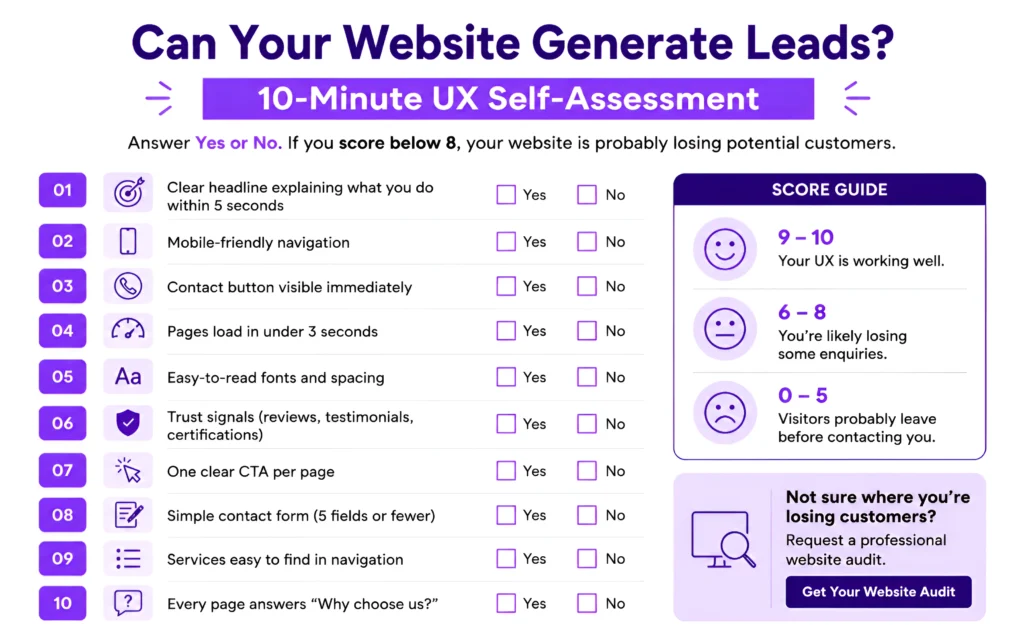
Why potential customers leave small business websites before converting into leads infographic

Common Google Business Profile Mistakes That Cost You Calls

Google Business Profile takes time to optimize, not just fill in the important information and put some main images and then leave it for customer reviews; that’s not enough.

After reviewing quite a few listings with business owners, I’ve noticed something consistent, most problems come from small things that don’t look serious at first glance. These are common Google Business Profile mistakes, and many businesses don’t realise they’re affecting enquiries until calls start slowing down.

One of the biggest issues is choosing the wrong or overly broad business category. Google relies heavily on this to understand what you actually do. If the category doesn’t clearly match the service people are searching for, your business may appear less often, or show up for the wrong searches altogether.

Another area that gets overlooked is Google reviews and ratings. It’s not just about having reviews; it’s about consistency and recent activity. When potential customers compare options, an inactive profile with old reviews can quickly lose attention, even if the business itself is excellent.

Then there’s the visual side. Many profiles either have very few or outdated photos on Google Business Profile. Customers often decide within seconds whether a business feels trustworthy. No photos, or poor ones, quietly reduce confidence, which is one reason a Google Business Profile may not be bringing customers despite getting visibility.

I’m also often asked, “Why is my Google Business Profile not getting calls?” In many cases, the profile hasn’t been properly maintained or reviewed since it was first created. Business details change, services evolve, but the listing stays the same.

The goal isn’t to constantly manage it like a marketing project. It’s simply to optimise your Google listing so it clearly reflects your business today — making it easy for both Google and potential customers to understand what you offer.

Once these common issues are addressed, the focus shifts from fixing mistakes to doing the few things that actually help generate enquiries consistently.

How to Improve Your Google Business Profile and Get More Enquiries

Lead generation optimization checklist showing steps to improve website conversions for small businesses

Once the common issues are cleared up, the good news is that improving results usually doesn’t require complicated changes. When a Google Business Profile is not generating leads, the solution is often about making the listing clearer, more active, and easier for customers to trust.

Here are the practical steps I normally walk clients through.

Start with accurate business details

Check your contact information, services, opening hours, and service areas carefully. Strong business information accuracy helps Google feel confident showing your profile to the right people, which directly helps improve local visibility.

NAP details (Name, Address, and Phone Number) must be accurate. If you have a website, then add a “Book an Appointment” link that helps improve the conversion rate.

Make sure the profile looks active

An active Google listing signals that the business is operating and engaged. Updating photos occasionally, responding to reviews, or posting small updates shows both Google and customers that the business is current.

You should post your business updates such as new services, business milestones, office updates, important announcements, offers and promotions, events, products, customer testimonials, behind-the-scenes photos, and educational tips. Weekly 2–3 posts are perfect to keep your profile active.

Show customers exactly what you do

Many profiles describe services too broadly. Clear service descriptions help people quickly understand whether you’re the right choice, which plays a big role in turning views into calls.

Here are the key things to focus on:
1. Clearly explain what your business does
2. Add your primary services
3. Include location or service areas
4. Add trust and experience
5. Use keywords naturally
6. Keep it within 750 characters
7. Do not add links or promotions

Focus on trust, not tricks

Encouraging genuine reviews, adding recent photos, and keeping information updated often does more than anything else when it comes to getting more customer enquiries. These are simple signals customers rely on before deciding to contact a business.

Analyze your competitors in your area who already rank in the top 3 pack listings. Check their profiles and make those changes to your profile. Regular improvements make your profile trustworthy and help you get local enquiries.

When these basics are done well, businesses often notice something shift, fewer empty views and more real conversations starting. That’s usually the point where a profile begins to get more calls from Google rather than just appearing in searches.

To make this clearer, let me show you a simple example of how this plays out in a real business situation.

📊 Forms Create Major Lead Loss

Around 41% of users abandon online forms because they are too long or ask for too much information.

Why it matters:

Many small business websites unknowingly block leads at the final step. Complex contact or quote forms create friction right when visitors are ready to convert.

Here I recommend some free websites and tools that help local businesses analyze their Google Business Profile:

  1. ai
  2. LocalHQ
  3. Growmefy GBP Audit Tool
  4. RankONE GBP Audit Tool
  5. Google Business Profile Insights

You can search these tools online and analyze important metrics that give clear stats.

From Views but No Calls to Regular Enquiries

A good example of this was a local service business I spoke with recently — a skin care salon that felt stuck. The owner told me their Google listing was getting views but no enquiries, even though they appeared regularly when searching their main service.

On the surface, everything looked fine. The business was showing in local search results, reviews were decent, and the profile existed. But when we looked closer, a few small gaps explained why the Google Business Profile was not getting more than 20 calls per month.

The services weren’t clearly listed, photos were several years old, and important information customers usually check first wasn’t easy to find. As a result, competitors with clearer profiles were getting the enquiries instead.

After updating the service descriptions, improving images (before and after results), and tightening up the profile details, something interesting happened. The business didn’t suddenly jump everywhere in rankings but profile visibility improved enough that people started choosing them more often.

Within a few weeks, the owner noticed the difference. Same area, similar search traffic, but the Google Business Profile started bringing enquiries instead of just views. I had double inquiries within three months of optimization.

I am sharing a PDF document, “How I Ranked #1 in Google 3-Pack (Local SEO Case Study).” You can see the result here.

This is why small adjustments matter. Often, it’s not about getting more visibility — it’s about making the visibility you already have work properly.

And when that starts happening, the next question most business owners ask is whether they should fix this themselves or get some help doing it right.

Need Help Fixing a Google Business Profile That Isn’t Working?

If your Google Business Profile is not working the way you expected, you’re definitely not the only one dealing with this. Many business owners set up their listing once and assume it should automatically bring enquiries over time. In reality, profiles often need a careful review to understand what’s quietly holding them back.

Fix Your Google Business Profile Visibility Issues

Get clear insights on what’s stopping enquiries from your listing.

Some businesses prefer to work through the improvements themselves, and that’s completely fine. But if you’ve already tried updating things and still aren’t seeing results, it can help to have someone look at the profile from an outside perspective, the same way you’d ask an expert to review accounts, operations, or your website.

The goal isn’t complicated changes. It’s simply to optimise your Google listing so it clearly represents your business, builds trust quickly, and helps improve local visibility where potential customers are already searching.

If you’d like a straightforward review of what may be stopping enquiries, and what could help you get more calls from Google, you can reach out for a practical assessment of your profile and what to fix next.

Next, let’s answer a few common questions business owners usually have about their Google Business Profile.

Google Business Profile FAQs

Why is my Google Business Profile not publicly visible?

If your profile is not publicly visible, it usually means Google hasn’t fully verified the business yet, or some required details are missing. Sometimes profiles are temporarily limited after edits or policy checks. When business information is incomplete or inconsistent, Google may reduce visibility until everything looks reliable. Checking verification status, business details, and categories is normally the first step when asking why is my Google Business Profile not publicly visible.

A business profile can exist but still struggle with showing on Google Maps. This often happens when competition nearby is strong or the profile lacks clear relevance for certain searches. If you’re wondering why is my business profile not showing up on Google, review your category selection, service areas, and location details. Profiles with accurate information and regular activity tend to appear more consistently on Maps over time.

Many owners notice their Google listing getting views but no enquiries, which usually means customers are seeing the business but not feeling confident enough to contact it. Missing photos, unclear services, weak descriptions, or outdated information can all affect decisions. The focus should be on turning views into calls by making the profile clear, trustworthy, and easy for customers to act on quickly.

To get more calls from Google, start by making sure customers immediately understand what you offer and how to contact you. Updated photos, accurate services, strong reviews, and correct opening hours all help build trust. Businesses that keep their profiles active generally see steady improvement in getting more customer enquiries because customers feel confident reaching out.

There isn’t a fixed timeline. Some improvements can make a difference within a few weeks, especially after correcting information or improving the profile presentation. Google needs time to recognise updates and adjust visibility in local searches. Consistency usually matters more than quick changes.

Yes — but mostly because updates signal that the business is active and reliable. Regularly maintaining details, responding to reviews, and adding current photos helps Google trust the listing. This often improves how frequently the profile appears when nearby customers search for related services.

Absolutely. Customers often compare several businesses before calling anyone. Recent Google reviews and ratings help people feel reassured that the business is active and trustworthy. Even replying to reviews can make a noticeable difference because it shows engagement and professionalism.

In most cases, nothing dramatic has happened. Profiles simply become outdated over time while competitors keep theirs updated. Small issues, incorrect details, limited photos, or unclear services, gradually reduce performance. Regularly reviewing the profile helps prevent enquiries from slowing without you noticing.

Google Business Profile Mistakes Losing You Leads Read More »

Blog feature image titled “How to Improve Local Search Visibility and Get Featured in Google Local Pack” with modern SEO illustration and digital marketing growth elements.

Why My Business Isn’t Ranking Locally — Even With Great Reviews?

Many business owners ask, why my business isn’t ranking locally even after collecting great reviews. The truth is, reviews alone don’t guarantee visibility. This blog explains what really affects local rankings and what practical steps you can take to improve them.

Deepak Sharma - SEO consultant

Deepak Sharma

SEO Consultant

Feb 20, 2026  |  6 min. read

3D icon illustration representing Google Business Profile optimization, local SEO growth, map rankings, customer reviews, and improved visibility in local search results.

I hear this a lot:

“I’ve got great feedback from customers. So why am I not ranking locally even with good reviews?”

It’s a fair question.

On the surface, it feels logical. If people like your service and leave five-star reviews, your business should show up in local search results. But that’s not how it works in practice.

Good reviews help. They build trust. They influence decisions. But when it comes to Google reviews and ranking for local SEO, they’re only one small part of a much bigger picture.

I’ve reviewed many websites where the business owner was doing a great job offline. Happy customers. Strong reputation. Solid word of mouth. Yet online, they were not ranking locally even with good reviews.

The issue usually isn’t the reviews.

It’s everything around them.

Google looks at how your website is structured, how clear your location signals are, how complete your business profile is, and how strong your local presence appears compared to competitors. Reviews support visibility, but they don’t replace the fundamentals.

📊 Most Visitors Don’t Convert

On average, only about 1.7% of website visitors convert into leads — meaning over 98% leave without taking action.

Why it matters:

This shows that getting traffic is only the first step. If your site isn’t guiding visitors clearly or making it easy to contact you, most visitors will simply leave without becoming leads — even if they find your business. This helps explain why many local businesses with decent traffic still struggle to generate enquiries.

At Digital Deep Tech, when we look into cases like this, we almost always find gaps that have nothing to do with star ratings.

In the next section, I’ll explain why your business might not be showing up properly in Google Maps or local search — even when customers clearly trust you.

Why Your Business Is Not Showing in Google Maps or Local Search Results

After reviewing a lot of small business websites, I can tell you this — when someone asks, why my business is not showing in Google Maps, the answer is rarely about reviews alone.

Reviews are one signal. Just one.

Google looks at three main things in local search results: how close you are to the searcher, how relevant your business looks for that search, and how strong your overall presence appears compared to others nearby.

Infographic explaining why small businesses are not ranking in Google local pack results, highlighting Google Business Profile issues, inconsistent citations, weak local signals, and missing on-page local SEO factors.

If your business is not showing in Google Maps, it’s usually because one of those pieces is weak.

Proximity is simple. If someone searches from 10 miles away, businesses closer to them often win. You can’t control that.

Relevance is about clarity. Does your profile clearly say what you do? Are your services properly listed? Is your website aligned with your location and service areas? If that connection isn’t obvious, Google hesitates.

Then there’s authority. This is where competition comes in. I’ve seen business owners confused about why their Google Business Profile is not ranking, only to realise three competitors nearby have:

  • More complete profiles
  • Stronger websites
  • Clearer location pages
  • More consistent business details online

That’s why it’s important to properly analyze local SEO competition instead of assuming reviews should carry the weight.

Another common issue is setup. Sometimes the business category is slightly off. Sometimes services aren’t listed clearly. Sometimes the profile is missing useful information. These small gaps affect google local pack ranking factors more than most people realise.

I also often find weak or missing location pages on the website. The location pages importance in local SEO is bigger than many expect. If your site doesn’t clearly show where you operate and what you offer in each area, Google has less confidence placing you in local results.

So when someone asks, why is my business not appearing on Google Maps, it’s usually a mix of clarity, competition, and profile structure, not a lack of good customer feedback.

In the next section, I’ll walk through the common mistakes I see business owners make that quietly hold their rankings back.

Common Mistakes to Avoid in Local SEO That Hurt Your Rankings

When I review sites for business owners in the US and UK, the issue usually isn’t effort. It’s small gaps that quietly stack up.

These are the most common mistakes to avoid in local SEO that I see again and again.

1. Ignoring Google Business Profile Optimization

Many owners set up their profile once and leave it.

Incomplete services. Wrong primary category. No updates. Thin descriptions.

Your profile needs to clearly explain what you do and where you operate. If it’s vague or half-filled, Google struggles to position you properly. That’s often why rankings stall.

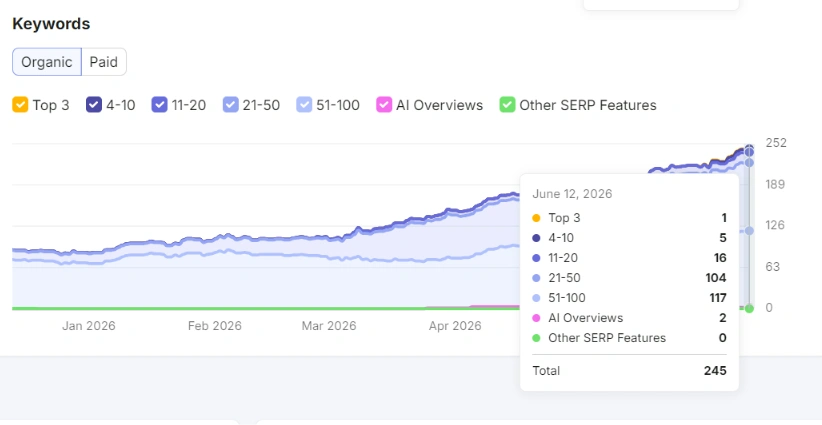
In my last case study, I was working on a project that had a good number of reviews, but the listing was not ranking in Google’s 3-Pack. I optimized the profile properly and posted regularly to keep the listing active. The results came after one month. You can see in the screenshot below that the listing is now ranking.

2. NAP Inconsistency

Before discussing this, I’ll explain the full form of NAP — Name, Address, and Phone Number. It is very important for any business listing.

Your business name, address, and phone number need to match everywhere online.

Even small differences — “Street” vs “St.” — can create confusion. Google Business Profile NAP consistency guidelines aren’t complicated, but they matter.

If Google sees mixed signals, trust drops slightly. And in local search, small trust drops make a difference.

3. Weak or Missing Local Pages

It starts with clear location signals on your website. If you serve specific towns or cities, those areas need proper pages that explain:

  • What you do there
  • Who you help
  • How customers can contact you

Thin, copied, or generic pages won’t help. They need to feel real and specific.

I often see that many businesses link their homepage to their Google Business Profile listing. This confuses search engines because when someone lands on the homepage, there are no clear local signals.

4. Technical Issues That Quietly Hold You Back

You don’t need to understand every technical detail, but some basics matter.

Slow loading speed. Broken pages. Mobile layout issues. Poor internal linking.

When clients ask me which technical SEO issues are most important for local SEO, I usually say this: focus on speed, mobile usability, and clean structure. If your site is hard to use, rankings suffer.

Local listings help bring local traffic to your website. Before contacting you, most users want to learn about your services and check your online reputation. Your website plays a big role in that decision.

If your website structure is poor, loads slowly, or the content is not aligned with the needs of your local audience, visitors will leave quickly. That is why it’s important to make sure everything is properly set up to improve your conversion rate.

5. Citation Errors

Many business owners don’t fully understand what are local business citations. In simple terms, they’re online listings that mention your business details — directories, local listings, industry platforms.

Common local citation mistakes that hurt local SEO include:

  • Inconsistent contact details
  • Duplicate listings
  • Outdated addresses
  • Wrong phone numbers

These don’t always cause dramatic drops, but they weaken your overall presence.

And just to clear up one more confusion I hear often — are social signals a Google ranking factor official statement? No. Google has said social media activity itself isn’t a direct ranking factor. It can help visibility, but it’s not the core issue when you’re not ranking locally.

None of these problems are dramatic on their own. But together, they explain why a business with good reviews still struggles to appear consistently.

In the next section, I’ll show you what actually works — practical steps you can take to improve your local visibility properly.

How to Improve Local Search Visibility and Get Featured in Google Local Pack

Step-by-step local SEO action plan infographic showing how to improve Google Business Profile optimization, strengthen local ranking signals, and increase visibility in Google local search results.

Now let’s talk about what actually moves the needle.

If your goal is to improve local search visibility and show up more consistently, the solution isn’t complicated — but it does require doing the basics properly.

Here’s what I usually walk clients through on a call.

1. Fully Optimize Your Google Business Profile

This is your starting point.

When people ask how to optimize Google Business Profile, I tell them to think of it like a storefront. It needs to be complete, clear, and active.

That means:

  • Choosing the right primary and secondary categories
  • Listing every relevant service properly
  • Writing a clear business description
  • Adding real photos
  • Keeping hours accurate

A proper Google Business Profile optimization checklist isn’t about tricks. It’s about completeness and clarity. Small gaps here often explain why profiles don’t perform.

If your Google Business Profile isn’t fully set up, nothing else will compensate for it.

2. Fix NAP Consistency Everywhere

Next, make sure your business name, address, and phone number match exactly across all listings.

Even small differences create doubt in Google’s system. When that doubt builds up, rankings soften.

Consistency strengthens trust. And trust supports visibility.

3. Improve Website Local Signals

Your website must clearly support your location.

That includes:

  • Clear service area mentions
  • Strong location pages
  • Contact details in the footer
  • Consistent messaging between your site and your profile

If someone asked me how to optimize for Google local 3 pack, I’d say this: your website and your profile must tell the same story.

When they align, your chances of appearing in local map listings increase.

4. Build Authority and Local Trust

Authority doesn’t mean hundreds of links or flashy campaigns.

It means:

  • Earning real reviews steadily
  • Getting mentioned in local directories
  • Keeping information updated
  • Publishing helpful local content when relevant

This is how you slowly build the kind of presence that helps you get featured in Google local pack results.

There’s no shortcut here. It’s steady work.

5. Monitor Competition

Finally, pay attention to who is ranking above you.

Look at:

  • Their profile completeness
  • Their website quality
  • Their local pages
  • Their review patterns

Sometimes improving visibility in local map listings is less about doing more — and more about closing the gap between you and the businesses already showing up.

At Digital Deep Tech, when we apply these steps consistently, rankings don’t jump overnight — but they do move in the right direction.

In the next section, I’ll give you a simple real-world example of how this plays out for a typical local business.

Why a 5-Star Business Still Didn’t Rank in Google Maps

Let me give you a real-world type of situation I see often.

A local salon in the Windsor, UK reached out. They had over 60 reviews. Average rating above 4.8. Customers were clearly happy.

But they kept asking, “Why are we not showing in the local pack when smaller salons are?”

When I looked at things more closely, the problem wasn’t reputation.

It was structure.

First, their location page was thin. It mentioned the city name once and didn’t clearly explain the areas they served. There was no depth. No real local signals.

Second, their business details weren’t consistent across directories. Some listings had an old phone number. One had a slightly different business name. These small inconsistencies weaken trust.

Third, their profile setup wasn’t complete. Services weren’t clearly listed. Categories weren’t fully aligned with what they actually did. It wasn’t terrible — just unfinished.

None of these issues alone seemed dramatic. But together, they explained why they were invisible in Google Maps.

We focused on tightening everything up. Clearer location pages. Consistent contact details everywhere. A properly structured profile.

This wasn’t about tricks. It was about proper setup.

Some business owners try to solve this themselves. Others choose to work with experts in Google Business Profile optimization when they realise the details matter more than they thought.

There are many providers offering Google Business Profile optimization services, but the real difference comes from understanding how your website, profile, and local presence connect together — not just filling out fields.

In this case, once the gaps were fixed, visibility improved steadily. No overnight spike. Just gradual, stable movement into better positions.

If your business feels stuck despite strong reviews, it’s usually something similar — not a lack of customer trust, but a few structural weaknesses holding you back.

In the final section, I’ll explain what your next step should be if you want clarity on what’s affecting your rankings.

Not Ranking Locally? Let’s Fix What’s Really Holding You Back

If you’ve read this far, you probably recognise parts of your own situation.

Strong reviews. Solid service. But still not showing where you should in local search.

The truth is, guessing won’t solve it.

What usually helps is a proper manual review — someone looking at your website, your profile, your location pages, and your competition together. Not an automated report with charts, but a real assessment that explains what’s working and what isn’t.

Not Sure What’s Holding You Back?

Get a clear, practical review of your local visibility gaps.

When I review a business, I look for the small structural gaps we’ve talked about in this article. Then I outline a clear action plan. What to fix first. What can wait. What will likely move visibility in a steady, realistic way.

No promises. No dramatic claims. Just clarity.

If you’d like that kind of review, you can book a consultation with Digital Deep Tech. We’ll go through your setup properly and give you straightforward feedback on what’s holding your rankings back — and what to do next.

From there, you can decide how you want to move forward.

📊 Form Abandonment Is a Major Leak

About 41% of users abandon forms because they have too many fields, significantly reducing lead capture.

Why it matters:

If your contact or enquiry form asks for too much information or feels complicated, nearly half your potential leads may leave before completing it. For small businesses, simplifying forms and removing friction often leads to measurably better lead flow.

FAQs

Why am I not ranking locally even with good reviews?

This is one of the most common questions I hear. The honest answer is that reviews are only one part of the puzzle. If you’re wondering why my business isn’t ranking locally, it’s usually because Google looks at more than ratings. It considers how close you are to the searcher, how clearly your services are defined, how strong your website is, and how your business compares to competitors nearby. Reviews support trust, but they don’t replace a solid setup.

Yes, when it’s done properly. Google Business Profile optimization helps Google understand exactly what you do, where you operate, and which searches you’re relevant for. A complete profile with accurate categories, clear services, updated photos, and consistent details improves clarity. That clarity increases your chances of appearing in local results. It’s not instant, but it does make a measurable difference over time.

It depends on your starting point and your competition. If your profile and website only need minor adjustments, you may notice movement within a few weeks. If there are structural issues or strong competitors in your area, it can take a few months. Local rankings usually improve gradually, not overnight. Steady corrections and consistency matter more than quick fixes.

No, reviews alone are not enough to rank in the local pack. They influence trust and can improve click-through rates, but they are just one ranking signal. Businesses with fewer reviews sometimes rank higher because their profiles are more complete, their website is stronger, or their location signals are clearer. Reviews help, but they don’t override weak foundations.

The most important google local pack ranking factors generally include proximity to the searcher, relevance of your business to the query, and overall authority. Authority comes from a strong website, consistent business details online, and steady customer engagement. Google wants to show businesses that are clear, reliable, and easy for users to contact.

If your business isn’t appearing on Google Maps, it’s often due to incomplete profile setup, category misalignment, inconsistent contact details, or weak location signals on your website. In some cases, strong competitors nearby may simply have more complete profiles. A proper review usually reveals one or two gaps that explain the issue.

Start by ensuring your profile is fully completed and accurate. Then align your website with your service areas clearly. Keep your contact details consistent everywhere. Continue collecting genuine reviews over time. Finally, monitor competitors and close the gaps between your setup and theirs. Showing in the local 3 pack is usually the result of steady improvements, not a single change.

Why My Business Isn’t Ranking Locally — Even With Great Reviews? Read More »
Blog thumbnail for WordPress lead generation problems and how to fix low website leads

Common WordPress Mistakes That Stop You Getting Leads

Many small businesses struggle with WordPress lead generation problems without knowing why their site isn’t converting visitors into real enquiries. This guide breaks down the most common mistakes and shows how to fix the issues quietly costing you leads and sales.

Shabnam Sharma

Shabnam Sharma

Social Media Manager

Feb 12, 2026  |  6 min. read

3D icon showing WordPress lead generation and website conversion concept

This is one of the most common emails I get:

“People are visiting my site, but nobody is getting in touch. What’s wrong?”

Most of the time, it isn’t one big thing. It’s a handful of small WordPress lead generation problems quietly stacking up. On their own they seem harmless. Together, they stop real people from taking the next step.

You might have traffic from Google, ads, or social media. But traffic on its own doesn’t pay the bills. If visitors don’t understand what you do, don’t trust the site, or don’t see a clear way to contact you, they leave. No form filled. No call made. No email sent.

Recently I worked with a client who was searching for an SEO agency for law firms. Their site was getting visits, but the phone wasn’t ringing — for the exact same reasons you’re reading about here.

📊 Visitor-to-Lead Conversion Is Generally Very Low

Only around 2.4% of website visitors become leads on average, with even strong lead pages often only reaching about 4% conversion. That means the vast majority of people who visit your site never take action like filling a form or booking a call.

Why it matters:

This shows why many WordPress sites feel like they’re full of traffic but empty of enquiries — most visitors leave without converting, especially if the site isn’t set up to guide them.

That’s usually when people start saying, “I don’t know why my site isn’t working” or “Why is my site not converting traffic?”

In reality, the site is working, just not in the way you need. It’s showing pages, but it’s not guiding visitors toward becoming enquiries. That gap between interest and action is where most WordPress websites fall down.

In this blog, I don’t want to discuss SEO tips or strategies. I just share a general perspective of the visitors on your website, what they feel, what they realize, their behavior, and what they think before deciding to make contact. Your website is the bridge between you and your audience. Once you see where that gap is, the fixes are often simpler than you expect.

In the next section, I’ll explain what usually causes these problems in the first place.

What causes WordPress lead generation problems

Most WordPress sites don’t fail because the business is bad or the service is weak. They fail because the site was put together in a way that doesn’t support how real people behave online.

A lot of common WordPress issues are invisible until you look at things through a customer’s eyes. Pages load slowly. Buttons are hard to spot. Forms feel awkward. On mobile, things shift around or get cut off. None of this feels dramatic, but every small friction point makes it easier for someone to leave than to get in touch.

Bad setup plays a big role here. I often see sites built with too many plugins, clashing themes, or page builders stacked on top of each other. The site might look fine at first glance, but behind the scenes it’s heavy, messy, and fragile. That’s where WordPress conversion issues start to creep in — pages take longer to load, forms fail, and important messages don’t show when they should.

And then there’s the design side of it. Many WordPress websites are built to impress the owner, not to help a visitor make a decision. Big images, clever layouts, and fancy effects can look great, but if the page doesn’t clearly say what you do, who it’s for, and what to do next, people get stuck.

So you end up with a site that looks professional, but doesn’t actually move anyone toward a call, a form, or a sale.

If you see this issue through an SEO expert’s eyes, website design matters in helping visitors make a decision, but content also plays a huge role. What you write, what you show on the website, such as images and videos, and how your CTA performs all matter. Does the content only show your business, or does it solve the visitor’s problem? Is the website optimized for both search engines as well as the target audience?

You cannot say that only one factor is responsible for your website not converting leads. When I review client websites, I see multiple points that distract visitors. These points often exist even on good-looking, professional websites.

In the next part, I’ll walk through the specific mistakes I see business owners making again and again.

Common WordPress mistakes hurting your leads

This is where things usually go wrong. Not in a dramatic, broken-site way — but in quiet ways that slowly drain enquiries.

One of the biggest ones is a WordPress website not converting. People land on a page, read a bit, and then… nothing. There’s no clear next step. No gentle nudge to get in touch. No obvious way to move from “just looking” to “let’s talk.”

That usually comes down to poor call-to-action placement. Buttons are buried at the bottom of the page, hidden in the menu, or written in vague language like “Learn more.” Real visitors don’t hunt for what to do. If it’s not obvious, they leave.

Infographic showing why visitors leave a WordPress website without contacting the business

Another common gap is having nothing worth signing up for. No simple guide, no checklist, no helpful download. Without some kind of lead magnet, there’s no low-pressure way for someone to raise their hand and say, “I’m interested.” They might like what they see, but not enough to fill out a long form.

Then there are the quiet WordPress SEO mistakes. Not the technical kind people argue about online, but the basic ones — pages that don’t explain what the business actually does, titles that don’t match what people search for, or important pages that Google barely sees. That leads to fewer of the right visitors showing up in the first place.

Mobile is another big one. A WordPress website not working on mobile doesn’t always mean it’s broken. It might just be awkward. Buttons too small. Text too tight. Forms hard to fill in. Most people are on their phones now, and if the site feels like work, they move on.

And finally, trust. Or the lack of it. Missing trust signals for websites — things like real testimonials, clear contact details, or even a proper About page — makes people hesitate. If they’re not sure who’s behind the site, they won’t send their details.

All of these things seem small. But together, they explain why so many WordPress sites get visits and still feel invisible when it comes to leads.

There’s one thing I want to talk about here: Google’s EEAT guidelines (experience, expertise, authority, and trustworthiness). When your website clearly shows these, it becomes easier to rank and attract genuine organic leads.

Next, we’ll look at what it means when your site isn’t even being seen in the first place.

Why your WordPress website is not showing in Google

A lot of business owners find themselves typing their own company name into Google and feeling a sinking feeling when nothing useful comes up. The site is live, you know it exists, but it feels invisible.

When a WordPress website isn’t showing up in Google search, it’s usually not because something is “wrong” in a dramatic sense. It’s more that Google doesn’t have enough clear signals to understand what the site is about or which pages matter. That often happens after a site has been rebuilt, moved, or added to over time without much structure.

I also see this when a WordPress website isn’t appearing in Google search because key pages aren’t properly linked, or important content is buried where both people and search engines struggle to find it. Sometimes the site is technically there, but it’s not being presented in a way that earns it a place near the top.

From the outside, it looks like Google is ignoring you. In reality, it’s just unsure what to do with what it’s been given.

In the next section, we’ll look at what happens when people do find your site, try to get in touch, and nothing comes through.

Why your WordPress website is not capturing enquiries

Sometimes the problem isn’t getting people to your site — it’s what happens after they try to reach you.

I’ve seen plenty of businesses lose good leads because their contact forms look fine but don’t actually work the way they should. Simple contact form best practices like clear labels, short forms, and obvious confirmation messages are often missing. When people aren’t sure if their message went through, they don’t try again.

Another quiet issue is a WordPress website not sending emails properly. A form gets filled in, but nothing ever arrives in your inbox. From the visitor’s side, it feels like they contacted you. From your side, it feels like nobody is interested. Those lost messages add up more than most people realise.

Even when enquiries do come through, they can slip through the cracks if there’s no simple way to keep track of them. Without some form of CRM integration for lead follow-up, replies get delayed, forgotten, or lost in personal inboxes. That’s not a people problem — it’s a system problem.

I also hear from business owners running ads who say their Google Ads aren’t showing on my WordPress website the way they should. Pages don’t load, tracking breaks, or the landing page doesn’t match what the ad promised. That gap makes paid visitors disappear just as fast as they arrive.

When these things are fixed, you don’t just get more enquiries — you actually start seeing the ones you were missing all along.

Next, we’ll look at the practical changes that usually make the biggest difference.

How to fix low leads on WordPress

Once you’ve seen where things are breaking down, the next step isn’t to rebuild everything. It’s to make a few focused changes that help real people move forward instead of drifting away.

Good lead capture optimisation starts with making it easy to raise a hand. That means clear forms, simple questions, and a reason to get in touch. When someone has to work to contact you, they usually won’t.

Infographic explaining what helps a WordPress website turn visitors into leads

A lot of conversion rate fixes are really just common sense. Put the main message where people actually look. Make buttons easy to spot. Say clearly who the service is for and what happens next. When visitors don’t have to guess, more of them act.

Then there’s the experience of using the site. Small user experience improvements — like cleaner pages, easier navigation, and fewer distractions — help people stay long enough to understand what you offer. Confused visitors don’t become customers.

Speed matters too. Slow pages quietly hurt site speed and conversions because people won’t wait. Even a few extra seconds is often enough for someone to back out and try a competitor instead.

📊 Slow Load Times Kill Conversions

A 1-second delay in page load time can reduce conversions by up to 7%, and mobile users are especially likely to leave if a page takes longer than three seconds to load.

Why it matters:

WordPress sites with heavy themes or lots of plugins can easily become slow. If your visitors get frustrated waiting for pages to load, they’re far less likely to turn into leads — and more likely to hit the back button instead.

And finally, everything has to work well on phones. Mobile-friendly site leads come from pages that load fast, buttons that are easy to tap, and forms that don’t fight back. If it’s awkward on mobile, most people simply won’t bother.

Finally, look closely at your wording. Good copy answers the unspoken questions behind why customers leave without buying. It reassures, explains, and makes the next step feel safe and straightforward.

Put these pieces together and your WordPress site starts doing what it was meant to do — turning interest into real conversations.

Next, I’ll show you what this looks like in a real-world example.

Real example: fixing WordPress conversion issues

Not long ago, I worked with a client who was looking for solo law firm marketing. The owner asked me something you might be thinking right now: “Why does my website look fine, but nobody is calling?”

The site had been online for more than five years and was meant to serve a local audience in Windsor. On the surface it seemed okay, but once I spent some time with it, the problems were clear.

First, the layout felt dated. It didn’t speak to the audience (30 to 65 years old) the firm actually served, so it never really connected with them. Second, the content was written as if the clinic was trying to reach the whole of the UK. Nothing on the pages made it feel like a local, trusted place in Windsor.

The service pages were another issue. They read more like blog posts than pages designed to help someone decide to book an appointment. There was plenty of text, but very little guidance on what to do next. On top of that, the blog hadn’t been updated in years, so there was nothing fresh or relevant for the people they wanted to attract.

We didn’t fix just one thing. We worked through the site step by step — cleaning up technical issues, reshaping the content so it spoke directly to local audience, and making the service pages clearer and more focused. New blog posts were written for that same audience, not for everyone.

Over time, the WordPress lead generation problems started to fade. After about six months of steady work, the change was obvious. Before, the clinic was getting around 20 calls a month. That grew to more than 40, without changing what they offered — just how the website supported it.

That’s what happens when you fix the common WordPress mistakes together, instead of chasing one quick tweak. Small, consistent improvements add up to real business results.

Next, I’ll show you what you can do if you want help finding and fixing these issues on your own site.

Get expert help to fix your WordPress lead problems

If you’ve made it this far, you probably recognise a few of these issues on your own site. A WordPress website not converting isn’t a sign that your business is failing — it’s usually a sign that the website hasn’t been set up to do the job it’s meant to do.

This is the point where having someone look at the site properly makes a big difference. When you work with people who deal with WordPress sites every day — including leading WordPress AI optimisation experts — patterns show up quickly. Things you’ve been staring at for months suddenly make sense.

Find Out Why Your Website Isn’t Converting

A quick review to spot what’s quietly blocking your enquiries.

It’s not about pushing new tools or chasing trends. It’s about seeing where visitors get stuck, where enquiries drop off, and what’s quietly holding the site back. Once those things are clear, the fixes are usually far more practical than you expect.

If your site feels busy but your inbox is quiet, it’s worth having someone walk through it with fresh eyes. That alone can uncover the reasons your leads aren’t coming through — and what to do about it.

FAQs

Why isn’t my WordPress site generating leads?

In most cases, it’s not because people aren’t interested. It’s because the site isn’t guiding them clearly. Visitors might not understand what you offer, where to click, or how to get in touch. Small issues like slow pages, confusing layouts, or hidden contact forms quietly stop people from taking action.

This usually happens when Google can’t easily understand or trust the site. Pages might not be well connected, the content may be thin or outdated, or the site could be slow and hard to use on mobile. When that happens, Google shows other sites instead.

WordPress doesn’t send emails the same way normal inboxes do. If it isn’t set up properly, messages can go missing or land in spam without you ever knowing. Many businesses think no one is contacting them, when in reality the enquiries just aren’t reaching their inbox.

The biggest ones are unclear calls to action, pages that don’t explain the service properly, slow loading times, and sites that don’t work well on phones. Add missing trust signals and broken forms to the mix, and leads disappear fast.

Getting visitors is only half the job. If the page doesn’t make it obvious what to do next, people will read, scroll, and leave. A site needs to guide visitors toward calling, booking, or filling out a form. Without that, traffic doesn’t turn into business.

Try using it like a customer. Can you quickly see what the business does? Is it easy to contact someone? Does it feel trustworthy? If any of those answers are no, the site probably isn’t set up to turn visitors into leads.

Yes, but only if it’s updated to match how people browse today. Older sites often look fine but don’t work well on mobile, load slowly, or speak to the wrong audience. Fixing those gaps can make a big difference without needing a full rebuild.

Start with the basics: make sure your main pages clearly explain what you offer and how to get in touch. Then check that forms, emails, and mobile pages all work properly. Those small checks usually reveal where leads are being lost.

Common WordPress Mistakes That Stop You Getting Leads Read More »
Good-looking website illustration showing why visitors don’t convert into enquiries

Why a Good-Looking Website Doesn’t Convert

A good-looking website doesn’t always mean better results. Many business owners ask why isn’t my website converting visitors even when the design looks professional. This blog explains what’s really stopping customers, the common mistakes websites make, and how small changes can turn visitors into enquiries and sales.

Deepak Sharma - SEO consultant

Deepak Sharma

SEO consultant

Feb 08, 2026  |  6 min. read

3D website conversion icon representing visitors, actions, and enquiries

Your website looks professional.
It loads properly. It feels modern. People even tell you it looks great.

But enquiries are low. Sales are slow.
And you’re left wondering why isn’t my website converting visitors, even though nothing looks obviously wrong.

This is something I hear all the time from small business owners. A site can look polished and still struggle to bring in customers. In many cases, the problem isn’t the design at all.

If you’ve ever thought my website looks good but doesn’t convert, or quietly asked yourself why a website that looks good still doesn’t sell, you’re not alone. This is a common issue — and it’s usually fixable once you understand what’s actually going on.

Why a Website That Looks Good Still Doesn’t Convert

A good-looking website doesn’t automatically mean a website that sells.
Design helps first impressions, but it doesn’t do the job on its own.

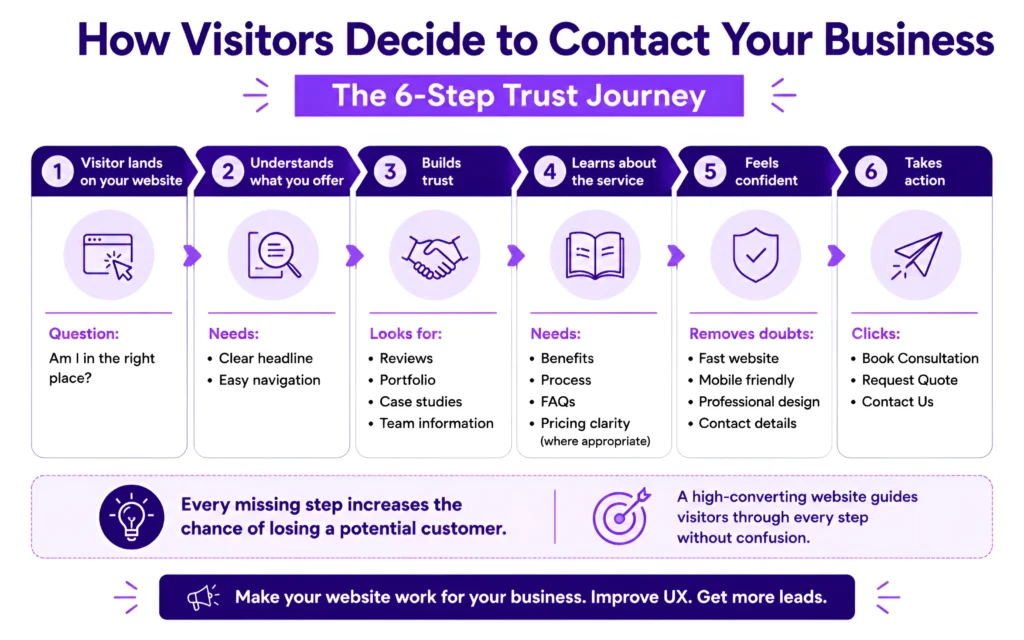
Most sites are built to look nice, not to guide visitors toward a decision. They focus on layout, colours, and images, but forget to answer the basic questions running through a visitor’s head: Is this for me? Can you help me? What should I do next? When that clarity and value proposition are missing, people hesitate — and hesitation usually means leaving.

This is one of the most common reasons a website doesn’t convert. Visitors aren’t confused because the site looks bad. They leave because they’re unsure, unconvinced, or don’t feel confident enough to take the next step. That’s why customers often leave without buying, even on websites that look polished and professional.

Before doing SEO, my main focus is to optimize the website content according to the target audience and search engines. The website must follow EEAT (Experience, Expertise, Authoritativeness, Trustworthiness) guidelines, which Google prefers. Design may attract visitors, but content builds trust, shows experience, and encourages visitors to take action. Simply put, most traffic is wasted if the website is not optimized for users.

Once you understand this, it becomes easier to spot where things start going wrong, and that’s where most websites begin to lose potential customers.

📊 Most websites convert very few visitors

On average, websites convert only about 2.35% of visitors into a meaningful action like a lead or signup, meaning roughly 97 out of every 100 people leave without converting. That’s the reality for most sites today.

Why it matters:

This shows that even if your design looks great, most sites don’t turn browsers into leads — and you need to focus on conversion factors, not just aesthetics.

Common Website Conversion Mistakes Business Owners Make

Infographic showing why visitors leave a good-looking website without taking action

After reviewing a lot of small business websites, the same issues come up again and again. They’re easy to miss when you’re close to your own site, but they’re usually clear to visitors.

Design over clarity

The site looks polished, but it’s not obvious who it’s for or how it helps. Without a clear message, visitors don’t feel confident enough to act.

In my 10 years of career, before designing a website, I have learned that it is important to understand the business goals, the target audience, their problems, and the right solutions. Only after that do I create the content accordingly. The most important part is understanding the user journey and building content section by section. CTAs should be used properly so users can easily make the required booking.

Assuming visitors know what to do next

Many websites expect people to figure it out on their own. When there’s no clear direction, visitors hesitate — and hesitation often means leaving.

Mostly, I see website designers focus on building beautiful websites without understanding the content. Business owners often make the same mistake. They see a good-looking website and feel satisfied, but the real value lies in whether the website content is fully optimized and targets the right audience.

Weak call-to-action problems

Buttons are vague, hidden, or trying to do too many things at once. If the next step isn’t obvious, people won’t take it.

For example, suppose you are walking in a beautiful garden. You see trees, then a few steps ahead you see flowers, fountains, and benches to sit and rest. After that, you walk through beautiful paths with flower-covered roofs and again find benches to sit. On a website, those benches are CTAs, where visitors pause, rest, and fill out a form or make an enquiry. That’s why understanding the user journey is so important.

Ignoring user experience and conversion issues

Small frustrations add up. Cluttered pages, confusing layouts, or too much text can quietly push visitors away.

A common mistake many business owners make is focusing on showing their business and explaining their services, instead of clearly offering solutions to users. They often do not show case studies, client reviews, past work, or results that build trust with first-time visitors. Another mistake is making the design too complex, especially during form submission. Filling out a form should take no more than two or three clicks. Complex and confusing layouts frustrate users, causing them to leave the website.

Slow pages and heavy visuals

This is a big one. Website speed hurting sales is real. If pages take too long to load, people leave before they even see what you offer.

Lastly, when I worked on a coaching website project, it looked good with great animations and visuals. However, when I audited it, I found that it was slow on both mobile and desktop, taking 5 to 7 seconds to load. You know that visitors wait an average of only 3 seconds before leaving a site. I explained this mobile website optimization issue to the client and then fixed it.

Missing trust signals for website customers

No reviews, no proof, no reassurance. When visitors don’t feel safe or confident, they won’t get in touch.

How is trust built on a website? A good-looking design is not enough. When you add real business images, videos, client reviews, case studies, and show real results to visitors, trust is built. A good-looking website is like a book with a beautiful cover. When you add trustworthy content inside it, users stay longer and feel confident that this is the right business to solve their problem.

These are all clear signs your website isn’t converting — not because your business isn’t good, but because the site isn’t doing enough to support it.

Once these mistakes are fixed, many websites start performing very differently, even without a full redesign.

📊 Slow loading loses more than half of visitors

Research finds that 53% of mobile visitors will leave a website if it takes longer than 3 seconds to load, and sites that load slower tend to have much higher bounce and abandonment rates.

Why it matters:

This directly ties into why customers leave without buying — performance issues like slow pages can stop visitors before they even see a clear offer or call to action.

How to Fix a Website That Isn’t Converting

If you’re trying to work out how to fix a website that isn’t converting, the good news is this: it’s rarely about starting over. In most cases, a few focused changes make more difference than a full redesign.

Start with your main message. A visitor should understand what you do and who you help in five seconds or less. If they have to scroll, guess, or piece things together, you’ve already lost them.

Next, be clear about who your service is for and how you help. Many websites talk around the problem instead of addressing it directly. When people recognise themselves in your message, they’re far more likely to stay and engage.

Keep each page focused on one clear action. When a page asks visitors to call, email, download, and book all at once, nothing stands out. One clear next step works far better than several competing ones.

Proof matters more than most people realise. Testimonials, short case examples, or even simple client quotes help remove doubt. This is a key part of how to improve website conversions, especially for service-based businesses.

Page speed also plays a bigger role than it seems. Heavy images, unnecessary animations, or cluttered layouts can quietly push people away. Improving load time and removing distractions often helps fix a low conversion rate without touching the design.

Finally, look closely at your wording. Good copy answers the unspoken questions behind why customers leave without buying. It reassures, explains, and makes the next step feel safe and straightforward.

These small changes might not look dramatic, but they’re often the most effective way to improve results, and they usually work better than a complete rebuild.

A Real Example: When a Good Website Still Doesn’t Sell

I worked with a coach whose website looked genuinely impressive.
Strong branding, smooth animations, polished pages, everything you’d expect from a professional build. On the surface, nothing looked wrong.

People who visited the site liked it. But they didn’t get in touch.

After a few months of work, traffic had barely moved and enquiries were still flat. The site looked good, but it wasn’t doing its job. This is exactly the situation where business owners say their website looks good but doesn’t convert, and it’s frustrating because it feels like you’ve already “done everything right”.

The real issue wasn’t the design. It was what sat underneath it. The site didn’t clearly explain the services, there wasn’t a strong offer on key pages, and there was very little content to help people understand the coach’s expertise. Visitors arrived, looked around, then left, which explains why customers leave without buying, even when a site feels polished.

We didn’t redesign the website. Instead, we clarified what was offered, added clear service pages, started publishing helpful content regularly, improved existing pages, and strengthened trust with real proof. The look stayed mostly the same, but the structure and messaging changed.

The difference showed quickly. Traffic started to grow steadily, and more importantly, enquiries followed.

That’s the real gap between a website that simply looks good and one that actually supports a business. Design helps people stay, but clarity, trust, and direction are what make them act.

Website conversion checklist helping small businesses identify why sites don’t convert

Not Sure Why Your Website Isn’t Converting?

If you’re noticing the signs your website isn’t converting — low enquiries, people dropping off, or traffic that never turns into conversations — it’s usually not one big issue. It’s a few small things working against you at the same time.

Sometimes it helps to have a second pair of eyes. A proper review can show what visitors are actually experiencing and what’s quietly getting in the way. Once those gaps are clear, it becomes much easier to see how to improve website conversions without guessing or making random changes.

See What’s Blocking Your r Enquiries

A quick, honest review of why visitors aren’t taking action.

If you want clarity on what’s holding your site back, I’m happy to take a look and point you in the right direction.

FAQs

Why does my website look good but get no customers?

A good-looking website can still fall short if it doesn’t clearly explain what you offer or what a visitor should do next. Design creates a first impression, but customers need clarity, reassurance, and a reason to take action. Without those, people browse and leave.

In most cases, visitors don’t convert because they’re unsure. The message may be too vague, the next step isn’t obvious, or there isn’t enough trust built. Even small gaps in clarity or confidence can stop someone from getting in touch.

Start by simplifying. Make your main message clear, focus each page on one action, and show proof that others trust your business. You don’t need a full redesign — small changes to wording, structure, and page flow often make the biggest difference.

Low enquiries, lots of visitors leaving quickly, or people reading pages but never contacting you are common signs. If traffic is coming in but nothing is happening after that, your website likely isn’t guiding visitors well enough.

Why a Good-Looking Website Doesn’t Convert Read More »
Banner for blog about fixing slow WordPress sites to improve enquiries

Why a Slow WordPress Site Kills Your Enquiries

A slow WordPress website can quietly push visitors away before they ever contact you. When pages take too long to load, trust drops, users leave, and enquiries disappear. This blog explains why it happens and how to fix it.

Guruparshad

Guruparshad

WordPress Developer

Jan 27, 2026  |  6 min. read

3D icon representing a slow WordPress site affecting enquiries and conversions

A slow WordPress site doesn’t just feel frustrating. It quietly pushes potential customers away before they ever get a chance to contact you.

When a website takes too long to load, most people don’t wait. They click back, open another option, and move on. That’s how a slow website ends up hurting leads without you even realising it.

When I review business websites, I see that the design looks impressive, with good CTA placement and strong authority, but the speed on mobile and desktop is slow. Traffic comes but does not stay on the website. As a result, the bounce rate increases, which is bad for SEO.

I hear this question a lot: “Is your slow WordPress website costing you leads?”
Usually, the answer is yes. Not because the business is bad, but because visitors are leaving quickly when pages don’t open fast enough.

The link between page speed and enquiries is very real. The good news is this isn’t unusual, and it’s usually fixable once you understand what’s causing the delay.

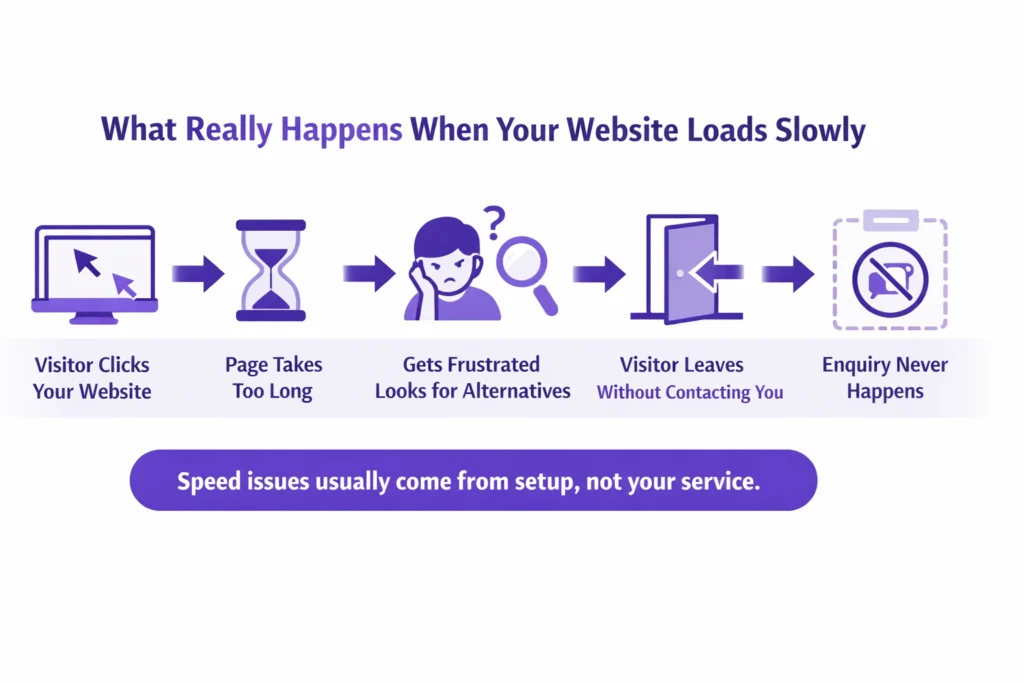
Infographic showing what happens when a slow WordPress site loses visitor enquiries

Why a WordPress Website Loads Slow (Root Causes)

One of the most common questions I hear is, “why is my WordPress site so slow?”
In most cases, it’s not one big problem. It’s a few small setup issues adding up and affecting the website loading time.

WordPress itself isn’t bad or slow by default. A WordPress website loading slow usually comes down to how it’s been built and maintained over time.

Here are the main reasons I see again and again:

Too many plugins

Plugins are helpful, but every extra one adds weight. Some are poorly built, others overlap, and together they slow the site down without you noticing.

It is true that plugins help in designing and make tasks easier for developers, but too many plugins add extra code (CSS/JavaScript) that takes time to load.

Weak or overcrowded hosting

If your hosting struggles, your website struggles. This is one of the biggest causes of WordPress performance issues, especially on shared plans. Before buying a hosting plan, I recommend checking the best options. It may be a bit costly, but it provides a better experience for visitors.

Large images and heavy page builders

Big images and complex layouts look nice, but they take longer to load. Visitors feel that delay straight away. When a website loads, images consume most of the loading time. Images with smaller file sizes load faster and more easily.

Slow mobile performance

Many sites seem “fine” on desktop but load very slowly on phones. That’s where most visitors leave. You know that most users use phones because they are reliable and easy for accessing websites. But slow mobile speed frustrates them, and they move away from the website.

No regular checks

When no one keeps an eye on speed, small issues quietly turn into bigger website speed problems. I see this problem on many websites. When my clients update content on their websites, they forget to check the speed on mobile and desktop. This hurts the performance of the website.

This is why people ask if WordPress sites are slow. They aren’t by nature — but the setup matters more than most business owners realise.

Once you understand what’s causing the slowdown, fixing it becomes much more straightforward.

53% of mobile users leave a page that takes more than 3 seconds to load.

This means more than half of your visitors give up before they even see your offer — especially on phones where most people browse.
Source: WeAreTenet website speed data (2026)

Why it matters:

It directly connects slow loading to visitor drop off, so readers instantly see how a slow WordPress site leads to fewer enquiries.

Common Mistakes That Make WordPress Sites Slow

When someone tells me, “my website is slow WordPress”, it’s usually because of a few everyday decisions that felt harmless at the time.

These are the most common ones I see, and they explain why website visitors leave quickly without enquiring.

Choosing cheap hosting and never upgrading

It works in the beginning, but as your site grows, the cracks show. Many WordPress hosting issues come from plans that simply can’t handle real traffic. So before buying hosting, you must check the best hosting plans in your area. I see that different countries have different hosting providers that work well.

Recently, I faced an issue with a USA client’s website. For some reason, the website crashed. The client had a Bluehost hosting plan, and their customer support was very good. Within two hours, I recovered the client’s website. That’s why reliable hosting with proper website backup options is important.

Installing plugins for every small feature

This is a big one. When I review sites, I see that some plugins are used for small features. By adding some CSS code, we can replace them and make the website faster. Yes, WordPress plugins do slow down websites when too many are active or poorly built. Each plugin adds load, even if it’s rarely used.

Ignoring mobile speed completely

A slow mobile website is often the biggest leak. If pages crawl on phones, people don’t wait — they leave. I see that many business owners don’t know about mobile responsiveness when designing their websites. When we design a website, there is an option to preview the design on mobile and adjust the settings and layout accordingly. Headings, text, and font sizes can be adjusted so they fit easily on the mobile screen and look good without distracting users.

Thinking speed is only a technical issue

Speed isn’t just about code. It affects how long people stay, how much they trust the site, and whether they take action. When I audit websites, I see that this issue is common. Clients often ask me how much time is needed to fix it. It depends on the size and structure of the website. If your website is small, with up to 5–10 pages, I can resolve it in 2–3 days with full client satisfaction.

Believing traffic matters more than performance

More visitors won’t help if the site can’t load quickly enough to keep them. Most clients focus on organic traffic. Yes, traffic can improve by creating new pages, publishing blogs, building case studies, and optimizing content. But in the end, they face the same problem—enquiries. Traffic increases, but sales do not. This happens when users come to the website but do not stay or explore other options.

What I see with most small business websites is that the design looks good, but it represents the business more than the client’s problems. A website doesn’t just need good content; it needs solution-based, trustworthy, and value-driven content that emotionally connects with visitors’ problems. That’s why user engagement is so important.

Most business owners don’t realise they’re making these choices. But once you spot them, it becomes clear why enquiries slow down — even when the business itself is solid.

What Actually Works to Fix a Slow WordPress Site

When clients ask me, “How do I speed up my WordPress site?”, they’re usually expecting something complicated. In reality, the fixes that matter most are practical and focused on how real people use the site.

Here’s what actually makes a difference for a slow WordPress site:

Start with reliable hosting

Good hosting isn’t about fancy features. It’s about stability and speed. If the server struggles, no amount of tweaking will fix the website loading time. The website data and files are stored on the server-side hosting. A fast CPU and SSD storage help the site load faster, especially on mobile.

Today, internet speeds like 4G and 5G are quite good, but slow hosting can still frustrate visitors. Choosing the right hosting will definitely improve website performance on both mobile and desktop.

Remove plugins that aren’t pulling their weight

If you haven’t used a plugin in months, it’s probably hurting more than helping. Cleaning these up is one of the simplest WordPress speed fixes.

When we add a plugin to a website, it installs with all its features, including extra code, CSS, and JavaScript files, even if many of those features are not used. When the website loads on mobile, the browser has to download these extra files, which creates more HTTP requests. That is one reason why the website becomes slow.

This is why it is important to audit your plugins and check which ones are truly useful. Some plugins are minor and can be replaced with a small custom CSS or JavaScript code instead.

Reduce image and page size

Large images slow pages down, especially on mobile. Simply shrinking them can noticeably improve how fast a page opens.

When I audit a site, I often see developers using PNG or JPEG images with very large file sizes in MB to keep the images clear. But these large files take more server space, and when the page loads, the browser needs more time to download them. That is why mobile speed becomes slow.

Compress your images or replace PNG and JPEG files with WebP. This can reduce image size from MB to KB and is more reliable for website performance.

Fix mobile loading first

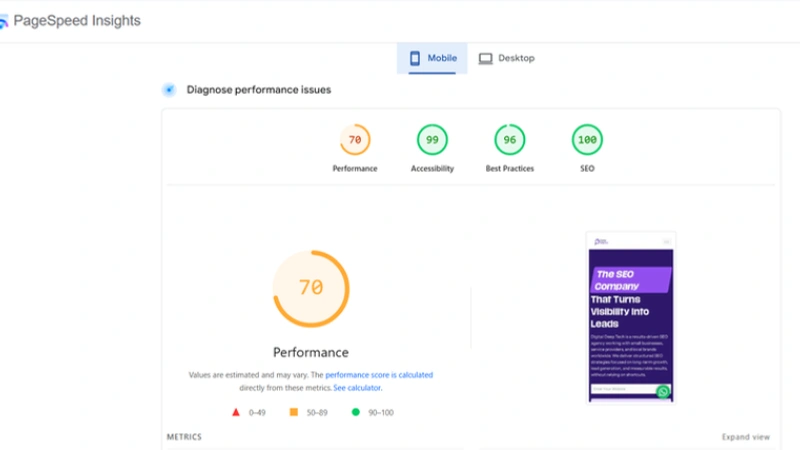
Always check how the site behaves on a phone. A slow mobile experience is usually where enquiries are lost. Simply search for “Google Speed Insight” on Google, open the site, and enter your website URL to check performance on both mobile and desktop.

This Google tool also gives suggestions that help improve mobile speed and overall website performance.

Focus on issues visitors actually feel

Not every technical warning matters. The real concern is whether pages load smoothly for users, not whether a tool shows a perfect score.

Think like a visitor. Analyze your website design section by section and ask how you can provide real value so users stay longer. Do not focus only on selling your services. Your content should be written around your clients’ pain points and offer clear, trustworthy solutions, with proper mobile responsiveness. This helps reduce bounce rate, improve conversion rate, and build more authority for your website.

Yes, WordPress speed does affect SEO. But more importantly, it affects whether people stay long enough to contact you. If you’re unsure where to start, the first step is simply to check website speed and see where the delay really is.

Once these basics are handled, everything else becomes easier to improve.

Sites that load in one second can have conversion rates up to 3× higher than sites that take five seconds.

Visitors are far more likely to take action when pages open fast, and each extra second of delay can reduce conversions significantly.
Source: TechKV web design and conversion stats (2025)

Why it matters:

This ties site speed directly to lead generation performance, not just bounce rates — helping business owners understand the real cost of slow pages.

How Speed Impacts Leads & Enquiries

Let me give you a simple, real-world scenario I see often.

A local service business was getting steady traffic. Before mobile speed optimization, people were landing on the site, reading a bit, and clicking around. But enquiries were almost zero. On the surface, everything looked fine.

The real issue was that the client’s WordPress site took too long to load. Pages felt sluggish, especially when moving toward the contact page. Before the form even appeared, visitors were leaving.

This is how a slow website hurts leads. People don’t complain. They don’t send feedback. They just move on to the next option.

Once the website speed issues were fixed, the change was noticeable. Pages opened faster, navigation felt smoother, and visitors stayed long enough to reach the contact page. That improvement in speed and enquiries wasn’t magic, it was simply removing friction.

It’s a good example of how website speed affects conversions more than most businesses expect. The offer didn’t change. The service didn’t change. The experience did.

This is why speed is often the quiet problem behind low enquiries.

Two-column infographic comparing slow vs fast WordPress sites and visitor behaviour

If Your WordPress Site Is Slow, Your Enquiries Are Leaking

If you’re dealing with a slow WordPress site, it’s worth knowing this: in most cases, it’s a setup issue, not a sign that the whole website needs rebuilding.

A slow website hurting leads doesn’t mean your service is weak or your messaging is wrong. It usually means visitors are hitting friction before they reach the point of contacting you.

The good part is that when a site loads slowly for visitors, it can be fixed. The right WordPress speed fixes focus on removing what’s holding the site back, not adding more complexity or changing what already works.

If you’re unsure where the problem sits, a simple speed check can give clarity. Looking at the site with fresh eyes often reveals website speed problems that are easy to overlook day to day.

Check Your WordPress Site Speed Today

See why visitors leave and how fast fixes improve enquiries.

If you want help reviewing this or exploring mobile website optimization services, the next step doesn’t need to be a big commitment. Sometimes a short conversation is enough to point things in the right direction.

FAQs

Why does my WordPress site load slowly for visitors?

In most cases, it’s not one single issue. Slow loading usually comes from a mix of heavy plugins, weak hosting, large images, or poor mobile setup. When these stack up, pages take longer to open and visitors lose patience.

HTML sites are simple and lightweight, while WordPress loads themes, plugins, and database content. That doesn’t make WordPress bad. When it’s set up properly, a WordPress site can still load quickly and feel smooth to users.

Yes, it does. Slow pages make people leave sooner, which sends negative signals to search engines. More importantly, speed affects trust. If visitors don’t stay long enough to read or enquire, rankings alone won’t help.

No. WordPress itself isn’t slow. Most speed issues come from how the site is built, hosted, and maintained over time. A well-set-up WordPress website can perform just as well as any other platform.

Start with the basics. Use reliable hosting, remove unnecessary plugins, reduce large images, and focus on mobile performance. These changes usually improve loading speed without needing a full redesign.

Use a simple speed testing tool and focus on how fast pages feel, not just scores. Check the site on your phone as well. If pages hesitate or take too long to open, that’s what your visitors are experiencing too.

Why a Slow WordPress Site Kills Your Enquiries Read More »
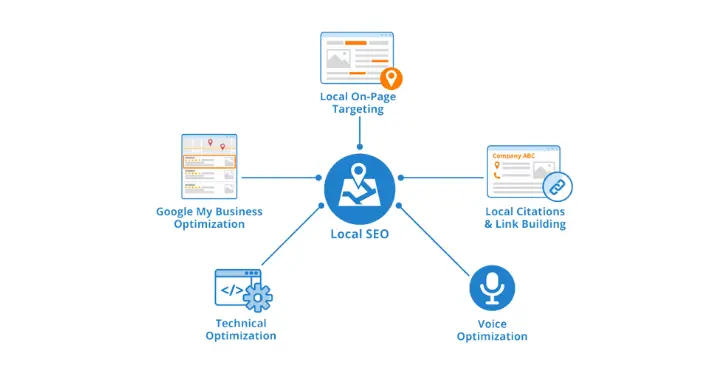
How long SEO takes for a small business and what realistic results look like over time.

How Long Does SEO Take for a Small Business?

Wondering how long does SEO take to work for small business websites in 2026? This guide breaks down what really happens after you start SEO, what early progress looks like, and how small businesses should set realistic expectations without relying on guesswork or empty promises.

Deepak Sharma - SEO consultant

Deepak Sharma

SEO Consultant

Jan 20, 2026  |  6 min. read

SEO timeline icon representing gradual growth and long-term results for small businesses.

Most small business owners ask this question after they’ve already tried something and felt disappointed. Money was spent, time passed, and the website still isn’t bringing enquiries. At that point, frustration is completely understandable.

The problem is that small business SEO expectations are often set without any real explanation. You’re told it will “take time,” but no one explains when SEO starts working or what progress should actually look like in the early stages. Without that context, it’s easy to assume nothing is happening.

This post is here to reset that. Not with promises, but with clear, honest answers about how long SEO takes to show results and what’s normal along the way. Once you understand the process, it becomes much easier to judge whether things are moving in the right direction.

Why SEO Takes Time for Small Businesses

SEO feels slow because it’s not something you switch on and see instant movement. There’s no button to press and no quick spike the next morning. What’s really happening is quieter and takes a bit of patience, which is why many business owners feel stuck early on.

One reason why SEO takes time is that search engines need to trust your website before they show it to more people. If the site is new, that trust hasn’t been earned yet. SEO for new websites usually moves slower because there’s no history, no consistency, and often a few basics that need fixing before anything else can work properly.

Another issue is the foundation itself. Many small business sites look fine on the surface but have unclear pages, weak content, or confusing structure underneath. Sorting that out doesn’t create instant traffic, but it’s necessary. This is where real SEO progress over time begins, even if it’s not obvious right away.

In the early months, the work is mostly about putting things in the right place so growth can happen later. It may feel invisible, but it’s the stage that makes the next one possible.

What I analyse in 2026:

Local competition matters. Mostly, I see that local businesses from various industries have little SEO knowledge and often do not hire any SEO agency. There are many reasons behind this, and budget for local SEO is one of them. By targeting the right keywords with low competition but high customer demand, it takes less time to rank on Google and in AI-driven searches.

Only about 2.35% of website visitors convert into leads on average.

That means roughly 97 out of every 100 visitors leave without taking action, like filling a form or clicking to call. This shows how small the window is for turning interest into contact.
Source: Contentsquare Digital Experience Benchmark Report 2026

Common Timeline Mistakes That Slow SEO Results

One of the biggest mistakes I see is expecting ranking improvements within a few weeks. That expectation usually comes from comparing SEO to ads, where results show up fast. SEO doesn’t work that way, and treating it like a short-term fix almost always leads to disappointment.

Checklist infographic helping local businesses understand if their website is ready for SEO results and what factors slow or improve rankings.

Another common issue is focusing on keywords alone. Business owners are often told that if the right words are added, traffic will follow. In reality, pages need to make sense, answer real questions, and work properly for local searches. Without that, even good keywords won’t move the needle.

Many people also stop too early. The first SEO results are rarely dramatic. They show up as small signs, a page moving up slightly, a few more impressions, better visibility in local searches. Organic traffic growth usually comes later, after those early signals stack up.

This is where short-term vs long-term SEO really matters. The early work can feel slow, but quitting at that stage often means walking away just before things start to turn.

The Right SEO Strategy That Works in 2026 for Small Businesses

  1. Properly optimize your Google Business Profile.
  2. Optimize your website for the local audience.
  3. Publish one blog per week addressing local customers’ pain points.
  4. Create local area pages—more content means more keywords to rank.
  5. Build quality backlinks and local business listings.

I follow these five simple steps to rank local businesses in 2026 and track results in Google’s AI overview.

What a Realistic SEO Timeline Looks Like

A realistic SEO timeline for small businesses looks very different from what most people are told at the start. It’s not a straight line and it’s rarely dramatic in the early months. Progress tends to show up quietly before it shows up clearly.

Month by month SEO timeline showing what progress looks like for a small business, from setup and fixes to consistent enquiries over 12 months.

In the beginning, the SEO results timeline is usually about getting the basics right. Pages become clearer, the site structure starts to make sense, and search engines understand what the business actually offers. You may notice small ranking movement, but not a flood of traffic yet. That’s normal.

For local businesses, things often move a bit faster. When location pages are set up properly and the Google Business Profile is in good shape, visibility can improve sooner than national or broader searches. That’s often when people start asking how long until small business SEO shows results, because early signs begin to appear.

Over time, consistency is what makes the difference. Steady improvements, useful content, and patience lead to a small business SEO timeline for results that builds on itself instead of starting over every few months.

What I have seen in the last 10 years:

SEO has not changed, or you could say it has evolved. As we discussed above, if the website is new, it normally takes 3 to 6 months to rank for local keywords. But if your website is old—up to 10 years—and has good authority, then ranking is not hard. The right SEO strategy can give the website the wings to rank in up to 3 months.

53% of mobile visitors will abandon a page if it takes longer than 3 seconds to load. Slow load times also increase bounce rates and cut conversion opportunities.

Many small business sites load slowly or aren’t mobile-friendly. When more than half of mobile visitors leave before the page finishes loading, you lose most of your potential leads before they ever see your offer.
Source: Site Qwality Website Speed Crisis Report (2025)

Example: How SEO Progress Builds Over Months

Here’s a situation I often see with a local service business called Bare Brilliance. In the first month, nothing looks different from the outside. No extra calls, no sudden jump in traffic. At this stage, many owners start wondering how long SEO take to start working for a small business like theirs does.

In the first two months, I optimized the website for local search queries, fixed technical issues, optimized the Google Business Profile, and improved UI and UX with the help of our website developer.

By around the third month, small changes begin to show. A couple of service pages move onto page first. The site starts appearing more often in local searches, even if enquiries are still limited. It’s not exciting yet, but it’s progress.

Around month six, things feel different. The business starts getting calls from local searches that weren’t there before. By the end of the year, SEO often becomes a steady source of enquiries rather than something they question every month. The client appreciated the results.

This isn’t a rare success story. It’s how SEO usually unfolds when the work is done properly and given enough time to settle.

Get clarity before you decide

If you’re still unsure whether your website is on the right path, that’s completely fair. Every business is different, and timelines can vary based on what’s already in place and what needs fixing.

Get Your SEO Timeline Explained Clearly

See what SEO progress should look like for your business and location.

If you want an honest view of how long SEO is likely to take for your business, and what progress should look like at each stage, get in touch. We can walk through your website together and set expectations that actually make sense for you.

FAQs

How long does SEO take to start working for a small business?

For most small businesses, early signs usually appear within two to three months. This doesn’t mean leads or sales yet. It’s more about visibility. Pages start getting impressions, rankings move slightly, and search engines begin to understand the site better. That early movement is often the first signal that SEO is working.

When people ask how long SEO takes to show results, they’re usually thinking about calls, enquiries, or form submissions. For many small businesses, that stage arrives around four to six months. Timing depends on competition, location, and the condition of the website when work begins.

SEO usually starts bringing leads once rankings improve and trust builds over time. This often happens after several months of steady progress. Leads don’t arrive all at once. They tend to grow gradually as more pages appear in the right searches and more people find the site naturally.

SEO takes time because search engines don’t take risks on new or unclear websites. They need to see consistent signals that a site is useful, reliable, and relevant. That trust builds slowly, especially for small businesses that are still strengthening their online presence.

Yes, SEO for new websites usually takes longer. A new site has no track record, no history, and often needs structural fixes before it can grow. Once those basics are in place, progress becomes more consistent, but patience is important early on.

SEO is a long-term approach. Short-term tactics may cause brief movement, but they rarely last. Long-term SEO builds steady growth, stronger rankings, and more reliable enquiries over time, especially for local businesses working within a defined area.

Often, yes. The local SEO results timeframe can be shorter because competition is limited to a specific area. When location pages and local profiles are set up properly, small businesses sometimes see visibility improvements sooner than with broader, non-local searches.

How Long Does SEO Take for a Small Business? Read More »
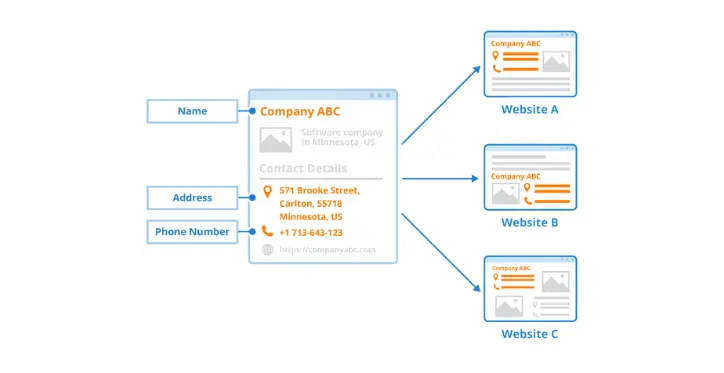
Banner explaining why SEO traffic doesn’t convert into enquiries

Why SEO Traffic Doesn’t Turn Into Enquiries

If you’re wondering why my website traffic doesn’t turn into enquiries, this guide breaks it down in plain language. It explains what usually goes wrong after visitors land on your site and what small, practical changes can help turn traffic into real enquiries.

Freelance content writer in India

Priya Sharma

Content Writer

Jan 14, 2026  |  6 min. read

Icon illustrating SEO traffic with low enquiry conversion

You’re doing the work. Your site is getting visitors from Google, but the phone doesn’t ring and the contact form stays quiet. This is one of the most common frustrations I hear. It’s also why many people start asking why websites fail to produce sales, even when traffic looks fine. In most cases, the issue isn’t effort or visibility. It’s what the visitor experiences once they arrive.

The Real Reason Traffic Isn’t Turning Into Leads

In many cases, the website is attracting visitors, just not the right ones. Google is doing its job by sending people your way, but those people may be early in their research or looking for something slightly different from what you offer. That’s usually where things start to break down.

I see this often when a site ranks for broad topics but doesn’t clearly spell out who it’s actually for. Someone lands on the page, scans it for a few seconds, and can’t tell if you solve their specific problem. They don’t dislike the site. They just don’t see a reason to get in touch.

This is also where how to get right website traffic matters. It’s not about more visitors. It’s about attracting people who already feel like you’re a good fit. When the message and the visitor’s intent don’t line up, traffic increases but enquiries don’t.

Most business owners assume that if people are arriving, the hard part is done. In reality, that’s only halfway. What comes next depends on clarity, relevance, and whether the site makes it easy for the right person to recognise themselves in what they’re reading.

Only about 2.35% of website visitors take an action like filling a form or booking a call, meaning roughly 97 out of 100 people leave without converting.

This shows that getting traffic is only the first step. The vast majority of visitors don’t become leads unless the site guides them clearly toward action.
Source: Website Conversion Rate Statistics

Mistakes That Stop Visitors From Enquiring

One of the biggest assumptions I see is that once traffic arrives, enquiries will follow on their own. Many owners believe the website will naturally do the job of converting your website traffic into sales without much guidance. Unfortunately, it rarely works that way.

Traffic vs leads funnel infographic showing where website visitors drop off before becoming enquiries and how to improve conversions.

A common mistake is talking too much about the business and not enough about the visitor. Pages list services, credentials, and features, but they don’t explain how those things help someone with a real problem. Visitors end up unsure whether to take the next step.

Another issue is asking for too much, too soon. Long forms, vague contact buttons, or requests for detailed information can feel like a commitment. When someone is still deciding, that friction is often enough to stop them.

There’s also a tendency to keep adding more content instead of fixing what already exists. Traffic grows, but the core pages stay unclear. At that point, the site is busy but not effective. These small missteps add up and quietly block enquiries before they ever happen.

How to Make Your Website Convert

If you’re trying to figure out how to convert website traffic into leads, start with the basics most sites overlook. When someone lands on your page, they should quickly understand who you help, what problem you solve, and what to do next. If that isn’t clear within a few seconds, they’ll move on.

5-step website conversion infographic explaining how to turn visitors into enquiries using clear messaging, CTAs, and trust signals.

Your main pages should guide the visitor, not just inform them. Use simple language. Explain the problem you solve in the same words your clients use. Make the next step obvious, whether that’s a short contact form, a clear call to action, or an invitation to start a conversation without pressure.

Trust matters just as much as clarity. Real examples, brief explanations of how you work, and reassurance around what happens after someone gets in touch can remove hesitation. People don’t avoid enquiring because they’re not interested. They hesitate because they’re unsure.

This is how you start to convert website traffic into sales without chasing more visitors. When the right people feel understood and guided, enquiries happen naturally. The traffic you already have becomes far more valuable.

UI and UX (Website Structure Also Matters)

Another important factor is UI and UX. Your website should be designed for both your target audience and search engines. Speed matters too—pages need to load quickly on desktop and mobile because visitors usually spend only a few seconds deciding if they’ll stay. A clean layout and fast loading time make it easier for them to engage.

Sites that take over 3 seconds to load see much higher abandonment, with visitors rapidly leaving and conversions dropping sharply. Faster-loading sites keep more people engaged and reduce bounce rates.

If a site is slow or confusing, visitors leave before they even see your message. Fixing load time and clarity can prevent this early drop-off.
Source: Web Design Statistics 2026

Google also values EEAT, which means your website should not just show your services, but also demonstrate your experience, expertise, authority, and trustworthiness.

Real Example from a Client Project

A Salon service business I worked with was getting steady traffic every week, but enquiries were rare. On the surface, everything looked fine. Rankings were solid and visitors were spending time on the site. Still, nothing was coming through.

When we looked closer, the issue was clear. The homepage talked about the company, not the customer. The contact page felt formal and asked for too much information. Visitors had no clear reason to reach out at that moment.

Once the messaging and content were updated to focus on the client’s problem, and the contact step was simplified, things changed. This is often how to turn website traffic into sales—not by adding more pages or chasing more visitors, but by making it easy for the right person to say yes and start a conversation.

What we focused on

  1. Analyzed the website structure and user journey.
  2. Optimized content for both customers and Google.
  3. Simplified the CTA structure to make it clear and easy to use.
  4. Published regular blogs addressing the problems customers face.

Result

  1. Traffic remained stable, but sales improved.
  2. The website now looks professional and builds trust.
  3. Continued blog publishing helped improve search rankings.

Get clarity before you decide

If your site is attracting visitors but enquiries aren’t coming through, start by looking at the pages that matter most. Small changes in messaging, layout, or calls to action can make a big difference. Clear, simple steps help visitors understand why they should get in touch.

Check How Your Website Converts Today

Quickly see what stops visitors from turning into real enquiries.

I can take a quick look at your website and share clear feedback, sometimes through a short video so you can see exactly what I’m referring to. The goal isn’t to sell you anything. It’s to help you understand what’s really happening on your site and whether focusing on SEO makes sense for your situation right now.

Focusing on converting your website traffic into sales isn’t about adding more content or spending more on traffic. It’s about making it obvious and easy for the right people to take the next step. Review your key pages from a visitor’s perspective and remove anything that could cause hesitation. Even small adjustments can turn passive visitors into real enquiries.

FAQs

Why is my website getting traffic but no enquiries?

This happens more often than you think. Visitors arrive, but the page doesn’t clearly show them why they should contact you or how to take the next step. Simple things like unclear messaging, hidden contact options, or long forms can stop people from enquiring. Fixing these points can help convert visitors into leads.

Usually, it’s not. Most of the traffic coming from search engines is fine—it’s real people looking for solutions. The problem is often how the website handles that traffic. If pages aren’t guiding visitors effectively, even good traffic won’t result in enquiries. Making small improvements can help turn visits into action.

In most cases, improving the website experience is faster and more effective than chasing extra traffic. Focusing on how to convert website traffic into leads ensures the visitors you already have are more likely to reach out. Sometimes a few simple adjustments can make a big difference.

Only if they’re completely off-target. Often, the issue isn’t keywords at all, but how the site communicates with visitors. When done right, even existing traffic can start converting. Learning how to turn website traffic into sales is about guiding visitors, not just chasing new ones.

Why SEO traffic doesn’t turn into enquiries Read More »
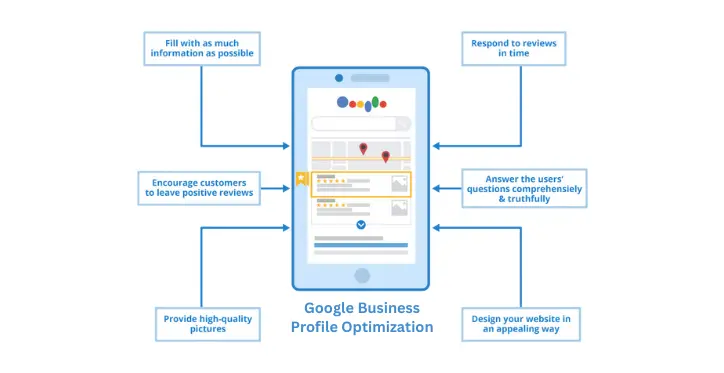
Does SEO still work for small businesses in 2026 and is it worth the investment

Does SEO still work for small businesses in 2026?

Many small business owners are asking if SEO is still worth it for small businesses in 2026. This article explains what’s changed, why results feel harder to see, and when SEO still brings real leads instead of just traffic.

Santosh Sharma

Santosh Sharma

Content Writer

Jan 08, 2026  |  6 min. read

3D SEO icon showing search growth and visibility for small businesses in 2026

If you’ve been wondering whether SEO still makes sense in 2026, you’re not alone. I hear this question almost every week. A lot of business owners are asking things like is SEO dead in 2026 or why SEO is dead in 2026 because what used to feel predictable now feels messy and uncertain.

Search results look different. Ads take up more space. Answers show up before you even click a website. It’s fair to question whether putting time and money into SEO is still worth it for a small business, especially when enquiries aren’t coming in the way you expected.

For local businesses, the doubt can feel even stronger. When visibility drops or leads slow down, it’s easy to assume local SEO isn’t working anymore. But in most cases, the problem isn’t that SEO has stopped working. It’s that the rules around how people search and decide have changed quietly.

To understand whether SEO is still worth it for your business, it helps to look at why this confusion exists in the first place.

Why SEO feels harder than before

The short answer is that SEO didn’t suddenly stop working. What changed is how people search and how Google shows results. Most expectations, though, are still based on how things worked years ago.

Why SEO Feels Broken Small Business in 2026

Today, someone might scan a result, read a quick answer, compare a few options, and leave without ever clicking the first link. That makes it feel like SEO isn’t doing its job. Business owners then start asking, does SEO work for small business anymore, when the real issue is that success is being judged the wrong way.

Another reason this feels broken is how SEO was sold. Many small business owners were promised traffic. Reports focused on rankings and visitor numbers, not on whether the website actually helped someone take the next step. Traffic went up, but enquiries didn’t, so trust in SEO dropped.

This is why SEO is important for small business in a different way than before. It’s no longer just about being visible. It’s about showing up in the right places and making it clear why someone should contact you when they land on your site.

For most small business owners, SEO still plays a role. But it only works when it’s aligned with how real people search and decide today, not how search worked in the past.

In 2025, about 58.5% of Google searches in the U.S. and 59.7% in the EU ended without clicking through to any website.

This means most people looked at search results but didn’t visit any external sites, making traditional SEO traffic less reliable on its own.
Source: Top SEO Statistics for 2025 — SMAMarketing

Common mistakes small business owners make

One of the biggest mistakes I see is expecting SEO to work quickly. It’s often treated like a switch you turn on and leads start coming in. When that doesn’t happen in a few weeks, frustration sets in and confidence drops.

Another common issue is judging success by traffic alone. More visitors look good on a report, but traffic doesn’t pay the bills. If people are landing on your site and leaving without getting in touch, the numbers don’t mean much. Enquiries are what matter.

A lot of small businesses also get stuck with generic SEO services for small business that look the same for everyone. The same checklist, the same monthly tasks, no real understanding of the business behind the website. Local businesses face this even more with local SEO services for small business that promise visibility but ignore what happens after someone clicks.

Website clarity is often overlooked too. Pages try to say everything at once or focus too much on the business instead of the visitor’s problem. When messaging isn’t clear, people hesitate and move on.

Finally, many owners stop too early. SEO gets cut just as small improvements start to build because results feel slow or unclear. Working with an SEO consultant for small business only makes sense if there’s patience to let the right changes settle and do their job.

Organic click‑through rates (CTR) for queries with AI summary features dropped by about 61% from mid‑2024 to late‑2025.

This shows that when search engines show direct answers, users are much less likely to click to a website.
Source: Google AI Overviews drive 61% drop in organic CTR — SearchEngineLand

What makes a real difference

What works today is simpler than most people expect. It starts with knowing exactly who the site is for and what problem it’s meant to solve. When SEO for small business tries to appeal to everyone, it usually connects with no one. Clear focus makes it easier for the right people to recognise themselves and stay.

Pages also need to match why someone landed there in the first place. If a visitor is searching for a specific service or answer, the page should meet that need quickly and clearly. This is one of the most overlooked parts of SEO strategies for small business. Relevance matters more than volume.

Another practical fix is making the next step obvious. If someone is interested, they shouldn’t have to hunt for how to get in touch or what happens next. Simple wording, clear buttons, and reassurance at the right moment remove hesitation.

It’s also important to measure the right thing. Rankings can move up and down, but leads tell the real story. One of the biggest benefits of SEO for small business is attracting people who are already looking for help. If those people aren’t reaching out, something in the journey needs adjusting.

Finally, consistency beats quick wins. Steady improvements, reviewed over time, work better than jumping from one idea to the next. That’s usually how you improve SEO for small business in a way that lasts and actually supports the business.

A real example from a local business

I see this a lot with local service websites. On the surface, everything looks fine. The site is clean, the content reads well, and traffic numbers look healthy. But when you dig a little deeper, the traffic isn’t coming from the right places. For local businesses, that’s a problem. You don’t need everyone. You need the right people in the right area.

In one case, the question wasn’t does SEO work for small business. It was whether the website was set up for local intent at all. We started by reviewing the site content and how a local visitor would move through the pages. The information was there, but it wasn’t written with a local searcher in mind.

We adjusted key pages to reflect location-specific needs, looked at what people in that area were actually searching for, and made the next steps clearer. We also focused on trust, adding real examples of past work and publishing regular blogs that answered common local questions.

Over time, the traffic became more relevant. Enquiries started coming from people who were a good fit. Local visibility improved, and conversations turned into real work. For many SEO for small business owners, that’s what progress really looks like. Consistent effort, clearer intent, and results that make sense for the business.

Is SEO worth it for your business? A quick self-check

Get clarity before you decide

If you’re still unsure whether SEO is worth it for small business in 2026, the fastest way to get clarity is to look at your own site through fresh eyes. Not a long report. Not a sales call. Just an honest review of what’s helping and what’s quietly getting in the way.

Is SEO Worth It for You?

Get a quick, honest review of what’s helping or blocking leads.

I can take a quick look at your website and share clear feedback, sometimes through a short video so you can see exactly what I’m referring to. The goal isn’t to sell you anything. It’s to help you understand what’s really happening on your site and whether focusing on SEO makes sense for your situation right now.

Once you have that clarity, you can decide what to fix, what to ignore, and how far you want to take things.

Does SEO still work for small businesses in 2026? Read More »
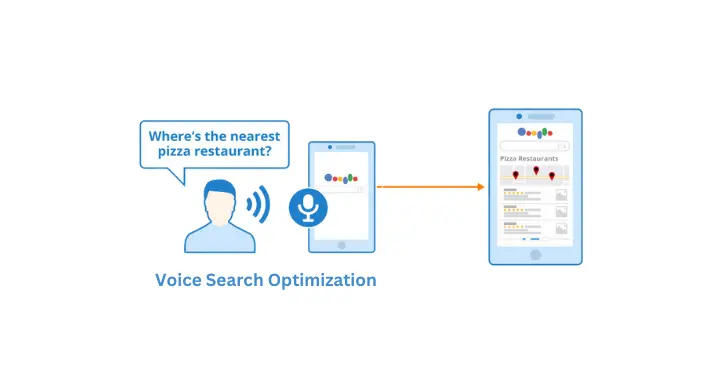
SEO Outsourcing: A Complete Guide for Businesses

SEO Outsourcing: What You Need to Know

Learn the basics of SEO outsourcing, its benefits, problems, and key factors to consider. Learn how collaborating with the right SEO experts can help you save time, reduce costs, and improve long-term results.

Freelance content writer in India

Reviewed by Priya Sharma

Content Writer

Sept 14, 2025  |  6 min. read

The Potential Risks of SEO Outsourcing

Every business wants an online presence. Before making a purchase, most customers search for information first. Search Engine Optimization (SEO) helps your business seen on the search engine. SEO gets businesses ranked higher on Google and attracts free, organic traffic.

Why Businesses Choose to Outsource SEO

The challenge is that many companies do not have the skills, time, or budget to handle SEO planning/activity. Outsourcing to freelancers or agencies can fill this gap. They give businesses professional search visibility and allow them to focus on their core work.

Since 93% of online experiences begin with a search engine, being visible when a customer is looking for information is important. If your business doesn't appear in results, competitors who invest in SEO will.

SEO outsourcing gives small businesses the chance to compete with bigger companies.  Amazon, for example, integrates resources and capabilities from both in-house teams and external agencies to manage millions of product listings.

Why Businesses Choose to Outsource SEO

SEO outsourcing is not limited to large companies. Small and startups use it too. It allows them to focus on what they do best, while experts handle technical tasks such as link building, keyword research, content optimization, and analytics. This approach is often less expensive than hiring full-time employees, while still providing access to professional-grade tools and up-to-date knowledge.

Search engines frequently update their algorithms. Outsourcing ensures your company remains competitive and aligned with the latest trends. Indian tech startups, including Nykaa and Zomato, rely on SEO agencies to strengthen their position against international brands.

The Advantages of Outsourcing

The Advantages of Outsourcing SEO

Outsourcing SEO provides significant value. Outsourced teams offer scalability to intensify campaignsduring major product launches or busy seasons without the delay of new hires. They also provide diversity of expertise, combining technical SEO expert, content writers, link builders, analysts, etc. into a single coordinated effort.

 This breadth of skills produces a well-rounded strategy that many internal teams cannot match. An example is Flipkart. They are working with multiple digital agencies to optimize product-based SEO and local content opportunities, providing it a stronger competitive position against Amazon. 

Things to Consider Before Outsourcing SEO

While outsourcing offers many advantages, businesses should carefully consider the following factors:

  • Timeframe: SEO takes time. Results typically appear only after three to six months before any changes happen in terms of search rankings. 
  • Provider evaluation: Evaluating an SEO provider requires more than cost comparison—case studies, testimonials, and experience in relevant industries should all be reviewed. 
  • Communication: The better the communication, the better the trust will be built, which ultimately creates a better quality of service. Clear expectations, reporting schedules, and feedback systems reduce the risk of misunderstandings.
  • Cost clarity: Rates can vary widely, so pricing and deliverables should be confirmed in advance.

Specialization is also worth considering. For instance, textile exporters in Surat often hire agencies with expertise in global buyer behavior, which helps them market their products effectively to international audiences.

The Benefits of Outsourcing SEO

The Benefits of Outsourcing SEO

There are clear advantages to outsourcing. Many companies report increases in organic traffic and conversion rates as a byproduct of improved rankings. Outsourcing is usually less expensive than keeping in-house SEO experts. Firms now have immediate access to the best talent and strategies.

Given the costs, outsourcing is an efficient decision on many levels. Some more advantages of outsourcing SEO are that it provides ongoing devotion to website performance, which most in-house teams may not deliver. For example, the Indian EdTech startup, Byju’s, partnered with international SEO agencies to optimize its content for global customers to expand its activities/target the US and UK markets.

The Potential Risks of SEO Outsourcing

Despite the benefits, outsourcing carries risks if the wrong partner is chosen. Agencies that rely on unethical or outdated tactics can reduce return on investment, harm search rankings, and damage a company’s reputation. Lack of transparency, poor-quality backlinks, or unrealistic promises are common warning signs.

US department store JCPenney is a well-known example. The company faced severe penalties from Google after its agency engaged in manipulative practices. This demonstrates why businesses should start with trial projects to test the approach of the agency, transparency, communication, and partnerships before committing to long-term contracts.

How to Outsource SEO Effectively

How to Outsource SEO Effectively

For companies looking to outsource SEO, they should approach outsourcing in a structured way.  Goals must be defined clearly, whether the priority is increasing organic traffic, raising keyword rankings, or improving conversions. Providers should be vetted carefully, with reviews and case studies examined for credibility.

Communication plans should include regular reports and meetings to track progress. Companies should sign service level agreements (SLA’s) to avoid misunderstandings and access to analytic dashboards to legitimize data as well. Training internal teams alongside the agency also strengthens collaboration and maximizes results.

A checklist can be helpful when evaluating potential SEO partners. Organizations should confirm:

  • The size and expertise of the agency’s team
  • The range and quality of SEO tools they use
  • Proven results and case studies within similar industries
  • Their approach to link building and content development

Ready to Make Your SEO Strategy Work Globally?

Let’s uncover the right keywords for your international audience — no guesswork, just results.

Conclusion

SEO outsourcing is not simply a way to reduce costs. It’s a growth strategy that blends flexibility, expertise, and resources to help businesses  compete in crowded markets. Global leaders like Amazon, Airbnb, Flipkart, and Nykaa depend on outsourcing, as do countless small businesses seeking to reach wider audiences.

The greatest advantage is sustainability. Outsourced SEO creates steady website traffic, strengthens brand loyalty, delivers long-term and attainable growth. By investing early, businesses can secure a stronger digital presence and achieve higher returns on their time, money, and effort.

SEO Outsourcing: What You Need to Know Read More »
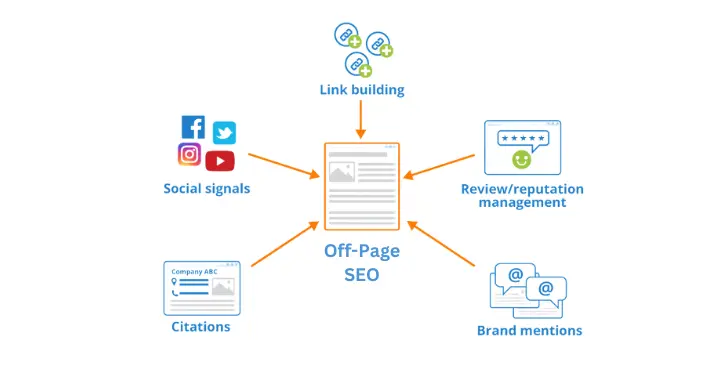
How Can SEO and Social Media Work Together

How SEO & Social Media Boost Website Visibility

At Digital Deep Tech, we’ve seen firsthand how SEO and social media work hand-in-hand to put businesses in front of the right audience. Ranking on the first page builds trust and drives clicks, while a strong social media presence keeps your brand visible, shareable, and engaging. Together, they don’t just boost website visibility — they create opportunities for long-term growth.

Freelance content writer in India

Written by Priya Sharma

Content Writer

Aug 8, 2025  |  6 min. read

How SEO and Social Media Boost Website Visibility

The internet is shaping businesses across every industry, and if you aren’t getting your website on the first page, you’re missing out on a lot of opportunities. More than likely, your ideal customers or clients are choosing from the businesses that have reached the top spots and established a strong web presence in general. And you know how they accomplish this? SEO and social media — that’s how.

How People Search the Web

There’s no nice way to put this because the statistics are rather grim if you own a business that ranks on the 3rd, 4th, 5th — or even the second page — of the SERPs.

But, here’s the truth…

Statistics indicate that 71 percent of people only check the first page of the results. So, no matter how much better your company is than the others, if you’re not hitting in this range, you’re more than likely losing business to the competition. Some studies show this percentage is even higher, in the 90-percent range, to be exact.

The people who are looking beyond the first page are often the ones who are inquisitive and want to delve deeply into a topic. They’re looking for alternate viewpoints and additional facts, rather than for a business to handle their plumbing or landscaping or a vet for their pet.

When people search the web for a business that sells the products they need or services they desire, they’re typically sticking with the first-page results. Some are trusting that Google’s algorithm will steer them in the right direction.

On the other hand, some are looking for answers, and they want them now! They’re busy and don’t want to scour through dozens of businesses all offering the same thing and claiming to be the best or provide what the reader is looking for.

Sometimes, the person is just overwhelmed by all the options. Limiting it to the first 10 results is less stressful and more manageable.

And who’s to say some aren’t just lazy and don’t want to put in the work or spend that time looking?

Getting Your Name Out There

Some people find a business, stick with it for all their needs in that area, and spread the word. Others then follow suit and use that company. But word-of-mouth marketing isn’t as common with the prevalence of the web nowadays, especially with the younger generations who grew up turning to the web for nearly all their educational needs outside of the classroom.

When you have strong SEO that gets your company’s name on the first page, you’re getting more exposure.

But there’s another part of the equation that can also help — social media. Did you know that the average person spends 141 minutes on social media each day? And while these platforms were once a place just to keep in touch with friends and family and meet new people, they’re now a prime source for businesses to throw their lines and gain visibility.

If you have a strong social media presence, people will share your posts and get your name out there even more. Moreover, when you create engaging content, you’ll have people interacting with your business, which makes your company seem more personable.

A Little Word of Advice — Providing Value Matters

Think about 10 years ago. The Google SERPs were filled with page after page of the exact same content, just regurgitated in different words. There was very little variation because reaching the top was about keyword density and placement, not how much value a page brought to the audience. And if you remember, the keywords didn’t even have to make sense in the piece, making it so the reader, more than likely, didn’t get anything from the piece.

The search engine algorithms aren’t so generous with poor quality content nowadays. If it doesn’t provide the reader with anything and only uses keywords naturally in the piece, it’s not going to rank anywhere near the top.

So, as you’re planning your pieces and writing them (or hiring a company to do it for you), you must consider the reader with every piece and give them something useful they can take away from the blog or web content. But sprinkling some keywords throughout is still important, or you’ll miss the mark and not rank, and therefore, not get the visibility you desire.

The same concept can be applied to social media. You need to provide viewers something that’s going to make them want to look at what you’re posting, whether it’s educational, entertaining, or promotional.

As you see, SEO and social media can boost your website’s visibility. You can even use your social media to promote your website and drive more traffic to your site. With these two being so important in today’s marketing landscape, using them to your advantage — and properly — is in your business’s best interest. And don’t forget about local SEO if you have a brick-and-mortar location or are offering services to your community.

Ready to Make Your SEO Strategy Work Globally?

Let’s uncover the right keywords for your international audience — no guesswork, just results.

About Author: Priya Sharma is a dedicated content writer at Digital Deep Tech, passionate about turning complex marketing ideas into simple, relatable stories. She loves crafting content that helps businesses connect with real people and build lasting trust.

How SEO & Social Media Boost Website Visibility Read More »

30 Days SEO Action Plan

Boost Your Local Business SEO Visibility in 30 Days

30 Days SEO Action Plan

Introduction

Today, small businesses can’t rely solely on foot traffic and word of mouth. Your online presence, in particular local search visibility, has become a growth driver that you cannot afford to ignore. Whether you are a plumber, restaurant owner, or the owner of some retail shop, maximizing your local SEO visibility will drastically increase the number of customers finding their way and ultimately landing at your doorstep.

Being a seasoned white label local SEO expert, I have successfully assisted hundreds of companies climb higher up the Google rankings, garner more local customers, and expand their businesses. In this blog post, I shall guide you through a 30-day actionable plan for boosting your local business’s SEO visibility. I will draw on proven strategies and techniques to help you navigate this journey and get your business noticed online-whether the competition is strong or weak.

Why Local SEO Matters for Your Business

So, as a small business owner, you might have heard about SEO but don’t really know why local SEO for businesses is very important. One of the biggest challenges that a small business may face is how to stand out locally. Especially on search engines like Google.

Without the correct local SEO strategy, you are invisible to most of your future customers searching for your service online. Imagine you operate a coffee shop in Sydney but failed to optimize for local SEO; a search by a customer like “best coffee shop in Sydney” means that your business is off the map, and this customer walks to your competitor’s shop instead.

Imagine losing customers to competitors because you are not showing up on the search results when it really counts. This problem is not one of supplying inferior products or services; it is that customers can’t find you on their Web. That cuts straight to the bottom line.

So, by optimizing for local business SEO, n you’ll be seen more often on Google, reach your local target audience, and eventually drive more foot traffic with sales. Next sections are going to explain how to boost your local SEO for small businesses within just 30 days.

what is local SEO?

Local SEO Basics

Before diving into the 30-day plan, let’s have a quick overview of what local SEO is.


Local SEO is the process of tailoring one’s optimization of their local presence to attract more business through relevant local searches. It occurs on Google and other search engines. If a person types “best bakery near me,” for example, local SEO will help your bakery rise to the top of that search.


There are a number of components within SEO for local businesses, including optimizing your website, claiming your Google My Business listing, managing online reviews, creating citations within directories, and maintaining consistency of name, address, and phone number.


For instance, 46% of all Google searches are for local information and 76% of people who search for something nearby on their smartphone visit the business within a day. If you don’t optimize for local searches, you are really losing out on an enormous number of potential customers.

The 30-Day Small Business Local SEO Plan

If you’re looking for how to get into the local SEO for small business, I have developed a 30-day actionable plan that will guide you in improving your visibility locally:

Week 1: Set the Foundation

  • Claim and Optimize Your Google My Business Listing: By now, you should claim your listing if you haven’t done so already. This is the first step toward enhancing your local presence.
  • NAP Standardization: Ensure the name, address, and phone number of your business are uniform on your website, other social media, and business listings. Inconsistent NAP details cause confusion to search engines and impact your rankings.
  • Mobile Friendliness: Most local searches are from mobile phones; thus, ensure it is a mobile-friendly website and loads quickly.

Week 2: On Page SEO Optimization

  • Keyword Research: Identify search terms that refer to your business locally. Assume you are a plumber in Sydney; some of the relevant terms would include “Plumber in Sydney” or “Best Sydney Plumbers.” Apply these keywords to your website’s title tags, meta description, as well as headers.
  • Include Local Keywords in Content: Optimize your service pages, blogs, and other website content with local keywords.
  • Location-Specific Pages: If you operate in several locations, ensure you create a different landing page for each of the locations with the relevant keywords and contact information.

Week 3: Citations and Listings

white label local SEO services
  • Get listed in the Right Directories: You should share your business information in local business directories like Yelp, TripAdvisor, and industry-specific directories. Listings will help Google affirm that your business exists or is real, thus your rankings will increase accordingly.
  • Social Media Profiles: Create new social media profiles by entering in your NAP details, and include your local keywords into the descriptions.
  • Online Reviews: Ask your customers to post reviews to your Google My Business listing as well as other review sites for which it makes sense. Good reviews can really improve your rankings.

Let's Discuss Your Project

Get a free one-month consultation and share your vision for digital marketing with us.

Week 4 – Link Building

  • Locally Relevant Content Writing: Blog about local events, news, or activities in your community that are relevant to your business. Restaurant owner? Blog about the local food markets nearest your restaurant.
  • Local Backlinks: Connect with local bloggers, local businesses, and attract backlinks. These reputable sources can assure Google you are an authority in your local business area.
  • Track Results: Monitor your website’s performance along with tracking keyword rank by using Google Analytics and Google Search Console.


After 30 days, you’ll be ready with local small business SEO and should start to see enhancements in search visibility.

Optimizing Google My Business for Better Local Visibility

Google Business Profile Optimization

Your Google My Business listing is an essential part of your local SEO strategy. And when you get it right, it can get you ranking at the top of Google Maps and local searches. This makes you even more present to the potential customer in your area.

How to Optimize Google My Business

 Complete all fields for your GMB profile: description of your business, hours, service.

  • Add Photos: You can upload clear photos of your business location, products, and services. Businesses with images get 42% more requests for directions.
  • Post Updates: GMB lets you post updates that help you share with customers, in an effort to show Google that you’re an active business.
  • Respond to Reviews: Actively respond to customer reviews to show the customers that you care about their feedback.
Voice Search Optimization

How to Leverage Business Listings for SEO Benefits

Web citations (or citations) are references to your company’s name, address, and phone number on other sites. Citations can help Google confirm that your business is legitimate and relevant for local search purposes.


Business local SEO success depends on the accuracy and consistency of all the listings that include information about your company. Incomplete and inaccurate information may confuse Google, which can have a negative impact on your rankings.

Off page SEO optimization

Why Do I Need Business Listings?

  • Boosts Local Relevance: Business listings are evidence to the search engines that your business is relevant to the location-based search conducted.
  • Boosts Domain Authority: Getting listed on high-authority websites such as Yelp and Yellow Pages improves your website’s domain authority which can boost your rankings for local searches.

Creating valuable content

Creating valuable content and earning local backlinks remain some of the top-ranking strategies to boost your local SEO rankings.

    • Create Locally Relevant Content: Talk about local events, news, or local interest on your blog. For instance, if you have a fitness center, you could blog on “How to Keep Fit at Local Festivals” or “Local Park Running Areas in Melbourne.”.
    • Build Local Backlinks: Building local backlinks is probably one of the most potent ways to improve your rankings in the local search. Let’s give local bloggers, newspapers, and other businesses some clicks, guest posts, and sponsorships, shall we?

How to Track Your Local SEO Performance

SEO is a long game, but it is nice to be able to see where your efforts are paying off. Here are some key metrics you should be tracking:

Creating valuable content

SEO is a long game, but it is nice to be able to see where your efforts are paying off. Here are some key metrics you should be tracking:

  • Google My Business Insights: This tool will give you data of how people are actually finding your business, what keywords they used in search, and so on and how many people visit your website or request directions.
  • Google Analytics: Track who’s visiting your site, from where, and how long they’re staying on your pages.
  • Keyword Rankings: Through Google Search Console or SEMrush, track what’s improving in your local keyword rankings over time.

Checking these metrics will give you an idea of what works and what doesn’t so that you can know where to invest next.

Conclusion

Boosting your local business in 30 days for SEO isn’t impossible. The right plan, consistency, and a deep understanding of what’s working for your business can help significantly in ranking much higher in local searches and attracting more customers. Just continue with this step-by-step guide and watch the growth of your business online.


Have questions on SEO for local businesses or personal guidance? Then you are welcome to get in touch with me. I am the founder of Digital Deep Tech, and I have already helped local businesses like yours thrive online-and would be glad to help you too!

FAQs

1. What is Local SEO?

Local SEO means the optimization of your online presence to attract more business from the local searches on Google and other search engines.

Local SEO will make it easier for you to increase visibility to local customers, hence easy for them to find you online.

You could feel you’re seeing improvement within a few weeks, but you usually expect to notice really significant changes in 3-6 months.

Because business listings represent points of online mentions of your business information, they do count toward your local relevance and placement.

Google My Business helps your business appear in the results in both Google Maps and online search so customers can find you easily.

Of course, yes, sure, good reviews will surely better your ranking local and drive more customers.

NAP stands for name, address, and phone number. Consistency of this information on all platforms will help to boost your local SEO.

You can optimize your website using local keywords, location-specific pages, and earning local backlinks.

Citations refer to mentions of your business on other websites. The more consistent and accurate your citations are, the better your rankings will be for local searches.

You can technically do Local SEO on your own, but hiring a professional means that your strategy is more effective and results-oriented.

Hire SEO Expert

About the Author

Deepak Sharma is the founder of Digital Deep Tech and a renowned SEO and digital marketing expert with over a decade of experience. Passionate about helping businesses enhance their online presence, Deepak specializes in creating SEO strategies that drive traffic and generate leads.

Follow me on LinkedIn —>

Boost Your Local Business SEO Visibility in 30 Days Read More »
White Label Local SEO Services vs. In-House SEO

White Label Local SEO Services vs. In-House SEO

White Label Local SEO Services vs. In-House SEO

Introduction

In today’s fast-changing digital world, small or even medium businesses at local levels are in constant struggle with gaining proper search engine visibility. As a Local SEO expert and founder of Digital Deep Tech, I understand very well all the burdens small businesses have to bear while trying to optimize their online presence. But they have to take a very serious decision whether to invest in in-house SEO or white label local SEO services. In this blog, I would like to outline the pros and cons of both so you can make a well-informed decision in favor of whatever helps your business grow the best.

Of course, with more than 50% of all searches being local in nature, business owners looking to attract customers to their venues will have quite a lot at stake. This blog will take each approach and delve deeper into the nuances of both, with a solid grounding in industry data and real-world experience.

What is Local SEO?

Before we head to Local SEO Services White Label and In-House SEO differences, let’s define what is local SEO. Thus, Local SEO means the optimization of all online presence of a business to attract more customers as a result of the most popular local searches. These strategies include optimizing Google My Business listings, online reviews, correctness of local citations, and implementation of on-page SEO practices.

what is local SEO?

Why do local SEOs matter?

According to Google, 76% of people who look for something nearby visit a business within one day. Additionally, 28% of these searches turn into a sale. Local SEO is therefore essential in the drive of small businesses for effective visibility in local search results.


For small business owners, understanding local SEO can prove quite important as it can potentially affect foot traffic, online sales, and also the reputation of a brand as a whole. Business owners lose customers to those competitors who are actively engaged in local SEO if they do not optimize for local searches.

The Problem with In-House SEO

Most businesses opt to in-house SEO, believing they will finally control marketing. There are, however usually a number of problems for the business involved:

1. Lack of Expertise

Very few small companies are able to offer the highly specialized knowledge and experience necessary related to the conduction of a comprehensive local SEO strategy. SEO is by no means static, with search engine algorithms constantly in flux. If a company is not constantly keeping up with this, its in-house team will fall far behind.

2. Resource Allocation

A full-time SEO team obviously will cost money and would drain those resources to other areas of the business. Small businesses often have limited budgets, so it might not be possible for them to allocate money for an SEO expert.


A full-time SEO team obviously will cost money and would drain those resources to other areas of the business. Small businesses often have limited budgets, so it might not be possible for them to allocate money for an SEO expert.

3. Time Constraints

white label local SEO services

Search engine optimization is not a one-time task. It must be constantly worked upon with updates. This stretches the scant time to the existing staff, who had to perform a multitude of tasks. For the small business, day-to-day activities will always score over the long-term SEO project.

Let's Discuss Your Project

Get a free one-month consultation and share your vision for digital marketing with us.

How In-House SEO Difficulties Affect You

Sometimes these problems can have fatal consequences. A business, under misunderstanding beliefs, may undertake certain practices that lead to penalties from search engines; of course, it will lead to severe repercussions on its appearance online. The multiple pressure for learning and adaptation in the constantly shifting SEO landscape can sometimes overwhelm stretched teams.


One of the local bakeries I worked with attempted to control their SEO in-house in the beginning. They were able to briefly spike into view and then flatten out because they did not know what was needed to keep altering algorithms. This is a classic symptom of problems that occur when businesses attempt to solely rely on in-house resources.


With failing in-house teams not being able to bring out the best strategies, frustration can run amuck. Precious time and budget are wasted in such scenarios, which inversely hinders growth rather than taking it forward. Also, this brings a feeling of disillusionment among the team members who think they are not moving forward.

White Label Local SEO Services: Benefits

Google Business Profile Optimization

Local SEO white label services are an exciting option for those organizations having trouble with local SEO on their own. Here is the reason why they may be the best option:

1. Availability of Expertise

White label providers specialize in SEO, employing professionals who are abreast of all the latest trends and best practices. Thus, your business will be suitably benefited by expert strategies to promote it properly in local markets. A white label service often offers a richer depth of knowledge compared to what can be obtained through an in-house team, where market engagements may be overlooked.

Voice Search Optimization

2. Cost-Efficient

A white label SEO service is a more cost-effective option than an in-house team. You will save on salaries, training, and employee benefits and therefore conserve resources better. Many white label services offer tiered pricing packages.

Off page SEO optimization

3. Scalability

White label SEO solutions can easily be scaled up to provide business solutions. You can expand your organization, reach new locations or offer more services- the solution providers will adapt to your needs. Such adaptability is perfect for organizations that want to expand operations without hiring multiple people.

4. Core Business Focus

With outsourced SEO, you’ll be able to focus on what you do best-running your business. That means you’ll be able to channel your energy toward customer service, product development, and those areas so crucial for revenue generation.

Consequences of White Label

I have seen thousands of businesses grow and scale when they outsource their local SEO. A small plumbing service that I had consulted for transitioned to white label services. Within six months, its website traffic went up by 150%. It was all because this business implemented proven strategies that this business’s in-house team could not execute so effectively.


Moreover, the efficient process offered by white label service providers will ensure businesses get their campaigns run much faster. Agility may be a huge silver lining in a highly competitive market for local businesses.

Cost Comparison: In-House v/s White Label

While weighing between the options of making SEO an in-house function and using white label services, one should not ignore the fact of cost comparison:


  1. In-house Costs: Hiring, training, and maintaining an in-house team is very cost-prohibitive. You pay salaries and benefits, software tools, and ongoing training. In fact, according to the Bureau of Labor Statistics, the average annual salary for an SEO specialist in the U.S. can be $62,000, excluding the benefits.


  1. White Label Costs: Most white label services will charge you a flat monthly fee for their experience, which may be in hundreds or thousands of dollars, depending on what is included within the scope. This model typically includes advanced tools and analytics that would be far too expensive for most small businesses to purchase individually.

A small business owner decides to manage SEO in-house. They commit a lot of time and resources, yet at the end of the year, not much returns on investment. Where it seems to have been better expenditure is when partnering with a white label service.

More Financial Benefits in White Label Service

Another major thing for white label services is that these services come with extra benefits that add up to the savings:


  • Access to Advanced Tools: Many of these white-label providers include premium SEO tools into the packages and may help you gain all the insights without making expensive subscriptions.
  • Training and Support: Most of the services include training and support, equipping your team to understand local SEO better even if you’re not managing it personally.

Expertise and Scalability

Local SEO is pretty tricky and always in flux. Certainly, good results depend a bit on some degree of expertise. White-label providers often have separate teams for various components of SEO-the technical optimization side and the content creation side. This is knowledge at this depth.

Scalability and Flexibility

A local business needs to be agile enough to respond to market shifts. White-label local SEO solutions are inherently more flexible. For instance, if a business wants to launch a new line of products, the white-label provider can change their strategy overnight by incorporating the change in products; the efforts at local SEO would stay on par with the business’s current goals.


But I do recall one landscaping company I aligned with to expand it into new areas. Utilizing white label local SEO services, they were able to penetrate three new markets within one year, while servicing their core base.

Long-term Growth

The white-label local SEO provider has to be agile in a fluctuating digital marketing landscape. Indeed, market trends change with the preferences of consumers and the way they search. An efficient white label local SEO provider will monitor changes and adjust the plan to keep your business on the fast track to long-term growth and profitability.

How to Select the Ideal White Label Local SEO Service

Upon selecting your white label local SEO provider, consider the following criteria:


  1. Reputation and Experience: You require a well-experienced provider with strong credentials in local SEO. Research the credibility of their reviews, case studies, and testimonials.


  1. Customization: A provider who understands your business well and tailors the service according to your needs is crucial. Unless you have a unique business model, one-size-fits-all approach may not be the best for your business.


  1. Transparency: A good white label service will provide you with pretty clear reporting and analytics that show what’s going on in your campaigns and what ROI is being brought in.


  1. Communication: That’s important. The provider, in terms of responsiveness and willingness to work closely with your team, matters.


  1. All-inclusive Services: You have to find providers who are going to give you everything you need in terms of local SEO services, including GMB optimization, local link building, citation management, and review monitoring.

Building a Successful Partnership

A successful white label local SEO partnership with a provider is built on openness and mutual objectives. Working in harmony as partners can help ensure that your SEO strategy aligns with your business goals

Real Life Examples

As highlighted in the previous case study, a resume writing service noted an increase in website traffic by 150% after transferring services to white label SEO. This was occasioned by a solid local SEO strategy involving optimizing its Google My Business listing, crafting a content marketing approach, and creating good online reviews for the business.

What's Been Learned

These case studies show real-world advantages of white label local SEO services. They have demonstrated just how often expertise, scalability, and a multidisciplinary approach to local SEO will be the difference for small business success.

And with all these insights and strategies thrown around in this blog, you will be able to decide the best course of action for yourself – whether to pursue in-house SEO or outsource it all to a white label local SEO provider. If you have specific questions or need one-on-one guidance on anything, feel free to ask! Here to help your business grow better.

Conclusion

To put it in a nutshell, each in-house SEO and white label local SEO has its pros and cons. For many small businesses, the benefits of outsourcing local SEO usually outweigh the advantages of an in-house team. White label solutions provide clients with access to all expert knowledge, the most cost-effective strategies, and scalable services that would fit their constantly changing requirements.


Being a local SEO expert, I certainly think that your business goals, budget, and resources need to be measured. If you cannot succeed with in-house SEO or just want to do what you do best, that is running your business, then white label local SEO services can help you out.


By taking the time to research your choices and make smart decisions, you can launch your business on the right path in a tough local market. But perhaps most importantly, really good local SEO isn’t about visibility. With the right approach, you will be linked more effectively with your community and driving meaningful engagement that converts.

FAQs

1. What are white label local SEO services?

White-label Local SEO services allow agencies to sell SEO services branded with their respective companies, but without having to manage the work.

I look for suppliers who have a successful track record, open communication, and a solution tailor-fit to the needs of my business.

Yes, they could definitely scale with the growth of your business and add services as those become necessary.

Local SEO is optimized by focusing on searches based on location, while traditional SEO targets keywords without any geographical constraint.

Absolutely! White label providers may help you optimize your GMB listing for accurate details and local search optimization purposes.

Research their skills, existing resources, and time and effort that would be needed to handle SEO properly.

Some of the key metrics include traffic, rankings on a local search engine results page, and call and visit conversions.

It is very important for small businesses to attract local customers, and by many studies’ findings, a significant portion of local searches ends in in-store visits.

Other frequent mistakes are GMB optimization, lack of local citations, and unmanaged online reviews.

There are many business owners who found success by mixing these two model types: tasks are outsourced as a white label service and managed in-house with other areas.

Hire SEO Expert

About the Author

Deepak Sharma is the founder of Digital Deep Tech and a renowned SEO and digital marketing expert with over a decade of experience. Passionate about helping businesses enhance their online presence, Deepak specializes in creating SEO strategies that drive traffic and generate leads.

Follow me on LinkedIn —>

White Label Local SEO Services vs. In-House SEO Read More »